Table of Contents

1. Executive summary: AML in football in 2026
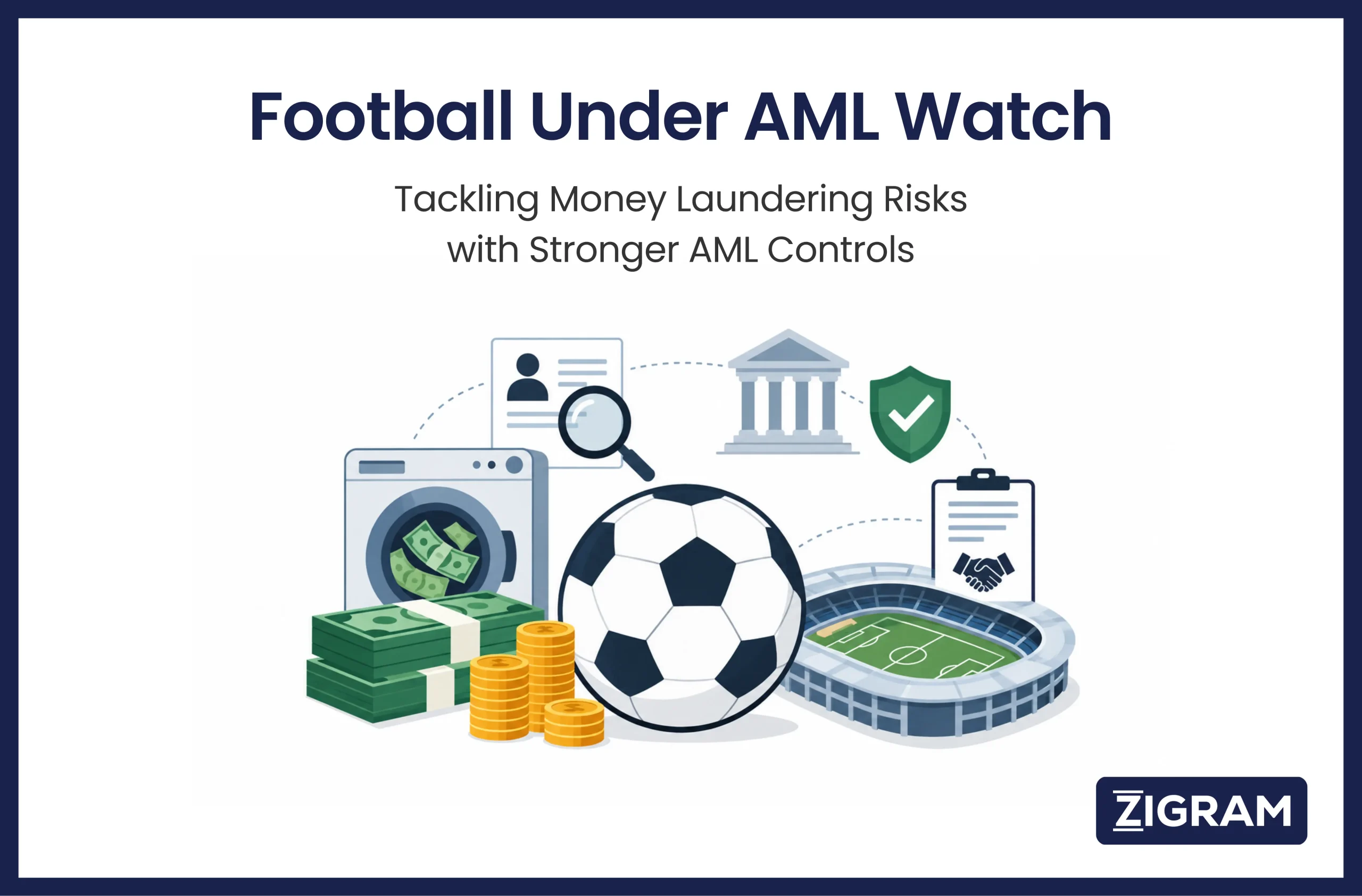
Anti-money laundering regulations are vital in professional football. By mid-2026, the football sector has shifted from being regarded primarily as a channel vulnerable to money laundering toward being expected to identify, assess and manage financial-crime risk proactively. This article builds on ZIGRAM’s analysis of UK football and money laundering vulnerabilities to examine what has changed, what regulators now expect, and what clubs, agents, and investors should do next.
The focus is on professional football in the UK and EU, but the issues are globally relevant. Three developments make AML in football an immediate priority for compliance teams and club executives, underlining the importance of stronger controls to protect the sport’s integrity and financial stability:
The EU’s 2024 AML package classifies professional football clubs and football agents as obliged entities under the new Anti-Money Laundering Regulation (AMLR), with obligations applying from 10 July 2029.
The UK government published its 2025 National Risk Assessment of Money Laundering and Terrorist Financing, explicitly reassessing risks from football clubs and agents around opaque ownership, transfers and intermediary fees.
The UK’s Football Governance Act 2025 established an Independent Football Regulator (IFR), strengthening ownership tests, financial transparency and governance requirements.
Key takeaways: ownership and investment structures are more complex than ever; regulators expect risk-based due diligence and ongoing monitoring even before formal AML rules take effect; and RegTech tools for screening, enhanced due diligence and transaction monitoring will be essential for football organisations to meet rising expectations without overwhelming manual effort.
2. From "vulnerable sport" to regulated financial ecosystem
Earlier debates about money laundering in football centred on club takeovers by opaque offshore vehicles, inflated transfers and weak governance. The discussion has moved on. Football is now treated as part of a broader regulated financial ecosystem, with expectations that major football clubs behave as corporate entities subject to financial-crime controls.
An estimated $140 billion is laundered through football each year, according to widely cited industry estimates. Premier League clubs alone generated turnover exceeding £6 billion in the 2023-24 season. Cross-border transfers, dependence on intermediaries, sponsorship from overseas firms, media-rights deals and global fan-based legitimacy create structural exposure. Criminal organizations may use clubs for reputation laundering or social influence, capitalising on the community goodwill that football generates.
Football AML risk is not limited to criminals seeking to launder money. It extends to sanctions exposure, politically exposed persons investing in clubs, fraud in transfer valuations, corruption, tax offences and manipulation of player registrations as financial assets.
Key football financial flows exposed to financial-crime risk:
Club ownership and investment (share purchases, private equity, multi-club models)
Player transfers and agent/intermediary fees
Sponsorship and advertising contracts
Loans and financing (shareholder, external, intra-group)
Media and broadcasting rights
Betting relationships and related-party transactions
3. Evolving regulatory landscape: UK, EU and global signals
AML rules affecting the football industry are tightening on two tracks: football-specific governance reforms and general AML regulation that now explicitly covers the football sector.
UK 2025 National Risk Assessment. The 2025 NRA reassessed football clubs and football agents as risk-bearing entities. Clubs must maintain greater financial transparency under evolving regulations. Larger clubs face heightened risk from overseas investors, including politically exposed persons and organised crime groups. Lower-league clubs are flagged as vulnerable due to financial distress and reliance on non-traditional funding. Football agents and intermediaries are identified as high in opacity, with concerns around fee structures, dual representation and cross-border flows. New UK AML regulations for football agents are due mid-2026, reflecting the UK government’s commitment to addressing these gaps.
UK Football Governance Act 2025. The Football Governance Act creates the Independent Football Regulator (IFR), which implements club licensing, Owner, Directors and Senior Executives (ODSE) fitness tests and financial resilience obligations. ODSE assessments for incumbent owners and senior managers came into force in December 2025; for new owners, from 5 May 2026. The IFR is not an AML supervisor, but its governance and ownership-integrity focus raise the bar on beneficial ownership reporting, source-of-wealth verification, and financial soundness.
EU AML framework. The 2024 AML package replaces the 5th AML Directive with a directly applicable regulation (AMLR) and a new directive (AMLD6). AML regulations classify professional football clubs and football agents as obliged entities. The 2029 AMLR applies directly to football clubs and agents from 10 July 2029, requiring customer due diligence, ongoing monitoring, suspicious-transaction reporting, and internal controls. The EU’s 2024 AML framework brings football under regulatory scrutiny over five years, with AMLA expected to issue technical standards and guidelines on risk assessments and CDD procedures in the interim. Governments impose legal obligations to enforce AML regulations, and clubs may face fines and penalties for non-compliance.
Timeline clarity. Current EU and UK AML regimes already apply to banks, payment firms and other entities dealing with football businesses. The AMLR’s obligations for clubs and agents are legislated but future-dated (10 July 2029). Governance codes, league licensing, and football association integrity programmes already create interim expectations that push toward AML-standard controls.
4. Understanding money laundering risk in the modern football sector
The Financial Action Task Force (FATF) marks football as vulnerable to money laundering in its FATF report on proceeds of crime in sports. Recent investigations across multiple jurisdictions confirm the risk is material. Football’s attractiveness to criminals stems from social legitimacy, high-value cross-border cash flows, perceived gaps in historical AML rules and the prestige that club ownership confers.
Money laundering can fund illegal activities like human trafficking, drug trafficking, and terrorism. Illicit funds entering the football sector do not only represent financial crime; they can undermine governance, distort competition, and enable further criminal activities.
Key typologies in the modern football sector:
Club acquisitions via layered offshore companies. SPVs in secrecy jurisdictions obscure the ultimate beneficial owner and the source of funds.
Inflated or circular player transfers. Clubs trade players back and forth at escalating values to create artificial cash flows and launder money through seemingly legitimate deals.
Disproportionate agent or intermediary fees. Commissions may be paid through sub-agents, shell companies, or consultancy contracts to disguise illegal money.
Fictitious or inflated sponsorship and advertising contracts. Shell sponsors, barter deals and payments through high-risk jurisdictions.
Misuse of loans and intra-group financing. Shareholder loans without documentation or economic rationale, used to move funds.
Ticketing and hospitality revenue abuse. Cash splitting, fake invoices, and bulk ticket purchases.
Betting-linked schemes. Match-fixing and insider betting arrangements enabling layering of proceeds.
The FIFA scandal involved over $200 million in fraudulent activities. Seven FIFA executives faced charges in a case that exposed systemic corruption across the world of football governance and highlighted who was responsible for the misconduct. Operation Matrioskas dismantled a Russian money laundering network in football, demonstrating how organised crime groups exploit the sport’s financial infrastructure. Criminal organizations may also use clubs to evade taxes through complex cross-border structures or to integrate proceeds from corruption and fraud.
Football organizations should segment risk by counterparty (owners, agents, sponsors, lenders), geography, transaction type, and complexity, rather than treating all football activity as equally risky.
5. Ownership, investment, and beneficial ownership risks
Club ownership structures are central to football AML discussions. Football clubs face risks involving opaque ownership and massive capital flows, particularly with cross-border investment, multi-club ownership models, and private equity involvement.
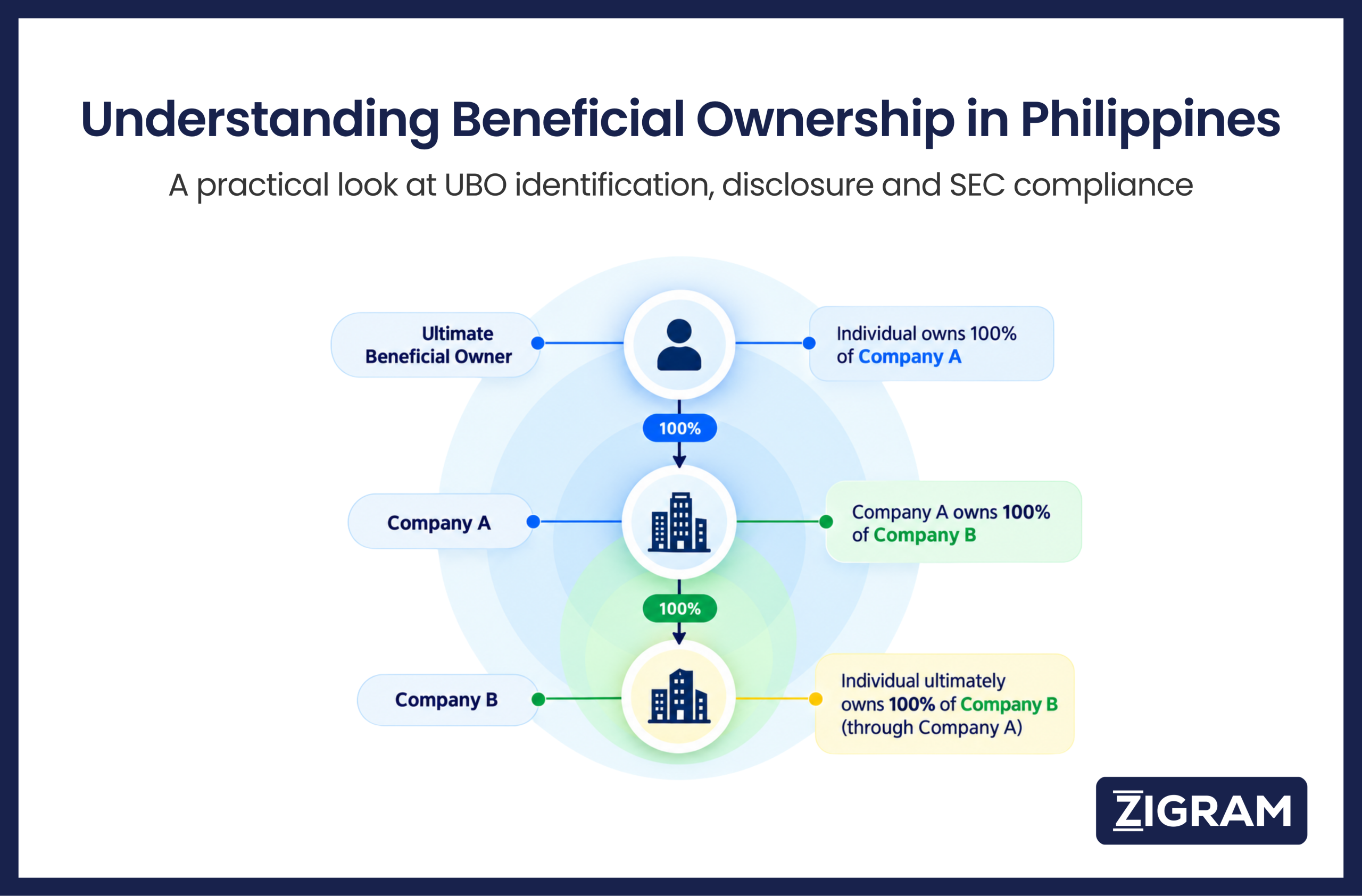
Common risk patterns include shell companies registered in multiple jurisdictions, nominee shareholders, trusts, layered holding structures and rapid resale of stakes. Leeds United was linked to money laundering under Massimo Cellino, illustrating how ownership opacity can expose clubs to financial-crime risk. Clubs must identify the Ultimate Beneficial Owner (UBO) in transactions involving ownership changes, and AML frameworks require clubs to screen for politically exposed persons (PEPs). A politically exposed person investing in a club, or investors from sanctioned jurisdictions, should trigger enhanced due diligence on the source of wealth and source of funds.
Regulators expect:
Clear mapping of beneficial ownership chains using corporate registries and reliable data sources
Documented source-of-wealth and source-of-funds assessments
Sanctions screening and PEP screening at onboarding and periodically thereafter
Escalation policies when UBOs are opaque or linked to adverse media
Illustrative example: An investor establishes an SPV in the Isle of Man, routes investment through a Delaware entity, and acquires a 40% stake in a professional football club. A screening platform identifies the UBO, flags that the individual is a PEP in a jurisdiction under sanctions, and a due diligence report documents the source of wealth. Only after verification does the club accept the investment, subject to conditions and periodic review.
6. Transfers, football agents and intermediaries: from opacity to enhanced due diligence
Player transfers and football agents have been repeatedly highlighted in NRAs, FATF reports and enforcement events as key vectors for moving illicit funds. Football transfers involve complex payment chains that may obscure fund origins, and agents often operate across jurisdictions with partial or no licensing oversight.
Transfer risks. Overvaluation of players, circular deals between related clubs, hidden third-party influence, side letters and image rights arrangements that obscure true payment flows. Neymar’s transfer to Barcelona was investigated for money laundering, exposing how high-value deals at clubs like Real Madrid and Barcelona attract regulatory scrutiny. In 2019, FC Porto was linked to a €50 million corrupt transfer, and corruption in Portuguese football involved a €9 million payment to agents.
Agent risks. Unregistered agents, dual representation, opaque fee sharing, cross-border payments to intermediaries in high-risk jurisdictions and use of consultancy contracts to disguise commissions. Mino Raiola received €49 million for Paul Pogba’s transfer, a fee level that illustrates why agent commissions require scrutiny. Chelsea was fined £10 million for 74 breaches of FA agent and intermediary rules, including secret payments to unregistered agents totalling approximately £47 million from 2011 to 2018. Football agents face stricter transparency rules by mid-2026 under UK regulatory developments.
From 10 July 2029, enhanced due diligence obligations under EU AMLR will require clubs and agents to conduct risk assessments, verify counterparties, maintain records and report suspicious activity to FIUs.
Transfer/agent risk scenario | Red flags | Recommended AML control |
|---|---|---|
Unexplained spike in agent fees | Fee exceeds market norms; multiple sub-agents involved | Enhanced due diligence on fee recipients; escalation |
Newly formed intermediary in offshore centre | Entity registered < 12 months; no trading history | UBO verification; source-of-funds checks |
Circular player trades between related clubs | Same players traded repeatedly at rising values | Transaction monitoring rules; pattern analysis |
Payments routed through high-risk jurisdiction | Payment path inconsistent with agent's location | Sanctions screening; geographic risk assessment |
7. Sponsorships, media rights, loans and related-party transactions
Beyond transfers and ownership, football clubs rely on sponsorship, advertising, media-rights deals and structured financing. Each creates channels through which funds of unclear origin can enter or exit the club.
Fake sponsorships can disguise illicit money in football. Shell entities offering contracts with little commercial substance, payments routed through high-risk jurisdictions and counterparties with links to organised crime or sanctioned state entities all pose material risk. Sponsorship deals may require enhanced due diligence to verify legitimate financing. In July 2026, the FCA wrote to 21 clubs in England over sponsorship deals with financial services firms not authorised in the UK; 13 clubs were involved in 18 such arrangements.
Media rights and image rights sold at non-market values to little-known entities, sub-licensing chains and contracts that justify large cross-border transfers without clear value delivery are all areas of concern. Shareholder loans without documentation, third-party lending structures and related-party financing serve as mechanisms to move funds in and out of clubs with little economic rationale.
Controls: Conduct due diligence on sponsors, media-rights partners and lenders, including beneficial ownership, source of funds and geographic risk. Benchmark contract values to market norms. Establish internal approval thresholds and escalation procedures when counterparties appear in sanctions, PEP or adverse media databases.
8. Regulatory developments to 2029: what football must prepare for now
The period between 2026 and 10 July 2029 is a preparation window. Higher compliance costs for AML may burden smaller football clubs disproportionately; under AMLR provisions, clubs with turnover below €5 million may qualify for partial or full exemptions, depending on Member State implementation.
Year | Key EU/UK developments | Impact on professional football | Preparation actions |
|---|---|---|---|
2025 | Football Governance Act in force; ODSE regime active; UK NRA published | Ownership tests and licensing obligations apply | Map ownership chains; document source of wealth |
2026 | AMLA issues initial guidelines; UK IFR expands scope; FCA scrutiny of sponsors | Interim expectations on due diligence rise | Inventory counterparties; review contracts for transparency |
2027 | AMLR obligations start for other obliged entities; technical standards issued | Football sector observes requirements applied to other sectors | Design CDD/EDD policies; build internal reporting procedures |
2028 | National transposition work; AMLA supervisory coordination active | Clubs must prepare systems and staff for compliance | Test transaction monitoring; train staff on football-specific red flags |
2029 | AMLR applies to clubs and agents from 10 July | Full CDD, monitoring, SAR and record-keeping obligations | Operate a functioning AML framework from day one |
Football organisations should treat 2029 as a deadline for operating a functioning AML framework, not a start date for building one. Systems, data and staffing should be designed, tested and refined well before that date.
9. Building an AML and financial-crime control framework for football organisations
Football organisations must implement customer due diligence controls proportionate to their risk profiles. Clubs should use robust internal controls and governance to support AML compliance, and clubs are required to implement ongoing transaction monitoring and suspicious activity reporting under the coming AML requirements.
Core components:
Governance and oversight. Board-level responsibility for financial integrity. Under AMLR, one member of the management body must ensure compliance.
Risk assessment. Cover ownership, transfers, agents, sponsors, lenders and geographic factors. Document inherent and residual risk.
Documented AML rules and procedures. Internal controls, reporting lines, customer due diligence and enhanced due diligence policies.
Staff training. Focused on football-specific typologies and red flags, not generic financial-crime content.
Counterparty due diligence in practice: Verify identity and beneficial ownership. Assess purpose and nature of the relationship. Understand expected transaction patterns. Determine when enhanced due diligence is required, for example when dealing with PEPs, high-risk countries or unusual ownership structures.
Ongoing monitoring: Periodic review of counterparty status. Rescreening for sanctions, PEPs and adverse media. Transaction monitoring of payments related to transfers, agent fees, loans and sponsorships. Investigation of unusual patterns such as round-tripping, split payments or last-minute routing changes.
Solutions like PreScreening.io (for screening owners, agents and sponsors), Due Diliger (for deeper ownership mapping and due diligence), Dragnet Alpha (for ongoing adverse-media monitoring) and Transact Comply (for transaction monitoring) can help football organisations operationalise these controls at scale as part of a complete AML system.
10. Using data, technology and external intelligence effectively
Football’s financial ecosystem is cross-border and fast-moving. Manual checks alone cannot deliver the speed, consistency or coverage that AML compliance demands. Innovative solutions combining automation with expert judgement are the practical path forward.
Key capabilities football organisations should adopt:
Automated name screening against sanctions, watchlists and PEP databases
Adverse media monitoring to detect emerging reputational signals about owners, agents and sponsors
Scalable KYC and KYB for entities involved in club transactions
Transaction monitoring rules tailored to football-sector risks (threshold, velocity, unusual counterparties)
Entity risk scoring combining geography, ownership complexity and sector exposure
External data sources should include corporate registries, UBO registers, regulatory enforcement databases, disciplinary records from governing bodies and ESG risk datasets. Technology must support human expert judgement: compliance teams, legal advisers and club executives must interpret alerts, conduct enhanced due diligence and make final risk decisions.
Effective data governance, privacy compliance and clear record-keeping policies are essential, particularly when handling information on PEPs, high-profile players and corporate sponsors under GDPR and UK data protection law.
11. Collaboration between football bodies, regulators and financial institutions
AML in football cannot be managed by clubs, agents or leagues in isolation. It requires coordination across regulators, FIUs, law enforcement and financial institutions.
FIFA and UEFA set licensing and transfer rules for compliance, and their Financial Sustainability Regulations already monitor club earnings and losses. These frameworks overlap with AML risk where clubs rely on related-party financing or mask deficits through opaque transactions. National associations maintain agent registers and disciplinary systems that could incorporate AML red flags into licensing criteria.
Banks and payment firms servicing clubs apply their own due diligence standards. Where clubs lack financial transparency or beneficial ownership clarity, financial institutions may de-risk or refuse to transact. Sponsors’ financial partners apply similar scrutiny. Football organisations should develop structured relationships with their banks: sharing risk assessments, clarifying ownership structures and setting expectations on reporting channels.
Useful collaborations include joint typology workshops between clubs and FIUs, data-sharing agreements for integrity and betting-fraud detection, and collective training initiatives across leagues to standardise interpretation of AML rules. Over time, regulators are expected to require the football sector to demonstrate sector-level maturity in financial-crime risk management, comparable to other non-financial obliged entities.
12. Looking ahead: from vulnerability recognition to continuous financial-crime risk management
The football industry is in transition. The focus has moved from recognising that the sport is vulnerable to money laundering toward building mechanisms for continuous financial-crime risk management. Money laundering undermines trust in football among fans, damages the sport’s reputation and distorts competition. Regulatory demands benefit professional football’s integrity and sustainability.
Strategic priorities for the next three years:
Clarify and disclose ownership structures; verify beneficial ownership and source of wealth for all investors
Embed due diligence and enhanced due diligence into transfers, sponsorships, agent relationships and financing arrangements
Implement proportionate AML rules and transaction monitoring systems, treating compliance not as a cost but as protecting club value
Prepare for the EU’s 10 July 2029 obligations while aligning with UK IFR and national expectations
Convergence of sports governance, financial regulation and sanctions policy will increase scrutiny of who owns, finances and commercially partners with professional football clubs. Credible AML frameworks will become a core element of club valuation and resilience. Fans, investors and regulators will expect accountability and commitment to financial integrity.
Clubs, agents, leagues and their financial partners that start building these capabilities now, working with specialised RegTech and data intelligence providers such as ZIGRAM, will be positioned to meet evolving regulations with confidence rather than scrambling to comply at the deadline.