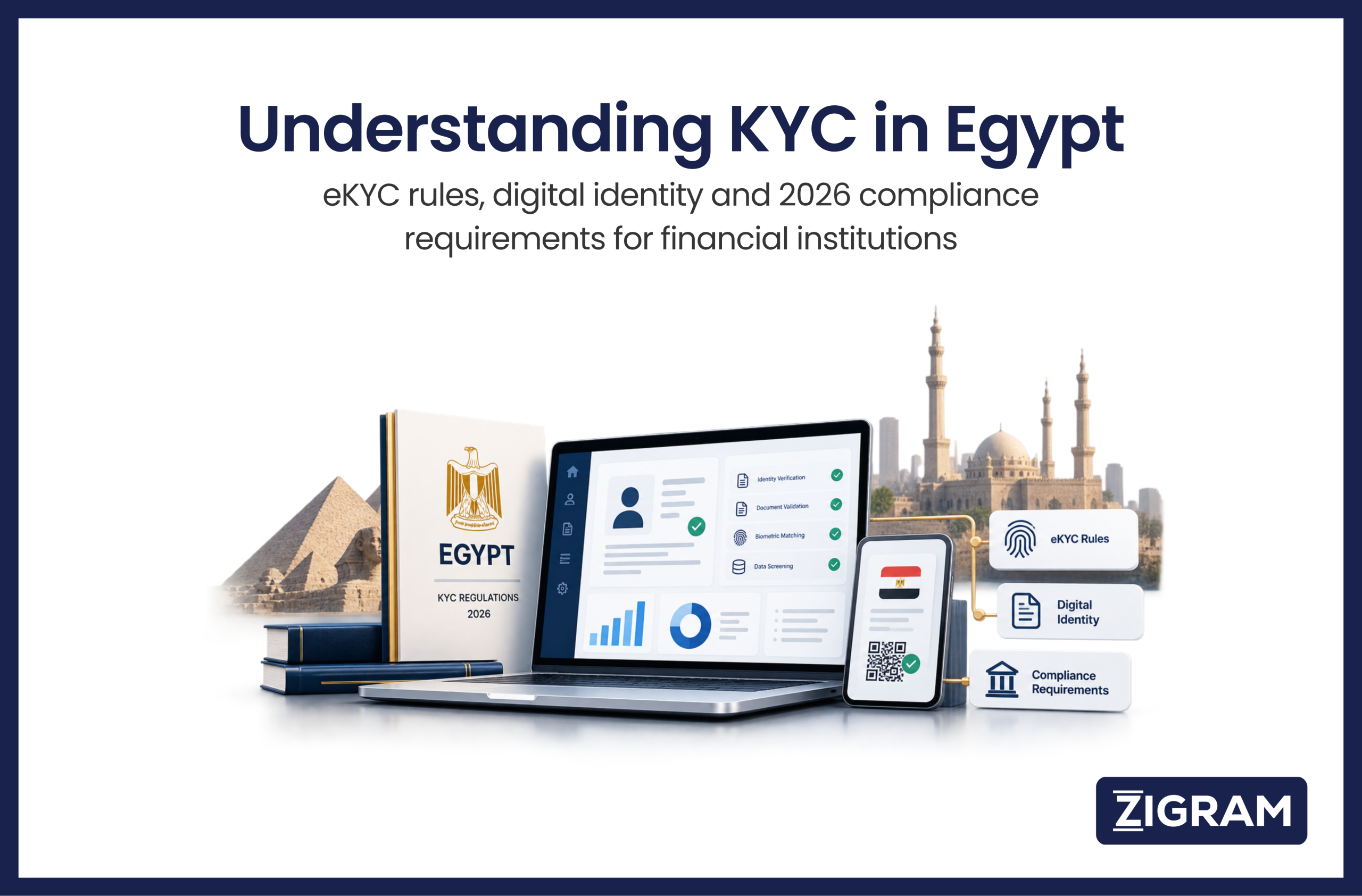
KYC in Egypt is the process of identifying and verifying a customer, understanding the risks of starting or maintaining the relationship, and applying that information to AML controls. KYC in Egypt is now entering a new phase: while customer identification has traditionally depended heavily on documentation and physical processes, the Central Bank of Egypt (CBE) introduced 2026 regulations for a Digital Financial Identity (DFI) platform that enables electronic customer identification and verification, or eKYC, across approved banking journeys.
That shift does not narrow KYC to digital identity alone. Financial institutions still need to identify beneficial ownership, assess customer risk, screen relevant parties, and keep customer data current as the relationship evolves. For compliance officers, AML teams, legal departments, banks, and other licensed financial entities operating in Egypt, the practical issue is how to adapt onboarding and review workflows to faster digital processes without weakening risk assessment, screening, or ongoing monitoring.
In this article, you will learn how KYC and eKYC work in Egypt, which authorities oversee the framework, what changed under the 2026 CBE rules, and how customer identification, beneficial ownership checks, risk profiling, screening, and ongoing data updates fit into the wider AML and digital identity process.
You will come away with:
a clear definition of KYC and eKYC in the Egyptian context
the main 2026 regulatory changes affecting onboarding and verification
the core compliance requirements financial institutions must apply
how KYC connects to broader AML obligations and digital identity workflows
What Does KYC Mean in Egypt?
Know Your Customer (KYC) is the process of identifying a customer, verifying their identity and understanding the risk associated with establishing or maintaining the relationship.
The CBE describes KYC and customer due diligence (CDD) as closely connected. Its guidance states that CDD includes identifying customers and beneficial owners, building a customer risk profile, applying customer-acceptance policies, keeping customer information updated and monitoring the relationship on an ongoing basis.
That distinction matters. A valid ID can establish who someone is. It does not automatically answer:
Who ultimately owns or controls a company?
What activity should be expected from the customer?
Does the customer present elevated sanctions or PEP risk?
Has the customer’s behaviour changed since onboarding?
Effective KYC compliance therefore continues after account opening.
Who Oversees KYC Requirements in Egypt's Central Bank?
The authority that matters depends on the institution and activity involved.
Authority | Role |
|---|---|
Central Bank of Egypt (CBE) | Supervises banks and relevant licensed institutions and issues KYC, CDD and eKYC requirements. |
Financial Regulatory Authority (FRA) | Supervises Egypt’s non-bank financial sector and sets customer-verification and AML/CFT controls for entities under its oversight. |
EMLCU | Egypt’s financial intelligence unit; it receives suspicious-activity information and establishes customer due diligence procedures in coordination with supervisory authorities. |
The EMLCU’s mandate specifically includes establishing CDD procedures and coordinating with regulatory authorities to verify compliance.
For readers looking at the wider regulatory structure, ZIGRAM’s guide to AML Compliance in Egypt: Regulations, Regulators and Key Requirements provides the broader AML context.
KYC vs eKYC and Digital Financial Identity in Egypt
The purpose of KYC and eKYC is similar. The difference lies primarily in how identification and verification take place.
Traditional KYC | eKYC |
|---|---|
Often involves physical or branch-based processes | Uses approved electronic identification and verification |
Documents may be manually collected and reviewed | Customer information can be processed digitally |
Updates may require additional manual interaction | Digital identity supports remote data updates |
Establishes customer identity | Establishes identity electronically but still feeds the wider CDD process |
The move towards eKYC in Egypt is particularly important because it can reduce onboarding friction without removing compliance responsibilities.
What Changed Under the 2026 CBE eKYC Regulations?
In August 2026, the CBE approved regulations governing the Digital Financial Identity Egypt framework.
The rules apply to banks operating in Egypt, eligible licensed entities participating in the approved DFI ecosystem and CBE-authorised banking agents. They establish minimum requirements around:
electronic customer identification;
electronic identity verification;
customer identity-information updates;
electronic authentication;
customer consent;
sharing Digital Financial Identity through the approved platform; and
governance, cybersecurity and data-protection controls.
The framework is designed to identify and verify bank customers remotely and support wider digital banking services. It also provides an alternative to manual onboarding by setting rules for electronic authentication and platform-based verification. Within that operating line, the rules cover remote onboarding for individual customers as part of a formal DFI process.
The CBE says the framework will allow customers to open bank accounts and obtain banking products and services through digital channels without visiting a branch.
This makes the CBE eKYC regulations more than a digitised version of document collection. They create a regulated framework for remote customer identification and financial identity.
And the regulatory activity has continued. On 28 September 2026, the CBE listed updated customer due diligence/KYC circulars covering banks, money-transfer companies and foreign-exchange companies.
Key KYC Compliance Requirements in Egypt
1. Identify and Verify the Customer
The starting point is establishing who the customer is using reliable, independent information. In digital onboarding, institutions also need evidence showing how verification occurred and which trusted source supported the result.
For non-bank financial activities, the FRA stated in August 2026 that applicable entities must verify national-ID authenticity and mobile-number ownership and check customers against relevant AML lists.
2. Identify Beneficial Owners
For legal entities, identifying the company alone is not enough, and KYC includes collecting government-issued identification documents for the natural persons who ultimately own or control the customer. CDD should establish those individuals, including for businesses, and the CBE includes identification of beneficial owners as part of the wider customer due diligence requirements. Under Decision 140 of 2023, retained digital onboarding evidence should support customer data verification at contracting with the same reliability expected of official documents. That information should then feed the institution’s customer-risk assessment.
3. Create a Customer Risk Profile
KYC requirements in Egypt are closely linked to the risk-based approach in banking and financing practice.
Relevant factors may include:
customer type;
business activity;
ownership structure, including beneficial ownership for legal entities and other businesses;
geography;
products and services used; and
expected transactional activity.
A risk score should therefore influence the controls applied to the customer, rather than exist only as an onboarding field.
4. Screen Customers and Related Parties
Verified identity information becomes the foundation for sanctions, PEP and other relevant watchlist screening.
This is where accurate identity data matters operationally. Poorly resolved names can generate unnecessary alerts, while incomplete ownership information can leave relevant parties outside the screening process, including politically exposed persons.
Screening should therefore connect with customer-risk assessment rather than operate as an isolated check, with controls that vary by product type, including financing activity, and with risk-based scoring that works in practice, not only on paper.
5. Keep Customer Information Current
KYC does not end once the customer has been onboarded.
The CBE’s CDD guidance includes maintaining customer and beneficial-owner information and monitoring customer relationships on an ongoing basis.
This has also become a visible policy priority. In August 2026, the CBE and Egypt’s Ministry of Foreign Affairs launched the “Update Your KYC in Egypt” initiative to make banking-data updates easier for Egyptians working abroad while maintaining regulatory and due-diligence requirements.
What Does eKYC Change for Digital Banking Services and Financial Institutions?
The biggest benefit of eKYC Egypt is not simply faster onboarding. It is the ability to establish verified identity digitally and use that information across subsequent compliance processes, similar to how CKYC 2.0 API integration for loan origination enables real-time customer verification and streamlined digital lending in other markets.
But eKYC should not be confused with the complete AML process. A successful electronic identity check can establish: “Is this person who they claim to be?”
AML controls must then answer additional questions:
“What risk does this customer present?”
“Who ultimately controls the relationship?”
“Has the customer appeared on a relevant watchlist?”
“Does actual transaction behaviour match what was expected?”
That is why identity verification, CDD, screening and monitoring should be connected rather than treated as separate compliance exercises.
From KYC Data to Ongoing AML Risk
Good KYC creates the context that later AML decisions depend on. Digital identity creation under this framework requires four possession and three liveness factors to validate the customer’s presence, with the date, electronic acceptance of terms and conditions, and related records captured to maintain evidentiary integrity. Customer identity, ownership, business activity, expected transactions and geography can all influence customer risk scoring, screening and transaction monitoring, which in turn depends on high-quality, remediated KYC data that is deduplicated, standardised and fit for ongoing AML use.
A useful compliance flow therefore looks like:

ZIGRAM’s Complete AML System uses customer and entity information across customer risk rating, name and watchlist screening, transaction monitoring and investigation workflows.
For financial institutions operating in Egypt, the real opportunity from digital identity is therefore not simply faster onboarding. It is making better use of trusted customer information throughout the relationship.
FAQs
What is KYC?
KYC is the process of identifying and verifying a customer and using that information to support customer due diligence, risk assessment and ongoing monitoring.
What is eKYC?
eKYC is electronic Know Your Customer. Under the CBE’s 2026 Digital Financial Identity framework, approved participants can identify and verify customers electronically and support remote banking services.
Is KYC the same as customer due diligence?
Not exactly. KYC focuses on identifying and verifying the customer. CDD is broader and includes beneficial ownership, customer risk profiling, maintaining information and ongoing monitoring.
Who regulates KYC in Egypt?
The regulator depends on the activity. The CBE supervises banks and relevant licensed entities, the FRA oversees non-bank financial activities, and EMLCU has a central AML/CFT and financial-intelligence role.
Does eKYC replace AML monitoring?
No. eKYC can digitise identity verification, but institutions still need customer risk assessment, screening, ongoing monitoring and investigation controls.