Table of Contents

A company name can tell you who is legally registered. It does not always tell you who ultimately owns, controls or benefits from the entity. That distinction sits at the centre of beneficial ownership compliance.
For financial institutions and regulated businesses in the Philippines, identifying the real individuals behind companies has become increasingly important for customer due diligence, sanctions screening, risk assessment and financial-crime investigations.
The requirements also changed significantly in 2026. The Securities and Exchange Commission (SEC) introduced revised beneficial ownership disclosure rules under Memorandum Circular No. 15, Series of 2025, alongside the rollout of the Hierarchical and Applicable Relations and Beneficial Ownership Registry (HARBOR).
In this article, you will learn who qualifies as a beneficial owner in the Philippines, what changed under the 2026 SEC rules, how the Beneficial Ownership Declaration works and why accurate UBO identification matters for AML compliance.
What Is Beneficial Ownership?
Beneficial ownership refers to the actual ownership or control behind a company, legal entity or arrangement. It looks beyond the name recorded on official documents to identify the individual or individuals, who ultimately own, control or benefit from the entity.
The person identified at the end of this ownership or control chain is known as the beneficial owner.
Under Philippine AML rules, a beneficial owner is generally the natural person who ultimately owns or controls a customer, exercises ultimate effective control over a legal person or arrangement, or on whose behalf a transaction or activity is conducted. This distinction matters because the legal shareholder shown in company records may not always be the person who ultimately controls the business.
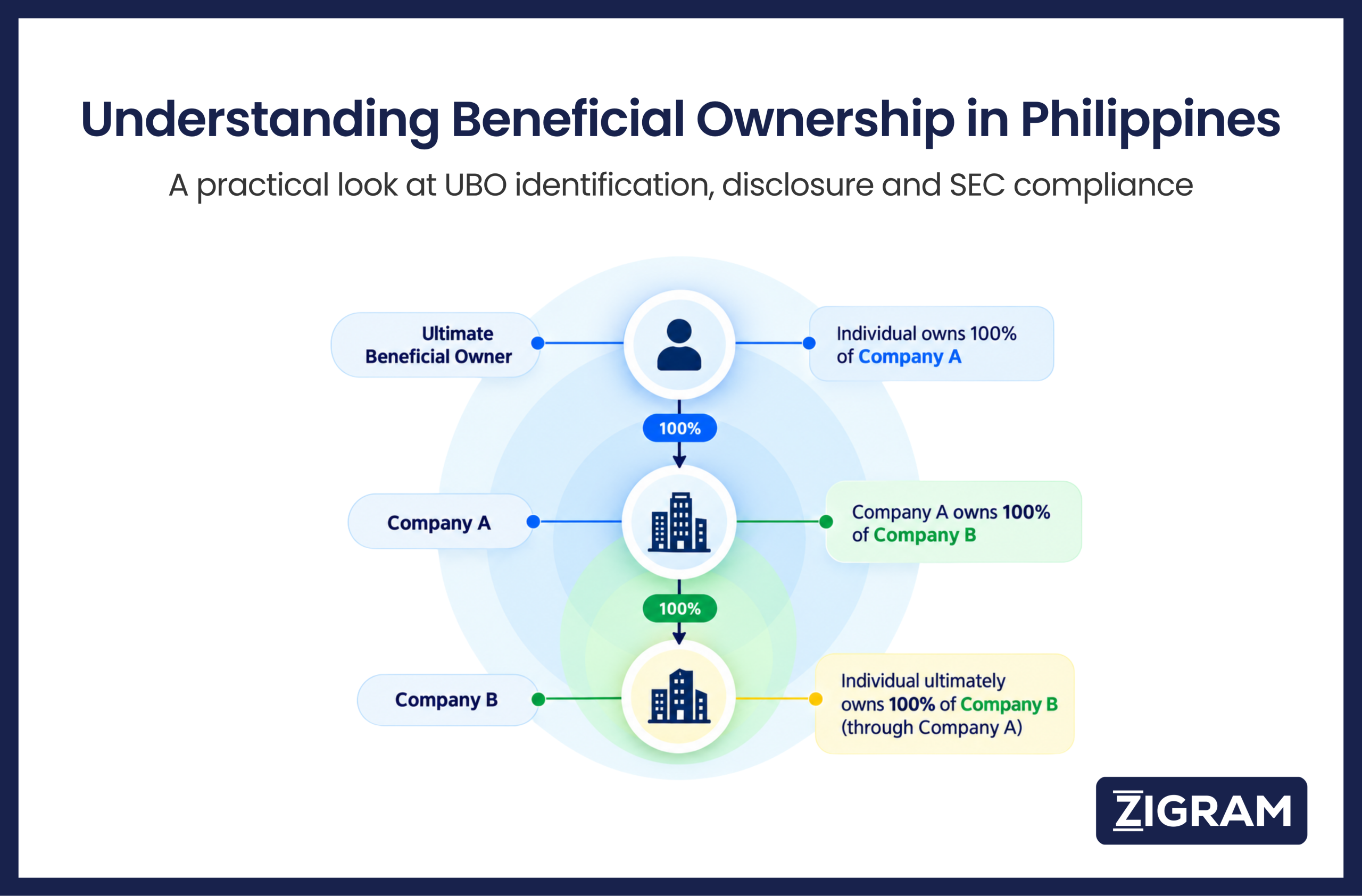
For example: Company A → Holding Company B → Investment Company C → Individual X
In this structure, Company B may appear as Company A’s direct shareholder. But if Individual X ultimately owns or controls the entities above it, Individual X may be the ultimate beneficial owner (UBO).
This is why UBO identification goes beyond collecting shareholder names. Compliance teams need to understand the complete ownership structure, identify the natural persons behind it and determine how control is exercised.
For more complex ownership structures, ZIGRAM’s guide on UBO identification in AML compliance explains a practical step-by-step approach to identifying ultimate beneficial owners.
What Changed in the Philippines in 2026?
The SEC issued Memorandum Circular No. 15, Series of 2025, establishing the revised Beneficial Ownership Disclosure Rules effective in 2026.
One of the most important changes is the revised ownership threshold. Under the new framework, a natural person who directly or indirectly owns at least 20% of the voting rights, voting shares or capital of the reporting entity can fall within the ownership category of beneficial ownership.
But percentage ownership is not the only test.
A person can also qualify as a beneficial owner through other forms of effective control, even where ownership falls below the threshold. The rules therefore require organisations to look beyond percentages when determining who actually controls an entity.
Ownership and control are not always the same
A practical assessment should consider:
Question | What compliance teams should establish |
|---|---|
Who owns the entity? | Natural persons with direct or indirect ownership interests |
Who controls it? | Individuals exercising effective influence or control |
Is ownership layered? | Whether companies, partnerships or other structures sit between the customer and UBO |
Are nominees involved? | Whether legal ownership differs from actual control |
Is the information current? | Whether ownership or control has changed since the previous review |
This distinction is important for both beneficial ownership requirements and AML risk assessment.
The Beneficial Ownership Disclosure and Declaration in 2026
Another important development is the way beneficial ownership declarations are submitted.
The SEC’s HARBOR platform is designed to collect, maintain and analyse beneficial ownership information and establish a centralised beneficial ownership registry.
The SEC currently lists the Beneficial Ownership Declaration (BOD) as a reportorial requirement to be filed through HARBOR, capturing core identifying details such as the beneficial owner’s full name and address. The BOD had previously been submitted together with the General Information Sheet, while the new framework separates beneficial ownership reporting through the dedicated system.
A transitional period allowed continued use of the previous GIS and eFAST process until 31 July 2026.
For compliance teams, this means beneficial ownership data should no longer be treated simply as another static corporate field. It is becoming structured regulatory information that must remain accurate and capable of being updated, with regulatory frameworks expecting ownership changes to be reported promptly.
How Should Institutions Identify a Natural Person as the Ultimate Beneficial Owner?
Ultimate beneficial owner identification should start with ownership but should not end there. A practical process can follow five steps.
1. Map the ownership structure
Begin with the customer’s immediate shareholders or owners. Where another company appears as a shareholder, move up the ownership chain until the underlying natural persons are identified. This is especially important where multiple corporate layers, foreign companies or holding structures are involved.
2. Calculate direct and indirect ownership
Direct ownership is relatively straightforward. Indirect ownership requires examining interests held through one or more entities. AMLC guidance distinguishes between direct ownership and ownership held through a series of corporate ownership tiers. The goal is to understand the complete ownership path, not simply the first corporate layer.
3. Look for control beyond shareholding
Ownership percentages can miss important risks. An individual may exercise significant control through contracts, voting arrangements, nominee relationships or the ability to influence key corporate decisions.
This means a person should not automatically be excluded from UBO consideration simply because their shareholding is below a numerical threshold.
4. Verify the information
A declaration by itself should not always be the end of the process. Depending on risk, institutions may need to compare beneficial ownership information with corporate records and other reliable, independent information.
5. Keep the ownership picture current
Ownership structures change, including after a transfer or acquisition of shares or control. Shares may be transferred, directors replaced, holding companies introduced or control arrangements modified. Institutions therefore need a process for identifying material changes and reassessing customer risk where ownership, control, or management changes materially.
Why Beneficial Ownership Matters for AML Compliance
Beneficial ownership is not simply a corporate-reporting issue; beneficial owners must be disclosed to help prevent money laundering. Opaque ownership structures can make it harder to identify sanctions exposure, politically exposed persons, hidden related parties or connections to suspicious activity, and beneficial ownership information supports anti-money laundering controls as well as efforts against terrorism financing.
Consider a company that appears low-risk at first glance.
Its direct shareholder produces no screening matches. But further ownership analysis reveals that the shareholder is controlled through several entities by an individual associated with a higher-risk jurisdiction or relevant watchlist entry.
Without identifying the ultimate beneficial owner, that risk may never enter the institution’s screening or monitoring process.
That is why beneficial ownership should connect with: Customer due diligence → UBO identification → Screening → Customer risk assessment → Ongoing monitoring, because identifying beneficial owners also strengthens sanctions enforcement and AML controls.
For a broader view of Philippine AML obligations and the country’s regulatory framework, see ZIGRAM’s Philippines AML/CTF Landscape.
Beneficial Ownership After the Philippines' FATF Grey-List Exit
Beneficial ownership transparency has also played a role in the Philippines’ wider AML reform programme.
The FATF removed the Philippines from increased monitoring in February 2025 after recognising progress across several areas. One of the specific improvements highlighted was better access for law-enforcement authorities to beneficial ownership information and measures to improve its accuracy and currency.
Grey-list exit therefore does not reduce the importance of beneficial ownership compliance. If anything, the 2026 SEC changes show that the focus is moving towards sustaining and operationalising those improvements.
Financial institutions should be able to answer three basic questions:
Who ultimately owns the entity?
Who actually controls it?
Does that ownership or control change the customer's financial-crime risk?
Connecting Beneficial Ownership to Customer Risk
Collecting a beneficial owner’s name without using that information elsewhere creates limited compliance value. Once identified, relevant UBO information should be available to screening, customer-risk and investigation processes.
For example, an ownership change may introduce a new PEP connection. A newly identified beneficial owner may generate a sanctions-screening alert. A complex ownership structure may increase the level of customer risk and require additional review.
The strongest compliance approach therefore treats beneficial ownership as risk intelligence rather than a one-time declaration.
ZIGRAM’s Complete AML System connects customer and entity risk assessment with name and watchlist screening, transaction monitoring and investigation workflows, allowing ownership-related risk information to form part of the wider AML process.
For organisations operating in the Philippines, the objective is not simply to know that a Beneficial Ownership Declaration has been filed. It is to understand who sits behind the entity, what risk they introduce and whether that risk changes over time.
FAQs
What is a beneficial owner in the Philippines?
A beneficial owner is the natural person who ultimately owns or controls an entity, or exercises ultimate effective control over it, the real person behind the structure, even when another party appears as the legal owner.
What is the beneficial ownership threshold in the Philippines?
Under the revised SEC framework, direct or indirect ownership of at least 20% of voting rights, voting shares or capital is one basis for identifying a beneficial owner.
What is a Beneficial Ownership Declaration?
A Beneficial Ownership Declaration records information about the natural persons who ultimately own or control a reporting entity. It may also capture whether a beneficial owner is a politically exposed person. Under the 2026 framework, the SEC provides for BOD filing through HARBOR.
What is HARBOR?
HARBOR stands for Hierarchical and Applicable Relations and Beneficial Ownership Registry. It is the SEC’s web-based system for collecting, maintaining and analysing beneficial ownership information.
Is beneficial ownership the same as legal ownership?
No. Legal ownership identifies the registered owner, who may hold title to assets or property, while beneficial ownership focuses on the natural person who ultimately owns, benefits from, or exercises effective control over the entity; a person may also hold a direct or indirect interest without being the registered owner.