Table of Contents
Introduction: Why CKYC 2.0 Migration Cannot Be Treated as “Just an Update”
CKYC 2.0 migration is becoming one of the most significant compliance and operational transformation programs for BFSI institutions in India. Unlike CKYC 1.0, which primarily functioned as a centralized repository for storing customer KYC records, CKYC 2.0 introduces a real-time, API-driven identity verification ecosystem designed for continuous compliance, stronger validation, and improved customer identity consistency.
Managed by CERSAI under the oversight of RBI, SEBI, IRDAI, and PFRDA, CKYC 2.0 modernizes how financial institutions collect, validate, share, and update customer identity data. The framework introduces structured XML/JSON data exchange, automated deduplication, stricter field-level validations, and event-driven KYC refresh processes.
For banks, NBFCs, insurers, securities firms, and fintechs, this is no longer just a compliance update. It is a large-scale enterprise transformation touching onboarding, AML monitoring, fraud detection, customer master management, and audit readiness.
Many migration failures occur because institutions underestimate legacy data cleanup, delay remediation, or treat CKYC 2.0 as only an IT project. Successful organizations approach migration with shared ownership across technology, operations, compliance, onboarding, and business teams.
ZIGRAM helps BFSIs simplify CKYC 2.0 migration through automated data validation, remediation workflows, deduplication, sanctions screening alignment, and audit-ready compliance operations.
Executive Summary
CKYC 2.0 marks a major shift from static KYC record storage to real-time, API-driven identity verification. Unlike the batch-based CKYC 1.0 framework, CKYC 2.0 introduces synchronous validation, structured XML/JSON data exchange, automated deduplication, and stricter field-level checks, reshaping how BFSIs manage onboarding, KYC refresh, and AML compliance. CKYC 2.0 leverages AI-driven deduplication for enhanced identity verification, using photo matching and biometric analysis to replace manual deduplication methods, improve data accuracy, and strengthen fraud prevention in real-time verification and ongoing risk monitoring.
For many institutions, legacy data is the biggest migration challenge. Years of inconsistent customer records, duplicate CKYC identities, outdated documents, and demographic mismatches can lead to high rejection rates, operational delays, and remediation backlogs during migration. Deliberate strategies are essential to mitigate these risks, improve project management, and ensure successful migration.
The transition also changes onboarding and financial crime workflows significantly. CKYC 2.0 enables real-time verification, faster exception handling, continuous due diligence, and stronger alignment with sanctions screening, fraud detection, and transaction monitoring processes.
This playbook provides a practical roadmap covering baseline assessment, legacy remediation, architecture modernization, API integration, correction cycle automation, and continuous monitoring. It also highlights how ZIGRAM helps BFSIs streamline CKYC 2.0 migration through automated validation, remediation workflows, deduplication, and audit-ready compliance operations. As you follow this roadmap, it is crucial to prepare for the next phase of migration, such as moving from data collection to analysis or from remediation to full-scale implementation.
What Is CKYC 2.0?
CKYC 2.0 is the next evolution of India’s Central KYC framework that enables real-time identity verification, API-based validation, structured data exchange, automated deduplication, and continuous customer due diligence across regulated financial institutions. CKYC 2.0 centralizes KYC processes across different financial institutions, allowing users to submit and verify their KYC information easily, reducing duplication and streamlining access to financial services.
The upgraded framework affects onboarding, KYC refresh, AML compliance, fraud detection, sanctions screening, and customer risk management across banks, NBFCs, insurers, fintechs, and securities firms. The CKYC process begins when an individual approaches a financial institution regulated by SEBI, RBI, IRDAI, or PFRDA to initiate their KYC registration, requiring essential KYC documents such as proof of identity and address.
By replacing static document-driven workflows with API-first verification and validation logic, CKYC 2.0 improves onboarding speed, data consistency, audit readiness, and regulatory compliance.
Understanding the CKYC Process
The Central Know Your Customer (CKYC) process is a government-backed initiative designed to streamline and secure the management of KYC records across India’s financial sector. At its core, the CKYC process establishes a centralized repository, managed by the Central Registry of Securitisation Asset Reconstruction and Security Interest of India (CERSAI), where verified KYC data is stored and maintained.
This central registry enables financial institutions to access up-to-date, validated KYC information for customers, eliminating the need for repetitive paperwork and manual data entry each time a customer interacts with a new financial service provider.
By consolidating KYC records on a secure platform, the CKYC process enhances data integrity and supports robust identity verification across banks, mutual funds, insurance companies, and other regulated entities. This unified approach not only reduces operational friction but also strengthens the security interest of India’s financial system by providing a reliable foundation for asset reconstruction and securitisation activities.
The CKYC process ensures that KYC data is consistently verified and accessible, supporting seamless transactions and compliance with regulatory standards. Ultimately, the central registry of KYC information modernizes the way financial institutions manage customer identities, promoting efficiency, security, and trust throughout the sector.
CKYC Accounts and Registration
CKYC accounts are structured to accommodate the diverse needs of India’s financial ecosystem, with four main account types: Individual, Minor, Sole Proprietor, and Non-Individual. Each account type requires specific KYC documents tailored to the nature of the account holder, ensuring that the identity verification process is both thorough and relevant. Upon successful completion of the CKYC process, every account is assigned a unique CKYC number, which serves as a single reference point for all future KYC-related activities.
This CKYC number allows customers to seamlessly open new bank accounts, demat accounts, or invest in mutual funds without repeatedly submitting supporting documents. Financial institutions can retrieve verified KYC details directly from the Central KYC Registry, significantly reducing manual paperwork and administrative overhead. For new customers, CKYC registration is mandatory across all financial institutions regulated by RBI, SEBI, IRDAI, or PFRDA, ensuring a unified and secure onboarding experience.
The centralization of KYC details through the CKYC process not only accelerates onboarding but also enhances security and data quality across the financial sector. Customers benefit from a paperless, efficient process, while institutions gain access to verified, up-to-date KYC information—streamlining compliance and supporting a modern, customer-centric approach to financial services.
CKYC 2.0 Migration: What Has Changed from CKYC 1.0?
CKYC 1.0 operated as a batch-oriented, document-centric system focused on centralized KYC registration and storage. Institutions relied heavily on PDF uploads, scanned images, and manual validation workflows.
CKYC 2.0 introduces a validation-heavy architecture built around real-time APIs, event-driven updates, structured XML/JSON formats, and automated identity verification.
Major changes include:
• Shift from PDF/image uploads to XML/JSON-based structured data exchange
• Enabling secure, real-time data access through APIs for instant retrieval and verification of identity information
• Stricter Aadhaar, PAN card, and demographic validation rules, with address verification and PAN card validation now mandatory steps in the process
• Automated deduplication and identity consistency checks
• Real-time verification and exception handling
• Trigger-based KYC refresh instead of one-time onboarding verification
Identity and address verification are crucial steps in the CKYC 2.0 process. Once KYC documents, such as Aadhaar and PAN cards, are successfully verified, including address verification, the financial institution uploads the customer’s KYC information to the Central KYC Registry, which generates a unique 14-digit CKYC number for the individual.
These changes fundamentally impact onboarding, AML workflows, customer identity management, and ongoing compliance operations.
The Four Migration Myths That Derail BFSI CKYC 2.0 Programs
Myth 1 – “It’s just an IT upgrade”
Treating CKYC 2.0 solely as a technology project ignores operational workflows, compliance ownership, and customer onboarding changes. Successful migration requires enterprise-wide coordination, and unified, accurate data from CKYC 2.0 migration enhances organizational decision-making, leading to better alignment and efficiency.
Myth 2 – “Our existing KYC data is already clean”
Legacy customer records often contain duplicate CKYC numbers, inconsistent spellings, outdated addresses, expired documents, and fragmented identities that fail new validation standards.
Myth 3 – “We’ll fix errors after go-live”
Delayed remediation creates rejection backlogs, operational bottlenecks, onboarding delays, and increased manual workloads.
Myth 4 – “Operations teams will manage migration”
CKYC 2.0 requires coordinated ownership across technology, operations, compliance, onboarding, and business teams to avoid fragmented execution.
Understanding the New CKYC 2.0 Expectations
CKYC 2.0 introduces stronger expectations around customer identity verification, AML alignment, and continuous KYC monitoring.
Financial institutions must now support:
• Multi-source Aadhaar and PAN validation
• Structured field-level validation checks
• Standardized address and demographic consistency
• Trigger-based KYC refresh workflows
• Better alignment with sanctions screening and transaction monitoring
• Evolution of the data model, moving from static documents to dynamic, risk-aware identity profiles with additional indicators such as ESG flags and crypto exposure
• Documentation requirements that specify valid documents and other valid documents, such as proof of identity and address, are essential for verification and are consolidated in the central repository to streamline compliance and support secure, paperless transactions
The framework also strengthens auditability through improved validation logs, rejection tracking, and correction cycle visibility.
Implementing robust data governance practices and structured policies is critical to ensure data quality, compliance, and operational efficiency throughout CKYC verification and ongoing data management.
For AML teams, cleaner customer identity data improves sanctions screening accuracy, adverse media matching, fraud detection, and risk-based customer due diligence.
How CKYC 2.0 Impacts Core BFSI Functions
CKYC 2.0 impacts technology, operations, compliance, onboarding, risk, and customer servicing functions simultaneously. Institutions must establish cross-functional governance structures to manage migration effectively. Identifying and involving key stakeholders early in the migration process is crucial to ensure alignment and visibility across all impacted areas.
Technology teams focus on APIs, schemas, integrations, and data lineage. Operations teams handle onboarding quality, correction workflows, and customer communication. Compliance and audit teams strengthen AML alignment, policy updates, and audit readiness. Product and onboarding teams redesign customer journeys around real-time validation.
Many BFSIs are establishing migration squads or war rooms to monitor exceptions, remediation queues, and operational KPIs during migration.
Technology & Data Teams: Moving from Files to Real-Time APIs
Technology teams must redesign KYC infrastructure around continuous API-based verification workflows.
Key priorities include:
• XML/JSON schema implementation
• Secure API authentication and encryption
• Real-time validation and retry handling
• Canonical customer identity models
• Cross-platform KYC consistency
• Logging, monitoring, and audit reconstruction
• Enabling secure, real-time data access through APIs for instant retrieval and verification
Institutions should also align customer identity definitions across core banking, CRM, LOS, LMS, and AML systems to avoid fragmented customer records. Updating the data model is essential to support dynamic, risk-aware identity profiles that incorporate new indicators such as ESG flags and crypto exposure. When redesigning infrastructure, migrating data elements and saved entities must be handled carefully to ensure data continuity and integrity during the transition.
Operations & Branch Networks: New Workflows, New Error Patterns
Branch teams and onboarding operations face major workflow changes under CKYC 2.0.
Capture-time validation becomes critical through:
• Mandatory Aadhaar/PAN validation
• Standardized address capture
• Reduced free-text inputs
• Mandatory field verification
Collecting basic information, including contact details, is required when filling out the CKYC form for identity verification and record creation.
Operations teams also need structured correction workflows, escalation processes, and customer re-contact procedures to handle registry rejections efficiently.
Training front-line staff to capture clean customer data the first time significantly reduces remediation workload later.
Compliance, Risk & Audit: From Reporting to Continuous Assurance
CKYC 2.0 strengthens risk-based customer due diligence by improving customer identity quality and enabling continuous KYC monitoring. Customers and institutions can check their KYC status and CKYC status online through self-service portals, allowing real-time access to verification progress and compliance status.
Institutions should update:
• KYC and AML policies
• Event-driven refresh standards
• Documentation requirements
• Audit evidence frameworks
• Exception approval processes
Audit teams increasingly expect traceable evidence trails covering the following:
• CKYC submissions
• Validation outcomes
• Error remediation
• Sanctions screening decisions
• Ongoing monitoring actions
The system allows users to view their records and report discrepancies or identity fraud directly through the CKYC portal, enhancing transparency and data accuracy. ZIGRAM centralizes audit trails, remediation tracking, sanctions workflows, and transaction monitoring alignment to simplify regulator engagement.
Legacy Data: The Hidden Risk in the CKYC 2.0 Journey
Legacy KYC data remains the biggest risk factor in most CKYC 2.0 migration programs.
Common problems include:
• Duplicate customer identities
• Multiple CKYC numbers
• Outdated addresses
• Missing documents
• Inconsistent demographic data
• Fragmented customer IDs
It is essential to identify and address data issues such as duplicates, missing documents, and inconsistent demographic data during migration to ensure data quality and compliance.
CKYC 2.0’s stricter validation logic and automated deduplication expose historical data quality issues quickly.
Without early remediation, institutions may face onboarding delays, rejection backlogs, operational inefficiencies, and increased regulatory scrutiny.
A Structured Legacy Data Cleanup Approach
A successful remediation strategy requires structured execution rather than ad-hoc corrections.
Step 1: Inventory all KYC and customer identity data sources.
Step 2: Define validation and data quality rules.
Step 3: Run profiling and deduplication exercises.
Step 4: Prioritize high-risk and high-value customer segments.
Step 5: Embed continuous validation into business-as-usual operations, and incorporate feedback mechanisms to improve clarity, accuracy, and stakeholder engagement throughout the remediation process.
Institutions should track measurable KPIs such as duplicate reduction, completeness scores, rejection trends, and correction turnaround times.
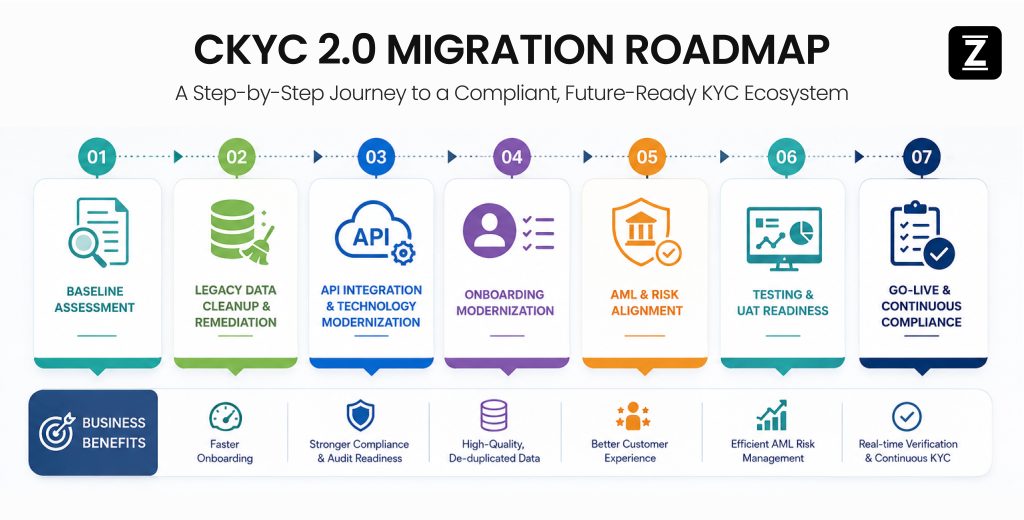
CKYC 2.0 Migration Roadmap for BFSIs
Step 1: Baseline Assessment
Map onboarding flows, integrations, correction workloads, rejection trends, and operational bottlenecks. A thorough planning phase is essential at this stage to outline objectives, design, and risk controls before starting migration, ensuring a robust foundation and minimizing future pitfalls.
Step 2: Define Target Architecture & Governance
Design future-state identity architecture, API integration models, and governance frameworks.
Step 3: Legacy Data Audit & Remediation
Profile customer records, classify issues, and implement structured remediation workflows.
Step 4: Upgrade Data Models & Interfaces
Implement XML/JSON formats, APIs, canonical identity fields, and integration layers.
Step 5: Build Error Handling & Correction Cycles
Create SLA-driven remediation workflows with dashboards and escalation paths.
Step 6: Pilot, Iterate & Scale
Run controlled pilots, measure operational impact, refine workflows, and expand gradually.
Step 7: Stabilization & Continuous Monitoring
Integrate CKYC metrics into enterprise AML and operational dashboards for ongoing optimization.
Common CKYC 2.0 Migration Pitfalls to Avoid
Common migration mistakes include:
• Treating CKYC 2.0 as only a compliance formality
• Delaying legacy data cleanup
• Building fragmented point solutions
• Under-investing in staff training
• Ignoring AML system alignment
• Weak audit trail management
• Neglecting data protection obligations
Institutions that proactively address these risks achieve smoother onboarding, lower rejection rates, and stronger compliance outcomes.
A Practical CKYC 2.0 Readiness Checklist for BFSI Leaders
Governance Readiness
• Steering committee established
• Cross-functional RACI finalized
• Migration roadmap approved
Data Readiness
• Legacy audit completed
• Deduplication workflows operational
• Priority remediation segments identified
Technology Readiness
• APIs tested
• XML/JSON formats validated
• Monitoring and logging enabled
Operational Readiness
• SOPs documented
• Staff trained
• Escalation workflows tested
Compliance Readiness
• AML/KYC policies updated
• Audit trails validated
• Decision criteria documented
Optimization Readiness
• Dashboards operational
• KPIs monitored
• Continuous improvement reviews scheduled
How ZIGRAM Makes CKYC 2.0 Migration Less Disruptive
ZIGRAM’s Complete AML System helps BFSIs simplify CKYC 2.0 migration through automated validation, remediation, monitoring, and compliance orchestration.
Key capabilities include:
• Large-scale KYC data profiling and deduplication
• Automated correction workflows and remediation queues
• Sanctions and name screening through PreScreening.io
• Transaction monitoring alignment through Transact Comply
• Entity risk assessment and verification through Entity Hero
• Audit-ready logging and workflow visibility
By reducing manual intervention and improving customer identity consistency, ZIGRAM enables faster onboarding, lower rejection rates, and stronger AML alignment.
Book a Demo with ZIGRAM to assess your CKYC 2.0 migration readiness.
Frequently Asked Questions (FAQs)
What is CKYC 2.0?
CKYC 2.0 is the upgraded version of India’s Central KYC framework that enables real-time identity verification, API-based validation, and continuous KYC monitoring. The CKYC card serves as a key tool for customer verification and compliance, allowing individuals and institutions to access and utilize KYC details efficiently. CKYC 2.0 is set to go live by the end of February 2026, integrating with DigiLocker for real-time validation, marking a significant milestone in the evolution of KYC processes in India.
How is CKYC 2.0 different from CKYC 1.0?
CKYC 1.0 relied on batch uploads and static document storage, while CKYC 2.0 supports real-time APIs, structured validation, and automated deduplication. CKYC 2.0 also enables real-time screening to detect synthetic and mule identities before account opening, and requires mandatory OTP-based consent for secure data access.
Why is legacy data cleanup important?
Legacy customer records often contain duplicates, outdated documents, and inconsistent identity data that can cause rejection-heavy migrations. CKYC 2.0 lowers operational costs for financial institutions by automating repetitive checks and reducing manual data entry, minimizing the need for remediation exercises.
How does CKYC 2.0 improve AML compliance?
CKYC 2.0 improves customer identity consistency, sanctions screening accuracy, audit readiness, and ongoing due diligence processes. The system allows for faster approvals for cross-border clients and reduces onboarding friction by requiring fewer supporting documents.
What role does RegTech play in CKYC migration?
RegTech platforms automate validation, remediation, monitoring, correction workflows, and audit tracking to reduce manual effort and operational risk. The CKYC registration process allows individuals to access their KYC details and eliminates the need to repeatedly produce physical KYC documents when engaging with different financial institutions.
How do I open a demat account or bank account using CKYC?
To open a demat account, bank account, or invest in mutual funds using CKYC, individuals must submit valid KYC documents—specifically proof of identity and address—to a financial institution regulated by authorities such as RBI, SEBI, IRDAI, or PFRDA. Once registered, the CKYC card and CKYC number streamline the onboarding process, making it faster and more secure for opening accounts and conducting transactions. The system saves time by centralizing KYC records and supporting documents, so users do not need to resubmit paperwork for each new financial service. Submitted documents are stored in the centralized CKYC database and can be accessed securely by different financial institutions as needed. Users can check their CKYC status and KYC status online through self-service portals, ensuring transparency and up-to-date compliance.
Conclusion: Turning CKYC 2.0 into a Strategic Advantage
CKYC 2.0 transforms KYC from a static reporting process into a real-time identity verification framework that supports onboarding efficiency, AML modernization, fraud prevention, and continuous compliance.
Institutions that proactively address legacy data cleanup, governance alignment, API modernization, and operational readiness will gain long-term advantages in customer onboarding, audit readiness, and risk management.
ZIGRAM serves as a long-term RegTech partner helping BFSIs build resilient CKYC and AML foundations through automated validation, remediation, and compliance orchestration.
Organizations that begin preparing early will be better positioned to achieve smoother migrations, lower operational disruption, and stronger regulatory outcomes.