Table of Contents
Introduction: Navigating the CKYC 2.0 Transition
The CKYC 2.0 application-first approach is emerging as the most effective strategy for financial institutions navigating compliance, auditability, and operational efficiency. The transition to CKYC 2.0 marks a pivotal moment for India’s financial sector, introducing a new era of digital KYC modernization as the government seeks to modernize the Central KYC Registry with advanced technologies. This article explicitly examines the two primary approaches to CKYC 2.0 migration, ‘Application-First’ and ‘API-First’, and evaluates their impact on operational efficiency, audit readiness, and regulatory posture. The discussion is tailored for AML compliance leaders, Chief Risk Officers (CROs), and Money Laundering Reporting Officers (MLROs), who are responsible for ensuring seamless compliance and robust risk management in a rapidly evolving regulatory landscape.
Understanding the right approach to CKYC 2.0 migration is critical. The chosen strategy will shape your institution’s ability to meet regulatory expectations, streamline operations, and reduce duplication of KYC processes across financial institutions, maintaining a strong compliance posture for years to come. As regulators push for stronger compliance, auditability, and fraud prevention, financial institutions must rethink how they approach CKYC 2.0 migration to ensure they are not only compliant but also operationally efficient and audit-ready.
What is CKYC 2.0? A Modern AI-Driven Upgrade
CKYC 2.0 is a modernized, AI-driven upgrade to India’s central financial repository. It represents a fundamental re-engineering of the entire KYC ecosystem, designed to address the security blind spots of CKYC 1.0 and prompted by the need for a more secure and transparent KYC process. CKYC 2.0 leverages advanced technologies and new regulatory mandates to transform how financial institutions onboard, verify, and manage customer identities. The transition from PDF records to structured data formats like XML or JSON enhances data validation and anti-fraud measures, making CKYC 2.0 not just a compliance requirement but an investment in institutional risk management.
Background: Why CKYC 2.0 Was Introduced
CKYC, or Central KYC, is India’s centralized repository for storing and managing KYC records of customers across financial institutions. CKYC 2.0 is a modernized, AI-driven upgrade to India’s central financial repository, designed to address the security blind spots of CKYC 1.0 and prompted by the need for a more secure and transparent KYC process. Systemic vulnerabilities in the existing Central KYC framework were highlighted by supervisory reviews and media reports, prompting regulators to initiate reforms and drive the modernization effort. This has led to the development of CKYC 2.0, which aims to enhance security, streamline processes, and better serve financial institutions across India.
Key Features of CKYC 2.0 Explained
CKYC 2.0 introduces several advanced features to enhance security, transparency, and operational efficiency:
AI-Driven Deduplication: CKYC 2.0 uses AI-based Duplicate Detection and Facial Recognition for deduplication, ensuring that each customer is uniquely identified and reducing the risk of duplicate or fraudulent records.
Multi-Layered Matching System: A multi-layered matching system cross-checks PAN, Aadhaar, and facial biometrics, ensuring user identities are verified and helping combat identity fraud.
DigiLocker Integration: CKYC 2.0 will integrate with DigiLocker to enable real-time validation and verification of documents, streamlining the verification process and enhancing data authenticity.
Direct Document Authentication: Documents uploaded by regulated entities can be authenticated directly with document-issuing authorities, ensuring all user documents are verified at the source.
Real-Time Access Alerts: A real-time access alert system notifies users whenever a financial institution accesses or modifies their KYC data, providing transparency and control over their information.
Integrated Grievance Redressal Mechanism: CKYC 2.0 includes an integrated grievance redressal mechanism for dispute management, allowing customers to raise and resolve issues efficiently through a self-service portal.
From CKYC 1.0 to CKYC 2.0: What Has Actually Changed?
CKYC 1.0 relied on PDF format document uploads, manual deduplication, and scanned images stored as static files. Customers had limited visibility into their KYC status, and regulated entities struggled with retrieval bottlenecks and duplicate KYC records. CKYC 2.0 addresses duplication by implementing advanced deduplication measures, reducing redundant verifications across financial institutions and streamlining KYC updates. A key change in CKYC 2.0 is the transition from PDF records to structured data formats such as XML and JSON, representing a significant technical security upgrade for financial institutions.
CKYCRR 2.0 addresses these gaps through:
Feature | CKYC 1.0 | CKYC 2.0 |
|---|---|---|
Data Format | PDF/Scanned Images | Structured XML/JSON |
Deduplication | Manual | AI-driven with facial recognition |
Document Validation | Offline | Real-time DigiLocker integration |
Customer Access | Limited | Self-service portal with grievance redressal |
Consent | Paper-based | OTP-based with alerts |
It eliminates the PDF format to ensure data integrity. The move to machine-readable formats allows for automated, field-level validations, while it implements stricter, deeper field-level validation and standardized data formats. These measures enhance data security, customer trust, and operational efficiency by introducing robust authentication and process improvements. CKYC 2.0 also allows customers to check their CKYC status and details via KRA portals.
These changes transform the central KYC registry from passive document storage into a live, transactional identity system. For AML programs, this means higher-quality KYC data feeding into name screening, transaction monitoring, and entity risk scoring.
Defining ‘Application-First’ vs ‘API-First’ for CKYC 2.0
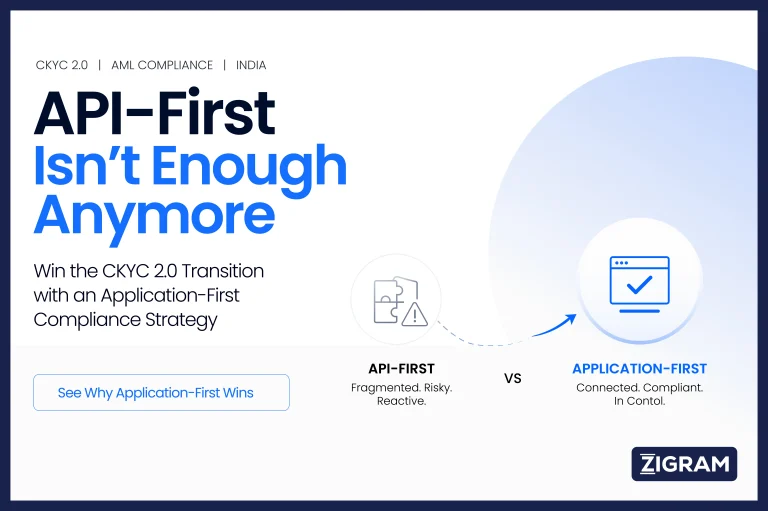
API-First means your institution builds its own front-end around CERSAI/Protean APIs. Vendors provide connectivity and documentation; you handle dashboards, workflows, and control governance.
Application-First means a vendor supplies a complete operational console with role-based dashboards, queues for new/modify/rectify requests, consent widgets, audit logs, and MIS reporting, built atop the APIs with optional hooks to your core systems.
The distinction matters because CKYC operations in a regulated environment require embedded controls:
Maker-checker approvals
Four-eyes principles for high-risk customers
RCU referral workflows
Standardized field validations per CKYCRR specs
An institution can still expose APIs internally while adopting an application-first vendor solution. The difference is what comes first: business UI and controls, or integration endpoints.
Why API-First Alone Falls Short in CKYC 2.0
API-only thinking emerged from developer preferences for “composable” tech stacks. This logic breaks down in regulated CKYC workflows where process evidence matters as much as data.
Practical Gaps of Pure API-First
No unified investigator dashboard across branches
Fragmented consent tracking
Ad-hoc error handling for API repudiations
Difficulty demonstrating compliance to auditors
CERSAI and the Reserve Bank care less about technical connectivity and more about how institutions govern access, monitor usage, and handle mismatches. When AI dedup returns a “possible match” queue, or DigiLocker has timing issues, you need screens, queues, and SOPs—not just endpoint calls.
Building your own application on top of APIs incurs hidden costs: long timelines, IT dependencies, fragmented UX, and inconsistent adherence to regulatory norms.
Risk Blind Spots Created by an API-Only Lens
Treating it as “just an integration project” creates blind spots in access governance. Who pulls which CKYC records, when, and why?
Potential audit findings include:
Absence of unified logs for CKYC views/downloads
No systematic evidence of OTP consent
Incomplete grievance resolution documentation
This undermines enterprise AML. Screening and transaction monitoring engines depend on consistent, timely KYC updates that API-only setups fail to orchestrate reliably. Consider synthetic identity fraud exploiting delays between CKYC updates and core banking, or deepfake-based customer onboarding slipping through without application-level verification controls.
Anatomy of an Application-First CKYC 2.0 Platform
Core Components
A mature application-first solution presents role-based dashboards, queues for pending requests, consent status widgets, and integrated search, all governed by encryption protocols and audit trails.
Onboarding UI
Customers submit their application form and documents at a Point of Sale (POS) location for CKYC processing.
Guided flows for branch staff with tooltips and reason codes
Review Workbench
Documents are scanned, and data is entered into the system after verification in the CKYC process.
Incomplete applications are rejected during the CKYC validation process.
Data validation and document verification are performed by KRA officials during the CKYC process.
Maker-checker approvals with SLA timers
The KYC status is updated, and a CKYC ID is provided to the customer upon completion of the CKYC process.
Consent Module
OTP capture, retry logic, and time-stamped evidence
Enhances customer trust through OTP-based consent notifications before data access.
The CKYC process includes in-person verification by intermediary officials.
Grievance Manager
Customer dispute tracking with resolution workflows
MIS Reporting
Documents are cropped as per requirements before being uploaded to the Central KYC Registry.
Board-ready reports and regulator packs
Regulated entities can search KYC records using the mobile number registered in the CKYC database.
The CKYC process includes a mechanism for reporting, deactivating, and merging duplicate KYC records.
This approach provides transparency across the KYC lifecycle while reducing errors through automation and standardized validations.
Why Application-First Matters for AML & FCC Leaders
Benefits for AML Leaders
An application-first platform enables AML leaders to see the full lifecycle: from document acquisition to CKYC sync, screening hits, periodic updates, and exit decisions. Unified dashboards combine CKYC status, sanctions outcomes, adverse media flags, and transactional risk profiles. It enhances security, fraud prevention, and user experience in digital onboarding. Individuals can access and manage their own KYC records through a dedicated customer portal. Detailed access logs and modern cryptography ensure a transparent audit trail for compliance and allow customers to check their CKYC status and details via KRA portals.
First-Line Controls
For first-line teams (branches, call centers, digital onboarding), guided workflows with built-in checks prevent identity fraud at the point of entry. Pre-configured rules flag mismatched PAN-Aadhaar details or inconsistencies with existing records.
Auditability and Compliance
Strong first-line controls reduce burdens on compliance and internal audit, lowering overall cost while improving auditability. Process evidence, screen-level and decision-level traceability, satisfies RBI inspection requirements far better than API logs alone.
How ZIGRAM Enables CKYC 2.0 Application-First Adoption
ZIGRAM provides a ready-to-deploy console integrated with “The Complete AML System“: PreScreening.io for name screening, Transact Comply for transaction monitoring, and Entity Hero for entity risk assessment.
The platform orchestrates CERSAI/Protean APIs, handles structured data formats, and leverages AI-based identity analytics. Managed services include data quality remediation, periodic KYC refresh campaigns for low-risk customers, backlog clean-ups, and support for regulatory examinations.
CKYC data normalized through ZIGRAM feeds directly into screening, monitoring, and due diligence modules, creating a unified entity view across legal identity, behavioral risk, and reputational signals. This integration supports risk-based KYC for banks, insurance, mutual funds, and other financial sectors.
Conclusion: Building a Future-Proof CKYC 2.0 Architecture
This is a trust upgrade for India’s records infrastructure. Approaching it via application-first delivers tangible benefits over API-only: faster compliance, lower operational risk, and regulator-ready evidence. The next phase of CKYC implementation is expected to roll out by the date set in the regulatory roadmap, with key milestones and enhancements scheduled for completion as per the official timeline.
In 2026’s fraud landscape: deepfakes, synthetic IDs, evolving data misuse threats, resilience depends on orchestrated workflows and controls, not just connectivity. It also employs encryption protocols to secure stored data, significantly enhancing data security.
Ready to transition? Contact ZIGRAM to assess your current CKYC posture, see a live demo of the application-first console, and map a migration plan aligned with RBI/CERSAI milestones.
Frequently Asked Questions (FAQs) on CKYC 2.0
What is CKYC 2.0?
CKYC 2.0 is an AI-driven upgrade to India’s Central KYC Registry that enhances data validation, deduplication, and compliance efficiency.
What is the application-first approach in CKYC 2.0?
It is a compliance-focused model where a complete operational interface is built over APIs to manage workflows, audit logs, and regulatory controls.
Why is application-first better than API-first?
Application-first ensures auditability, structured workflows, and regulatory compliance, which API-first alone cannot guarantee.
Who regulates CKYC 2.0?
CKYC is governed by CERSAI under RBI regulatory oversight.