Table of Contents

What Is Money Laundering Through Litigation?
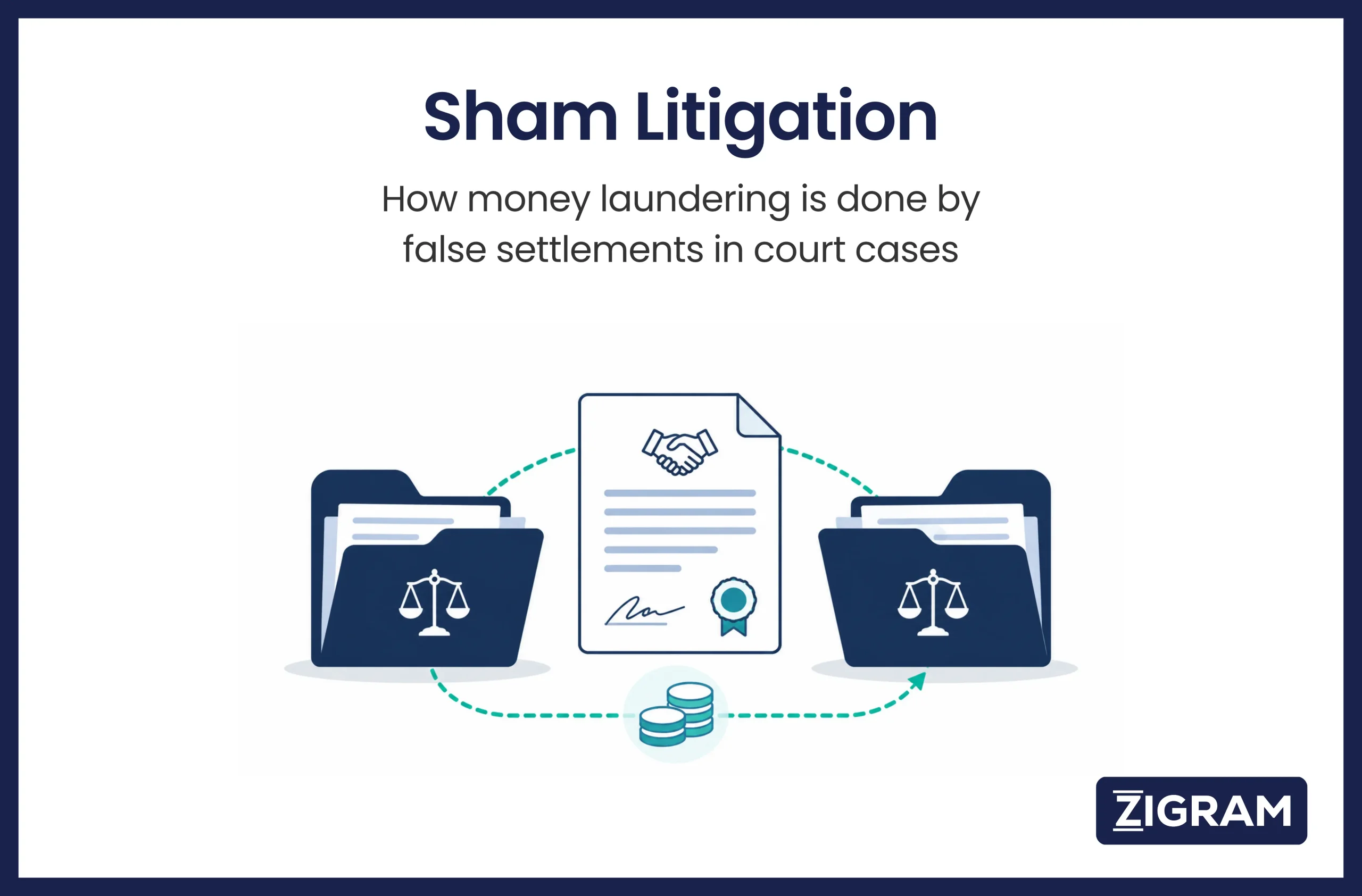
Money laundering through litigation is the misuse of legal disputes, court proceedings, arbitration or settlement arrangements to make illicit funds appear to have a legitimate origin. Illicit actors can exploit litigation vulnerabilities by fabricating disputes, colluding with opposing parties, inflating claims, or manipulating settlement payments to create a legal explanation for moving money.
For AML compliance leaders, legal professionals, banks, payment institutions, and risk and compliance officers in regulated financial services firms, the core task is distinguishing genuine litigation from sham litigation. This article focuses on litigation-related laundering typologies, red flags in legal settlements, practical detection controls, legal professionals’ AML obligations, and how technology can help identify suspicious litigation-linked payments; it does not provide legal advice on conducting the underlying case. A genuine lawsuit or settlement is not inherently suspicious, but the risk rises when the dispute, parties, claimed losses or payment arrangements do not align with the commercial and legal facts or when the process is used to disguise criminal property.
Regulatory bodies recognize sham litigation as a money laundering risk. The UK Solicitors Regulation Authority (SRA) identifies sham litigation as a potential money laundering threat, while Gibraltar’s 2025 legal-sector typology report describes fabricated claims and collusive disputes as mechanisms that can give transfers the appearance of legitimate court-related payments. SRA guidance on sham litigation | Gibraltar FIU Legal Typology Report 2025.
How Can Litigation Be Misused to Launder Money?
Legal proceedings can create formal records, such as pleadings, judgments, settlement agreements and payment instructions, that may make a transfer appear to arise from a legitimate dispute. In a sham arrangement, the legal process is used as a cover rather than to resolve a genuine disagreement.
Common typologies include:
1. Fabricated or sham disputes
Parties may create a false claim based on a fictitious debt, contract or business disagreement. A settlement or judgment can then provide an apparent legal basis for transferring funds.
2. Collusive litigation
Two or more parties may cooperate to create the appearance of an adversarial dispute while privately agreeing on the desired outcome. The proceedings may be designed to generate documentation that supports a transfer between related or cooperating parties.
3. Inflated claims or fabricated losses
A dispute may have a genuine basis, but the claimed damages, debt or losses may be materially exaggerated or partly fictitious. Payments linked to the inflated portion can obscure the true purpose or source of funds.
4. Manipulated settlement payments
Settlement funds may be routed in ways that do not align with the parties or the dispute—for example, through unexplained third-party recipients, unrelated accounts or payment instructions that lack a clear legal or commercial rationale.
5. Misuse of client accounts
A legal professional’s client account may be exploited as a conduit for funds, particularly where the movement of money is not clearly connected to the legal work being performed. The SRA warns against misuse of client accounts and highlights sham litigation as a potential means of disguising criminal property.
AML Red Flags and Warning Signs in Litigation and Settlement Activity
No single indicator proves money laundering. Compliance teams should assess the full context, including the parties, dispute history, verifying client identities, the source of a transaction or settlement funds, payment path and expected activity.
Potential warning signs include:
-
Unclear commercial rationale: The dispute appears to lack a credible business, contractual or personal basis.
-
Unusual party relationships: Claimants, defendants, beneficial owners or payment recipients have undisclosed connections.
-
Inconsistent documentation: Invoices, contracts, pleadings, settlement terms and payment details do not tell a consistent story.
-
Unexplained third-party payments: Funds are directed to parties that are not clearly connected to the claim or settlement.
-
Unusual urgency: A party pressures professionals to settle or release funds quickly without a convincing reason.
-
Unexpected payment instructions: Settlement proceeds are requested to be sent to an account or jurisdiction unrelated to the parties or matter.
-
Disproportionate settlement value: The amount paid appears inconsistent with the evidence, claim value or circumstances.
-
Unusual client behaviour: A client shows unexplained familiarity with internal processes, provides information about the opposing party that would not ordinarily be expected, or avoids reasonable questions from professionals or questions put to clients during review.
-
Geographic or ownership complexity: The parties, beneficial owners, accounts and legal advisers are spread across jurisdictions without a clear explanation.
The SRA’s guidance highlights unusual client information, payment preferences, third-party transfers and settlement urgency as matters that may warrant scrutiny. New Zealand’s AML/CFT guidance also identifies rapid settlement and requests for quick onward payment as potential indicators. These are risk indicators, not automatic grounds to reject a claim or presume criminality.
Why This Typology Matters for AML Compliance Leaders
Litigation-related laundering can challenge traditional monitoring because the payment may be described as damages, compensation, debt repayment or settlement proceeds. A transaction’s legal label does not, by itself, establish that the underlying funds are legitimate.
For banks, payment institutions and other financial entities, the challenge is to connect payment activity with the customer’s profile and available context. A settlement payment may be expected for a business, but an unexplained recipient, unusual routing or a material mismatch with the customer’s known activity may require further review.
For legal-sector professionals, the risk includes being drawn into arrangements that create a paper trail for funds without a genuine legal purpose. The FATF’s risk-based guidance for legal professionals emphasises assessing money laundering risks and applying proportionate customer due diligence, including understanding beneficial ownership where relevant. FATF: Risk-Based Approach for Legal Professionals.
Practical Controls to Detect Litigation-Related Money Laundering
1. Understand the parties and beneficial ownership
Establish who the clients, counterparties and relevant payment recipients are. Where risk warrants, identify beneficial owners and examine whether parties have undisclosed relationships. Identity checks are a core safeguard, and refusals or evasive answers may justify enhanced scrutiny.
2. Validate the purpose and context of the dispute
Review available contracts, invoices, correspondence, claim details and settlement terms for consistency, and test whether the matter fits your knowledge of the client and the wider business context. The objective is not to second-guess legitimate legal outcomes, but to identify material gaps or contradictions that require explanation. Sudden changes in instructions or explanations that do not fit what was previously understood about the matter are warning signs that merit further enquiry.
3. Scrutinise payment instructions
Compare the payer, recipient, account details, amount, payment route, and source of funds with the documented settlement. Large amounts of cash, cash deposits, or settlement funding that cannot be clearly traced through a bank account may require deeper review. Escalate unexplained third-party payments, unexpected jurisdictions, instructions that do not align with the matter, or cases where a bank statement or account record does not adequately explain the origin of the funds involved.
4. Apply risk-based transaction monitoring
Monitoring scenarios can consider unusual settlement-related payments, deviations from customer behaviour, unexpected counterparties and activity inconsistent with the stated purpose of the account. Alerts should be reviewed with relevant customer and transaction context rather than relying on amount thresholds alone.
5. Maintain clear investigation records
Document the rationale for decisions, the information reviewed, explanations obtained and any escalation. Where suspicion arises, teams should record client explanations, supporting evidence and any follow-up enquiries before deciding whether suspicion should be reported, then follow applicable internal procedures and jurisdiction-specific reporting obligations for any relevant conduct.
6. Train relevant teams
Legal, operations, onboarding, payments and AML teams should understand how sham litigation may present in practice and how to escalate concerns. This is good practice for law firms and other teams that may encounter litigation-linked payments, while still applying a risk-based approach. The SRA recommends appropriate awareness and risk-management measures, while FATF guidance supports a risk-based approach tailored to the professional’s exposure.
How Technology Can Support Detection
Technology can help compliance teams connect screening, customer risk, payment activity, and investigation workflows, but it cannot determine whether a legal dispute is genuine without appropriate context and human review.
ZIGRAM’s solutions can support different parts of this process:
-
PreScreening.io supports screening of individuals and entities against relevant watchlists and risk information.
-
Transact Comply supports transaction monitoring, configurable scenarios, risk scoring and investigation workflows.
-
Entity Hero supports customer and entity risk assessment.
-
DueDiliger provides due diligence intelligence that can help analysts investigate entities and potential risk indicators.
These capabilities can help identify inconsistencies, prioritise alerts and build a more complete view of parties and transactions. They should be used as part of a risk-based AML framework, not as a substitute for legal analysis or investigative judgment.
Frequently Asked Questions
Is every litigation settlement a money laundering risk?
No. Litigation and settlements are legitimate mechanisms for resolving disputes. Risk depends on the facts, parties, purpose, documentation and payment arrangements.
What is sham litigation?
Sham litigation is a fabricated or deliberately manipulated legal dispute used for a purpose other than genuinely resolving a dispute—potentially including disguising the movement or origin of criminal property.
What are the main red flags in settlement payments?
Examples include unexplained third-party recipients, unusual payment routes, urgency without a clear reason, inconsistent documentation and settlement amounts that do not align with the known circumstances.
Are legal professionals automatically subject to the same AML obligations in every jurisdiction?
No. Obligations vary by jurisdiction, professional role and activity. For example, the SRA explains that the scope of UK AML regulations differs from obligations under the Proceeds of Crime Act. Some lawyers and law firms may face broader AML expectations when particular services or transaction types create higher risk, so obligations should be read in context rather than to the letter. Professionals should follow applicable local law, regulatory guidance and internal procedures.
Conclusion and Next Steps
Money laundering through litigation exploits the credibility of legal processes to create legitimate-looking forms of payment or settlement documentation that conceal illicit funds. In practice, this can involve two parties colluding, or one company using a fabricated claim, to move money under court-approved or negotiated cover, but inconsistencies in the parties, evidence, payment instructions or commercial rationale may reveal the risk.
For AML leaders, the priority is a contextual, risk-based approach: understand the parties, examine the purpose of the dispute, scrutinise settlement payments, connect transaction activity with customer risk and escalate concerns through the appropriate channels. Legal proceedings should not be treated as suspicious by default; the objective is to identify when the process itself may be misused to conceal illicit funds.