Table of Contents

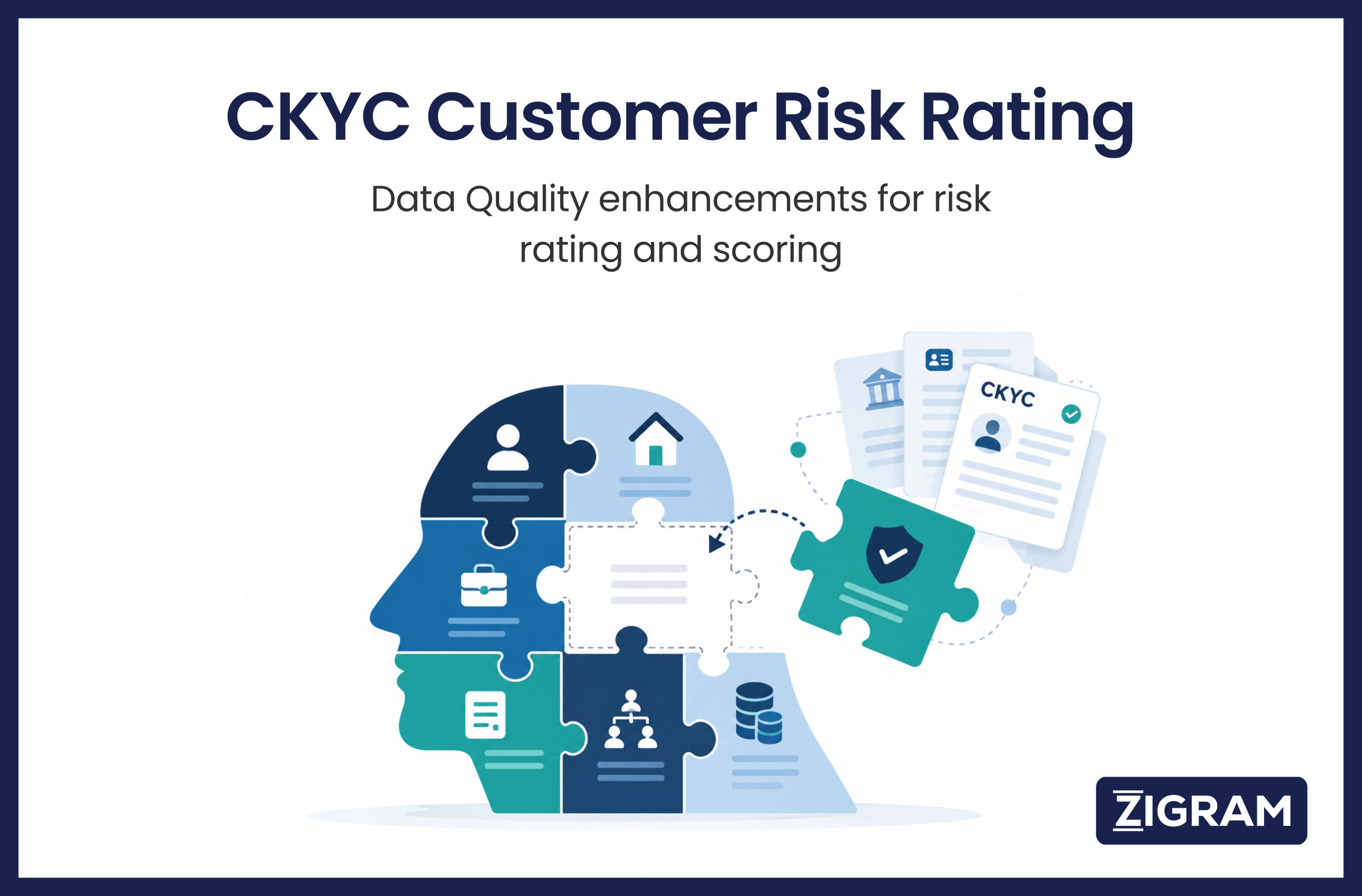
CKYC data quality is a critical foundation for reliable customer risk rating in financial institutions. When onboarding records are incomplete, inconsistent or outdated, institutions may misunderstand a customer’s identity, business activity, ownership structure or expected behaviour. These gaps can weaken customer due diligence (CDD), distort risk classification and make ongoing AML monitoring less effective.
For AML compliance leaders, the key question is whether retrieved CKYC information is accurate, relevant, and complete enough to support the institution’s assessment. CKYC can provide a shared KYC data foundation; it does not assign a customer’s AML risk rating or replace institution-specific due diligence.
Better onboarding data gives compliance teams a stronger starting point, but the institution must interpret it in context and keep the profile current.
Why customer risk rating depends on better KYC data
A customer risk rating is an institution’s assessment of the money laundering and terrorist financing exposure associated with a customer relationship. It is one component of a wider anti-money laundering (AML) programme and helps determine the nature and intensity of CDD, whether enhanced due diligence (EDD) is appropriate, and how the relationship should be monitored. The methodology, factors and thresholds should reflect the institution’s business model, customer base, products, delivery channels and risk appetite. It should also be proportionate: higher-risk relationships may call for EDD and closer ongoing monitoring, while lower-risk relationships may receive standard customer due diligence and periodic reviews in line with the institution’s policy and applicable requirements.
The RBI’s Master Direction on Know Your Customer (KYC) provides for customer risk categorisation and ongoing due diligence by regulated entities. The FATF Recommendations also establish an international framework for applying risk-based customer due diligence.
Neither framework makes a central KYC record a substitute for the institution’s own judgement. A record can confirm that information has been submitted to the CKYCRR, but it does not necessarily tell the institution whether a customer’s activity, source of funds, ownership or transaction pattern is consistent with the proposed relationship. Financial institutions still need to conduct ongoing customer due diligence, assess money laundering and terrorist financing risks, and document how the information informs the customer risk profile.
Four data qualities matter particularly:
Accuracy: names, identifiers, dates, addresses and entity details should match reliable evidence.
Completeness: information relevant to the customer’s type and risk profile should not be missing.
Consistency: the same customer should not appear as conflicting or fragmented profiles across systems.
Currency: information should be reviewed and updated when it changes or becomes stale.
CERSAI’s CKYCRR access best-practice circular reiterates correct uploads, updates after due diligence, liveness checks and consent capture. These controls support data quality; they do not calculate risk.
How poor onboarding data creates blind spots
Weak data can affect customer risk assessment in several ways.
Incomplete profiles can hide relevant context. If occupation, nature of business, expected account activity or ownership information is missing, a reviewer may not have enough information to judge whether the proposed relationship makes sense. A company registration record, for example, will not by itself explain the company’s expected turnover, main counterparties or source of funds.
Inconsistent identifiers can fragment the customer view. Variations in names, addresses or identification details can create duplicate records or complicate screening. A mismatch should be investigated and resolved; it should not automatically be treated as evidence of wrongdoing.
Outdated information can make a once-reasonable rating unreliable. A change in address, employment, business activity or ownership may alter the customer’s risk context. If the institution continues to rely on the old profile, monitoring may be calibrated against assumptions that are no longer valid.
Identity verification can be mistaken for risk assessment. A successfully retrieved CKYC record does not establish that the customer is low risk. Identity checks answer who the customer is; customer risk assessment considers the risks of entering into and maintaining the relationship.
This is also why data remediation matters. Understanding common CKYC rejection reasons and CKYCRR errors helps teams address avoidable gaps at source. Stronger validation can also make it harder for inconsistent or fabricated identity details to pass unnoticed, although no single repository or check can eliminate synthetic identity fraud in financial onboarding.
What information should inform a customer risk rating?
The factors used depend on customer type and the institution’s methodology; a sound assessment considers them together.
The following dimensions are commonly relevant:
Customer identity and type: verified identity, legal form, customer category and identification status.
Occupation and business: employment, industry, nature of business and purpose of the relationship.
Financial profile: expected activity, source of funds and, where relevant, source of wealth.
Geography: residence, operating locations, counterparties and relevant jurisdictional exposure.
Ownership and control: beneficial owners, controllers, signatories and ownership complexity.
Screening information: relevant sanctions, PEP and adverse media results.
Products and channels: services requested, delivery method and how the relationship will be used.
Activity over time: actual transactions and deviations from the expected customer profile.
For individuals, occupation, income context, residence and intended account use may matter. For legal entities, assess the business model, directors, beneficial owners and control structure. CKYC contributes KYC details; supplementary information comes from onboarding, reliable external sources and customer activity.
A PEP match, adverse media result or higher-risk geographic connection should be assessed in context and under the institution’s policies. These are risk indicators for review, not automatic proof of criminal activity. Sector and occupation can also matter: some business activities may present greater exposure to money laundering typologies, but the sector alone should not determine the rating. Likewise, no universal set of weights should be presented as mandatory: scoring models and qualitative assessments must be calibrated and governed by each institution. A risk scoring matrix can help make the factors and rationale transparent, provided it is tested and reviewed rather than treated as an unquestionable automated decision.
How CKYC 2.0 can strengthen the data foundation
The evolution of CKYC 2.0 and real-time KYC verification in India makes the quality and usability of shared customer information an important operational consideration. More structured records and improved digital exchange can help institutions retrieve, validate and reuse KYC information with less repeated data entry.
That can support customer onboarding controls in three ways:
More consistent capture: standardised fields can reduce avoidable variation between records and channels.
Earlier exception detection: validation checks can identify missing, contradictory or incorrectly formatted information before it flows into downstream processes.
A clearer update path: changes to customer information can be reconciled with internal records and considered during review.
CKYC 2.0 should not be described as an AML risk engine. It does not independently assess source of funds, determine beneficial ownership risk, conduct the institution’s full screening, or assign a risk category. These remain part of the regulated entity’s own CDD and risk management framework.
For implementation context, see the update on CKYCRR 1.0 reporting requirements and the guide to choosing AML software for the CKYC 2.0 era.
Customer risk assessment must continue after onboarding
A risk rating is not a one-time label. The customer relationship can change, and new information can make the original assessment incomplete.
Institutions should combine scheduled reviews with event-driven reassessment. A review may be prompted by a change in beneficial ownership, a new line of business, a material geographic change, a relevant screening result, adverse media or transactions that differ significantly from the expected profile. These triggers help keep ongoing monitoring aligned with the latest customer information instead of relying on a static onboarding snapshot.
Ongoing monitoring provides an important feedback loop. The RBI KYC Direction expects regulated entities to undertake ongoing due diligence so that transactions remain consistent with their knowledge of the customer, the customer’s business and risk profile, and the source of funds or wealth. Effective ongoing monitoring combines automated monitoring rules and analyst review: systems can surface unusual patterns, while compliance teams assess alerts against the customer’s expected activity, historical patterns and wider context.
An unusual transaction or monitoring alert does not by itself prove illicit activity; it should be investigated. Where the review establishes suspicion, institutions should report suspicious transactions in accordance with applicable reporting requirements. This ongoing monitoring process helps financial institutions respond to changing money laundering risks without treating every alert as confirmed suspicious behaviour.
The outcome may be no change, updated information, additional CDD or EDD, or a revised risk rating. Recording the evidence and rationale makes the process explainable and auditable. The same record helps compliance teams show what was known at customer onboarding, which risk factors mattered and why controls changed.
Turning better customer data into better AML decisions
Compliance leaders can make the data-to-risk link more reliable by taking a practical, repeatable approach:
Map data to risk factors. Document which onboarding and CKYC fields support each part of the institution’s customer risk methodology, and identify where supplementary information is needed.
Set validation rules. Check mandatory fields, formats, duplicates, cross-field consistency and document validity before information is used downstream.
Manage exceptions. Route gaps and contradictions for remediation, with an owner, evidence trail and clear closure criteria.
Document the methodology. Maintain defined risk factors, thresholds, rationale codes, review triggers and controls for authorised overrides.
Connect lifecycle signals. Make relevant screening, customer updates and transaction monitoring outcomes available for periodic and event-driven reviews.
Test the process. Track unresolved data exceptions, repeat mismatches, manual overrides and rating changes to identify weaknesses in data capture and the assessment model. Keep documentation of model changes and review outcomes for audit and regulatory scrutiny.
Technology can support parts of this workflow, but it should be selected according to the control gap. For example, Entity Hero can be considered in the context of entity intelligence and a more informed view of business relationships. Fraud Fighter is relevant to the separate but connected task of identifying fraud indicators. At a broader level, the Complete FRAML System reflects the value of connecting fraud and AML capabilities across a financial crime programme. These capabilities complement—not replace—an institution’s policies, evidence review and accountable compliance decisions.
Frequently asked questions
Does CKYC assign a customer risk rating?
No. CKYC is a centralised repository for KYC records. Each regulated entity remains responsible for assessing the customer relationship using its own CDD process, risk methodology and relevant information.
How does KYC data quality affect customer risk assessment?
Incomplete, inaccurate, inconsistent or outdated information can distort a customer’s profile and obscure relevant risk indicators. Reliable data gives compliance teams a stronger basis for classification, due diligence and subsequent review.
What factors influence customer risk rating in AML?
Common factors include customer type, identity, occupation or business activity, geography, products and delivery channels, expected activity, ownership and control, screening results, and actual transaction behaviour. Their relevance and treatment depend on the institution’s documented methodology.
Should a customer risk rating change after onboarding?
It may. Material changes to ownership, business activity, geography, screening information or transaction behaviour can justify reassessment. Institutions should combine periodic reviews with event-driven triggers.
Does better CKYC data mean a customer is lower risk?
No. Better data does not necessarily reduce risk. It improves the institution’s ability to identify and understand risk—including risk that incomplete information might otherwise conceal.
Conclusion
Customer risk rating starts with the quality of the information collected at onboarding, but it does not end there. CKYC can provide a useful shared data foundation; regulated entities must validate and supplement that information, apply their own risk-based methodology and revisit the customer profile as circumstances change. Better data does not guarantee a lower rating. It supports a more informed, explainable and defensible decision.