Table of Contents

Banking fraud does not always begin with a stolen card or compromised password.
A customer can be manipulated into making a payment. A legitimate account can be taken over. A synthetic identity can be used to enter the financial system. And funds from one fraud event can quickly move through a network of mule accounts.
As banking becomes more digital, the methods used to commit fraud are becoming more varied and increasingly connected. Recent fraud research from TransUnion also points to growing risk across existing customer relationships, showing why banks need to look beyond onboarding alone when assessing fraud exposure.
Understanding the different types of banking fraud helps financial institutions recognise where risk can emerge, what signals matter, and where conventional controls may fall short.
What Is Banking Fraud?
Banking fraud refers to deceptive or unauthorised activity involving a bank, its customers, accounts, payments or financial services for financial gain. It can involve external fraudsters, legitimate customers, organised networks or even insiders.
The fraud may begin during onboarding, account access, lending, payments or everyday account activity. In many cases, one type of fraud can also lead to another.
For example, stolen credentials may result in an account takeover, followed by an unauthorised payment that eventually reaches a mule account.
Common Types of Banking Fraud
1. Account Takeover Fraud
Account takeover occurs when a fraudster gains control of a legitimate customer’s account. This may happen through phishing scams that trick users into revealing sensitive information, direct victims to fake online banking pages, and steal login credentials, online banking credentials, or other login credentials through social engineering or malware.
Once access is gained, fraudsters can gain unauthorised access to bank accounts, change account information, add beneficiaries, or transfer money once they take over the account.
Two-factor authentication helps reduce unauthorised access, but SIM-related attacks can still target financial accounts.
The difficulty for banks is that the account itself remains genuine. The risk lies in identifying that the behaviour behind it has changed.
2. Payment Fraud
Payment fraud involves fraudulent transactions across cards, bank transfers, wires, instant payments and other payment channels.
It may involve transactions initiated without the customer’s permission or payments made by customers who have been deceived. Unusual transaction amounts, payment velocity, new beneficiaries and unexpected destinations can all provide useful fraud signals.
The Federal Reserve’s 2026 Risk Officer Report also found rising fraud challenges across major payment channels, including debit cards, wires, ACH and account takeover.
3. Authorised Push Payment Fraud
In authorised push payment fraud, the customer themselves approves the transaction after being manipulated by a fraudster.
The fraudster may impersonate a bank employee, supplier, executive, investment adviser or another trusted person. Vishing involves phone calls from supposed bank representatives seeking confidential information. Fraudsters may cite a bank account number or other financial information to make the request seem credible. Because the transaction is genuinely authorised, authentication alone may not identify the fraud.
Banks therefore need to consider the wider context around the payment, including beneficiary risk, transaction behaviour and changes from the customer’s normal activity. Customers should immediately report suspected APP fraud or suspicious payment requests to help minimise losses and improve the chance of recovering funds.
4. Mule Account Fraud
Mule accounts are used to receive, move or withdraw proceeds from fraud, and they are also commonly used in money laundering. Some account holders knowingly participate, while others may be recruited without fully understanding how their account will be used.
The aim is often to make illegally obtained money appear legitimate as it moves between accounts.
Common indicators can include multiple incoming payments from unrelated accounts, rapid movement of funds, sudden changes in account activity and links to other suspicious accounts or beneficiaries. Rapid movement through multiple bank accounts can also signal broader fraudulent activities, not just an isolated case.
Mule activity is particularly important because it can connect an individual fraud event to a much wider network.
5. First-Party Fraud
First-party fraud is committed by a legitimate customer using their own identity. It can include deliberately providing false information, abusing credit facilities, making dishonest transaction disputes or obtaining financial products without an intention to meet the associated obligations.
This type of banking fraud can be difficult to identify because identity verification may show nothing unusual. The risk often becomes visible through changes in behaviour over time.
6. Synthetic Identity Fraud
Synthetic identity fraud involves combining genuine and fabricated information to create an identity that does not fully exist, and it can overlap with identity theft when criminals blend real personal details with invented ones. Fraudsters may use these identities to open accounts, obtain credit or loans, make unauthorized purchases or transfers, or set up false accounts before later abuse. Creating false accounts can help criminals build credibility before larger fraud occurs.
Because the identity can appear credible across individual checks, banks may need to examine connections between identity information, devices, accounts and behaviour.
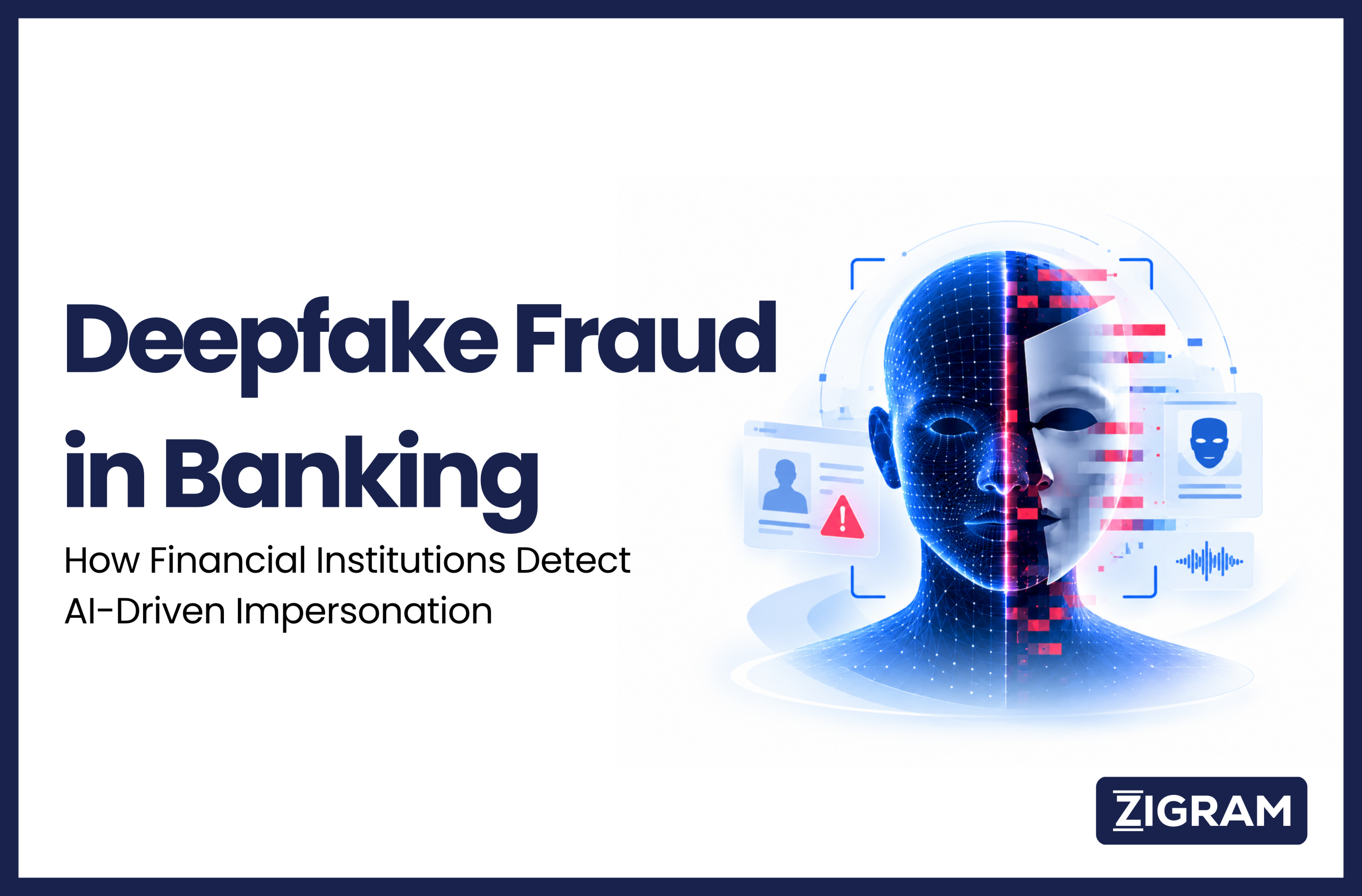
7. Deepfake and Impersonation Fraud
AI-generated voices, images and videos are making impersonation fraud more convincing. Fraudsters can imitate customers, executives or other trusted individuals to support payment requests, account changes or other fraudulent instructions. Smishing involves fake SMS messages containing malicious links or prompts that support impersonation and help criminals gain access to accounts or payment approvals.
Even when the synthetic media itself is difficult to identify, the financial activity that follows may still create detectable signals. Before that activity occurs, fraudsters may also use fake websites or instructions shared through social media platforms to mislead unsuspecting victims.
A new beneficiary, unusual payment value or sudden behavioural change can provide additional context.
For a deeper look at how these attacks work and how financial institutions can detect them, read ZIGRAM’s latest article on deepfake fraud in banking.
8. Lending and Application Fraud
Application fraud can occur when false, stolen or manipulated information is used to obtain a loan or another financial product. It may involve fabricated income information, false documentation, identity misuse or synthetic identities.
For banks and lenders, the risk does not necessarily disappear once an application is approved. Unusual utilisation, repayment behaviour and movement of disbursed funds can reveal fraud later in the customer lifecycle.
9. Insider Fraud
Insider fraud occurs when employees, contractors, bank employees or other individuals with legitimate access misuse their position for financial gain. This can include unauthorised transactions, manipulating account records, misuse of credentials or collusion with external fraudsters, especially where changes to account records help conceal abuse. Insider fraud can also support schemes such as cheque kiting, which exploits the time gap between cheque issue and clearing, or help conceal ATM fraud involving counterfeit devices.
Because the user may already have authorised access, unusual activity and deviations from expected behaviour become particularly important. Insiders may also help create or hide false accounts for personal gain, making those behavioural signals easier to miss.
Why Is Banking Fraud Becoming Harder to Detect?
The biggest challenge is that modern banking fraud rarely depends on one suspicious event. Banks therefore need both detect fraud capabilities and fraud prevention controls, because the two approaches work together.
A login may be legitimate. A customer may genuinely authorise a payment. An account may have passed onboarding checks. A transaction may remain below a predefined threshold.
Yet the combination of those events can still indicate fraud.
Financial institutions also operate across multiple channels, systems and products. When identity, device, payment, beneficiary and behavioural information are assessed separately, important relationships between events can be missed. This is why companies increasingly need scalable, AI-powered tools for transaction monitoring and regulatory compliance that can detect suspicious activities in real time across digital and mobile channels.
Fraud is also becoming faster. With instant payments and digital banking, the time available to identify suspicious activities before funds move further can be very limited. Mobile banking fraud losses increased by 33% in 2023, which makes response speed even more important. Missed cases can lead to financial loss, regulatory scrutiny, loss of customer trust, and weaker competitive standing. Stronger due diligence and entity risk assessment also support better regulatory and compliance outcomes.
How Can Financial Institutions Strengthen Banking Fraud Detection?
There is no single control that can address every type of bank fraud.
A stronger approach combines fraud detection with fraud prevention across the customer and transaction journey.
Implementing security measures such as strong encryption and two-factor authentication helps prevent fraud, and banks must implement strong encryption to protect customer data while two-factor authentication reduces unauthorized access to accounts.
Financial institutions can focus on:
Behavioural monitoring: identifying activity that differs from normal customer behaviour.
Transaction monitoring: assessing value, velocity, timing and payment patterns.
Beneficiary analysis: understanding who is receiving funds and whether that recipient introduces additional risk.
Device and access signals: detecting unusual access to online accounts or attempts to reach sensitive information, as well as changes in the way an account is being used.
Entity relationships: identifying links between customers, accounts, beneficiaries and previously suspicious entities.
Real-time risk assessment: evaluating combinations of signals early enough to support intervention.
For customer-facing controls, regularly reviewing bank statements and avoiding suspicious requests can help detect suspicious activity earlier and prevent banking fraud.
The goal is not simply to generate more alerts.
It is to understand the context around an activity and determine when several apparently normal events begin to form a suspicious pattern, with security measures and internal controls helping protect the financial institution’s funds as well as customer accounts.
How ZIGRAM Helps Financial Institutions Monitor Banking Fraud
Different types of banking fraud may begin in different ways, but they often create connected signals across customers, transactions, accounts and entities, and connected monitoring helps identify suspicious activities across customers, financial transactions, and entities.
ZIGRAM’s Fraud Fighter supports Fraud Monitoring & Detection through real-time fraud monitoring, intelligent risk rating and behaviour analytics, with support for fraud prevention as well as monitoring and detection.
This helps financial institutions assess suspicious activity with greater context and identify changes in behaviour and transaction patterns as risk develops.
Where fraud also involves mule networks, suspicious fund movement or wider financial crime risks, ZIGRAM’s Complete FRAML System connects fraud monitoring with the broader financial crime risk landscape and supports regulatory compliance.
Conclusion
Banking fraud is no longer limited to a single channel, customer or transaction. Account takeover, payment fraud, scams, mule accounts, synthetic identities, deepfakes and first-party fraud can all appear at different stages of the same financial journey.
For financial institutions, understanding the different types of banking fraud is therefore only the beginning. The stronger defence comes from connecting behaviour, transactions, beneficiaries, devices and entities to understand when seemingly ordinary activity starts to indicate something more.
Explore the Wider Fraud Landscape:
Fraud Detection in Banking: https://www.zigram.tech/article/fraud-detection-in-banking
First Party Fraud Detection in Banking: https://www.zigram.tech/article/first-party-fraud-detection-in-banking
Behavioral Biometrics for Fraud Prevention: https://www.zigram.tech/article/behavioral-biometrics-fraud-prevention