Table of Contents

Singapore AML laws are designed for a high-trust economy: money moves fast, cross-border business is common, and regulated firms are expected to detect risk before it becomes enforcement exposure. These laws play a crucial role in maintaining Singapore’s status as a trusted international financial centre.
For banks, fintechs, crypto platforms, insurers, corporate service providers, and other gatekeepers, the message is clear. Singapore’s anti money laundering framework is not just a legal checklist. It is a practical operating model for protecting the financial system from money laundering, terrorism financing, proliferation financing, drug trafficking proceeds, and other financial crimes, and reinforces Singapore’s reputation as a reliable and secure business hub.
Overview of Singapore’s Anti-Money Laundering (AML) Regime
In practice, financial institutions and gatekeepers face heavy compliance obligations under Singapore’s AML framework and countering terrorism financing (CTF) measures as part of broader regulatory compliance standards enforced by authorities such as the Monetary Authority of Singapore and the Ministry of Law. They must identify customers, verify beneficial owners, monitor transactions, screen against sanctions and adverse media, keep records, and file reports when a suspicious transaction appears.
Regulatory & Institutional Landscape
Singapore’s AML/CFT/PF regime is supervised by several regulatory authorities, with MAS at the centre for the financial sector and other agencies supervising designated non-financial businesses and professions.
Key institutions include:
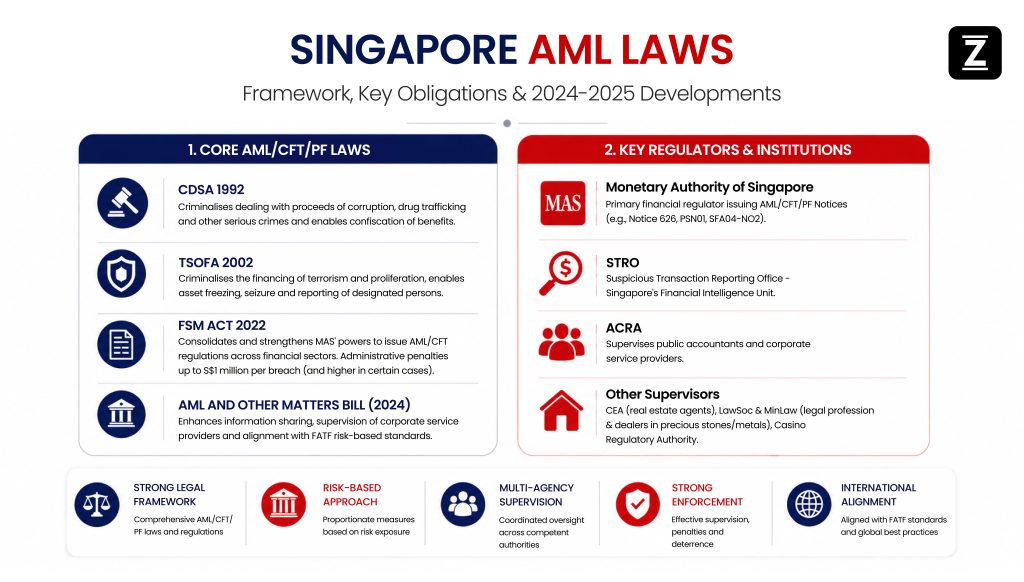
The Monetary Authority of Singapore, or MAS, is the integrated financial regulator and central bank. The Monetary Authority of Singapore (MAS) is the primary authority responsible for regulating anti-money laundering (AML) and countering the financing of terrorism (CFT) in Singapore, ensuring the integrity of the financial system.
MAS issues various legally binding instruments, including acts, regulations, and notices, to enforce compliance with AML and CFT regulations while also providing guidelines that are not legally binding but serve as best practice recommendations. Examples include MAS Notice 626 for banks, PSN01 for payment services, and SFA04-N02 for capital markets intermediaries.
The suspicious transaction reporting office, STRO, is Singapore’s financial intelligence unit. It sits within the commercial affairs department of the singapore police force and receives STRs from private sector entities and law enforcement agencies.
The corporate regulatory authority, ACRA, supervises public accountants and corporate service providers. The Council for Estate Agencies supervises real estate agents. The law society and Ministry of Law oversee the legal profession, law practice rules, legal professionals, and precious stones and metals dealers.
Singapore’s National Anti-Money Laundering Strategy and National Strategy for Countering the Financing of Terrorism guide prevention, detection, enforcement, and international cooperation. The National Anti-Money Laundering Strategy published in October 2024, outlines Singapore’s approach to addressing money laundering risks, focusing on prevention, detection, enforcement, and international cooperation.
Penalties Under Singapore AML Laws
Non-compliance with AML regulations in Singapore can result in significant penalties, including fines of up to S$1 million, approximately US$774,000, per offense for financial institutions that fail to adhere to the Monetary Authority of Singapore’s (MAS) AML policies. The FSM Act also allows civil penalties, directions, licence revocation, and prohibition orders against firms or individuals.
The Corruption, Drug Trafficking, and Other Serious Crimes Act 1992 (CDSA) imposes penalties for those convicted of money laundering activities, including monetary fines and potential imprisonment. This includes offences connected to corruption, drug trafficking, drug dealing, criminal conduct, and other serious crimes.
Enforcement is not theoretical. In May 2024, the Monetary Authority of Singapore (MAS) imposed a penalty of S$2.5 million on a wealth and fund management company for failing to conduct necessary risk assessments and report suspicious transactions, highlighting the serious consequences of non-compliance.
Core AML / CFT / PF Laws and National Strategies
Singapore’s framework is built around statutes that criminalise financial crimes and strategies that tell firms where risk is moving. For compliance teams, the point is not only to know the law, but to translate it into controls, alerts, escalation paths, and evidence.
The CDSA 1992 is the primary anti money laundering law. It criminalises dealing with benefits from corruption, drug trafficking, and other serious crimes, enables confiscation of benefits, and can apply to individuals and corporations. It also has extraterritorial reach where overseas conduct corresponds to serious offences under Singapore law. Compliance teams sometimes refer to the CDSA informally as the Other Serious Crimes Act because of its wide coverage.
TSOFA 2002 is Singapore’s key terrorist financing law. The Terrorism (Suppression of Financing) Act (TSOFA) criminalizes the provision of funds or financial services to terrorists and designated terrorist entities. It also supports asset freezing, seizure, reporting of designated persons, and controls relating to terrorism financing offences and the financing of terrorism.
The FSM Act strengthens MAS powers across financial institutions and other financial institutions. It supports AML/CFT rules, information sharing, enforcement, and administrative penalties. The Act also helps Singapore meet United Nations obligations, including targeted financial sanctions and controls linked to weapons of mass destruction.
In response to international sanctions, MAS has implemented regulations that prohibit financial institutions from providing services to designated entities, particularly following geopolitical events such as the Russian invasion of Ukraine. Sanctions screening is therefore a critical component of the anti-money laundering (AML) compliance framework, requiring financial institutions to check customers against international sanctions lists to prevent facilitating transactions for individuals or entities involved in illicit activities.
In November 2024, Singapore enacted the Anti-Money Laundering and Other Matters Act, which enhances law enforcement capabilities to prosecute money laundering offenses and aligns the AML/CFT framework for casino operators with Financial Action Task Force (FATF) standards. The financial action task force risk-based standards remain an important benchmark for Singapore’s national aml strategy.
Singapore’s National Anti-Money Laundering Strategy, updated in 2024, emphasizes a risk-based approach to combat money laundering, focusing on prevention, detection, and enforcement while adapting to rapidly changing risks and criminal typologies. The Proliferation Financing National Risk Assessment, Environmental Crime Money Laundering NRA, and Terrorism Financing NRA help relevant authorities decide where enhanced controls are needed.
Who Must Comply: Sectors and Activities in Scope
Obligations vary by licence and sector, but the risk based approach applies broadly across regulated entities.
Financial institutions in scope include the following:
Banks, merchant banks, finance companies, and capital markets intermediaries
Life insurers, financial advisers, and other financial institutions
Licensed payment service providers, including digital payment tokens and crypto service providers
Money changers and remittance agents
Businesses providing payment services or cross-border value transfer
Designated non-financial businesses and professions also have AML obligations. These include corporate service providers; registered filing agents; company secretaries; law practices; public accountants; estate agents; precious stones and precious metals dealers; and casinos, which are specifically regulated to prevent money laundering through compliance with AML and CTF requirements.
Even unregulated businesses can face duties under CDSA and TSOFA. They must avoid dealing with criminal proceeds and file suspicious transaction reports when appropriate. Cross-Border Cash Reports mandate submission when individuals move physical currency or bearer instruments exceeding S$20,000 across Singapore’s borders.
Higher-risk sectors identified in proliferation financing work include banks, digital payment token providers, maritime insurers, corporate service providers, and businesses exposed to legal persons, trade routes, or opaque ownership chains.
Key AML / CFT / PF Obligations for Businesses
Here are the key AML compliance requirements most regulated firms need to build into daily operations.
1. Enterprise-wide risk assessment
Risk assessments are mandatory for financial institutions to identify, assess, and understand their own money laundering and terrorism financing risks across products and geographies. A good money laundering, terrorism financing, and PF risk assessment also considers customers, delivery channels, virtual assets, sanctions exposure, legal persons, and rapidly changing risks.
2. Customer due diligence
Customer Due Diligence (CDD) is the process of collecting and verifying information about a customer during onboarding, which includes identification, verification, and ongoing monitoring of information provided by customers. Customer due diligence should cover customer identification documents, beneficial owners, purpose and intended nature of the business relationship, and risk profile.
Enhanced Due Diligence (EDD) must be applied to high-risk customers, non-face-to-face clients, or those from high-risk jurisdictions to mitigate potential risks associated with money laundering and terrorist financing. Financial institutions in Singapore must apply enhanced due diligence measures when screening politically exposed persons (PEPs) and their associates, which includes obtaining management approval before establishing business relationships with them.
3. Screening and monitoring
In Singapore, banks are obligated to perform screening of their customers against adverse media sources related to money laundering and terrorism financing, as well as against lists provided by the Monetary Authority of Singapore (MAS) or other relevant authorities.
Ongoing transaction monitoring is essential for financial institutions to detect and report suspicious transactions, which may include unusual patterns or activities that do not align with a customer’s known profile. Financial institutions are expected to implement automated systems for transaction monitoring to handle increased customer volumes and identify suspicious activities effectively.
Financial institutions must regularly test and modify their transaction monitoring rules to ensure they can effectively identify suspicious transactions and reduce false positives and negatives.
4. Record keeping and reporting
Financial institutions are required to keep records of customers and transactions for at least five years from the end of the business relationship or final transaction as part of their due diligence obligations. Record keeping should include CDD files, transaction data, internal investigation notes, STR rationale, and audit evidence.
A suspicious transaction report must be filed to STRO as soon as practicable where there is suspicion of ML, TF, or PF. Firms need internal policies for escalation, a suspicious transaction reporting officer or MLRO, and controls against tipping off.
5. Governance
Financial institutions must invest heavily in compliance teams, internal audits, and training to meet regulatory demands. A competent compliance officer should have authority, resources, and access to senior management. The Board should receive reporting on alerts, overdue reviews, STRs, sanctions hits, and remediation.
Sector-Specific Themes: Corporate Service Providers, Real Estate, Legal & Accounting
Non-bank gatekeepers are under sharper scrutiny because the 2023 scandal involved shell companies, luxury property, high-value assets, and opaque offshore structures.
For corporate service providers, ACRA and Ministry of Finance expectations focus on verifying beneficial ownership, assessing complex corporate structures, and preventing misuse of legal persons for money laundering risks or proliferation financing. High-risk factors include the creation of multiple shell companies, nominee-heavy structures, unexplained foreign funding, or rapid changes in directors.
For estate agents, CEA’s framework requires risk-based due diligence on buyers and sellers, especially where luxury property purchases are funded from opaque offshore vehicles. Unusual source of funds, foreign buyer complexity, or inconsistent customer explanations should trigger escalation.
For the legal sector, the Legal Profession Act, Law Society of Singapore guidance, and Ministry of Law requirements expect law firms to understand clients, sources of funds, trust structures, and cross-border risks. A law practice handling property, trusts, M&A, or escrow should treat terrorism financing and proliferation financing risks as part of routine due diligence.
For accountants, ACRA’s AML rules include the Accountants (Prevention of Money Laundering and Financing of Terrorism) Rules 2023. Audit and advisory teams may spot red flags such as circular flows, unexplained related-party transactions, or companies with no commercial rationale.
Recent Developments and Enforcement Trends (2023–2025)
Singapore is tightening AML regulations to maintain its reputation as a clean and trusted financial centre. Singapore’s AML framework serves a critical economic and geopolitical function in maintaining its status as a trusted financial center, and strong enforcement reinforces Singapore’s reputation as a secure hub for legitimate capital.
In August 2023, a significant money laundering scandal in Singapore, involving $2.3 billion, raised concerns about the effectiveness of existing AML measures and led to the introduction of the Anti-Money Laundering and Other Matters Bill, which aims to enhance the prosecution of financial crimes and improve inter-agency cooperation. The case was later widely discussed as the S$3 billion money laundering case, involving foreign nationals, luxury goods, high-end properties, bank accounts, and corporate structures.
The 2024 reforms expanded supervisory reach, improved data sharing, and increased expectations around beneficial ownership verification and risk assessments. MAS has also used the FSM Act and civil penalties to publish industry lessons.
In 2024, a massive data leak called “Dubai Unlocked” unveiled a massive property ownership of alleged money launderers from Singapore, across the world, including parties involved in a $3 Billion money laundering scam.
Thematic attention is growing around digital payment token service providers, cross-border payment flows, trade finance, environmental crime money laundering, illegal wildlife proceeds, illegal logging proceeds, and virtual asset cash-outs. Firms should expect more testing of EDD, transaction monitoring, STR escalation, and sanctions controls.
Building an Effective AML Compliance Program in Singapore
A strong AML program starts with a documented enterprise-wide ML/TF/PF risk assessment. Use Singapore’s national risk assessment findings to evaluate products, customers, geographies, delivery channels, outsourcing, and new technology.
A practical program should include:
Clear internal policies approved by senior management or the Board
Risk-based customer due diligence and enhanced due diligence workflows
Sanctions, PEP, adverse media, and targeted financial sanctions screening
Transaction monitoring scenarios calibrated to Singapore typologies
A named AML compliance officer or MLRO with sufficient authority
Staff training for front office, operations, compliance, and senior management
Independent testing of compliance programs, STR processes, and automated alerts
The goal is not to create paperwork. It is to ensure compliance, detect suspicious transaction activity early, and demonstrate risk mitigation measures to regulators.
There is an increasing reliance on RegTech solutions, such as AI-powered transaction monitoring and automated KYC software, to comply with regulations. This is especially important for firms operating across multiple jurisdictions, with high customer volumes, and fast payment rails.
The Monetary Authority of Singapore (MAS) is actively encouraging the adoption of advanced technologies, including AI, to enhance AML compliance processes, such as real-time transaction monitoring and behavioral analysis, to better combat financial crimes.
Modern RegTech can support name screening, sanctions screening, PEP checks, adverse media review, entity risk scoring, case management, and audit-ready record keeping. The most useful systems also provide explainability, model validation, workflow logs, and evidence that alerts were reviewed consistently.
How ZIGRAM Supports AML Compliance for Singapore-Based Institutions
“The Complete AML System” by ZIGRAM supports regulated entities in Singapore and across the region with RegTech tools for AML/CFT/PF compliance, due diligence, screening, monitoring, and emerging risk management.
PreScreening.io, our name screening solution, helps teams screen customers, beneficial owners, and counterparties for sanctions, PEPs, adverse media, targeted financial sanctions, and other risk indicators. Dragnet Alpha and SATOC support ongoing news and adverse media monitoring for KYC and KYB refreshes.
Transact Comply enables configurable transaction monitoring for money laundering, terrorism financing, proliferation financing, and other serious crime scenarios. It is designed for banks, fintechs, digital asset service providers, and payment firms working under MAS Notices.
Entity Hero supports entity risk assessment and beneficial ownership analysis, helping financial institutions and corporate service providers strengthen controls around complex corporate structures and higher-risk jurisdictions. DueDiliger reports, and ZIGRAM’s ESG and crypto risk modules help compliance teams enhance EDD for high-risk clients.
If your organisation is reviewing Singapore AML laws, upgrading AML compliance requirements, or preparing for stronger supervisory scrutiny, book a demo with ZIGRAM to explore how an integrated AML compliance platform can help you move faster with better control.