Table of Contents
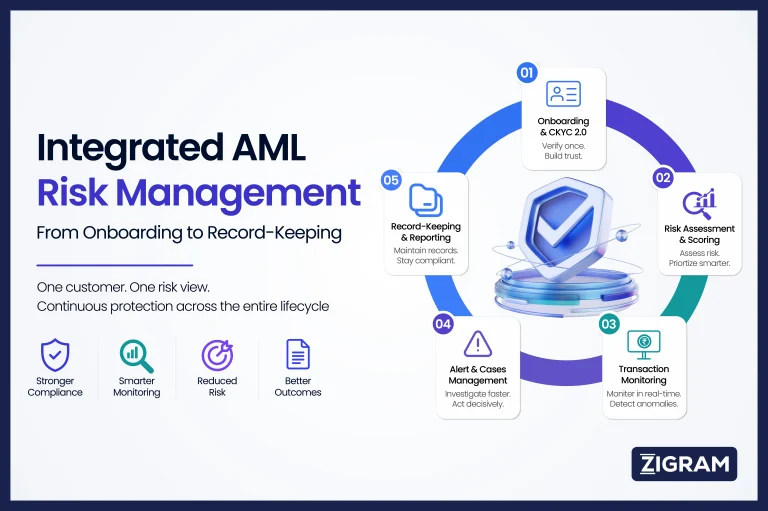
Integrated AML risk management has become essential for financial institutions navigating increasingly complex regulatory environments. Modern anti-money laundering programs have evolved beyond siloed compliance processes into unified systems that connect onboarding, transaction monitoring, and record-keeping across the entire customer lifecycle.
This shift reflects a fundamental truth about financial crime: criminals don’t respect organizational silos. Risk management is the process of identifying, assessing, and addressing financial, legal, strategic, and security risks to an organization. When your CKYC system doesn’t communicate with your transaction monitoring engine, and neither connects to your deceased customer registry, you’ve created gaps that sophisticated launderers will exploit.
Post-2020 AML reforms have accelerated this integration imperative. The Anti-Money Laundering Act of 2020 is the most significant overhaul of U.S. AML regulations since the Patriot Act, extending requirements to cryptocurrency exchanges and other sectors. FATF guidance now explicitly calls for risk-based approaches where onboarding data informs ongoing monitoring, and monitoring outcomes feed back into customer risk profiles. Regulators in India, the EU, and key financial hubs increasingly examine whether institutions maintain audit-ready trails connecting every stage of the customer relationship.
This article focuses on CKYC 2.0 as an integrated risk engine input rather than a standalone compliance artifact. ZIGRAM operates as a B2B RegTech provider delivering “The Complete AML System” with name screening, transaction monitoring, adverse media, entity risk assessment, ESG and crypto risk, with global coverage. For compliance heads, MLROs, CROs, and AML operations leaders at banks, NBFCs, fintechs, insurers, capital markets firms, and VASPs, the integrated approach isn’t just regulatory hygiene, it’s operational survival.
What is Integrated AML Risk Management?
Integrated AML risk management is a unified approach that connects customer onboarding, KYC/CKYC data, transaction monitoring, risk scoring, and record-keeping into a single system to detect and prevent financial crime across the customer lifecycle.
Benefits of Integrated AML Risk Management
Single customer risk view
Reduced false positives
Faster onboarding
Better regulatory compliance
Improved audit readiness
Real-time risk monitoring
How CKYC 2.0 Transforms AML Compliance
The journey from fragmented customer verification to centralized KYC frameworks reflects decades of regulatory learning. In India, the Central KYC Registry, launched in 2016, aimed to eliminate redundant onboarding across financial institutions. Subsequent 2023-2024 circulars have expanded requirements, but the core promise remains: verify once, share securely, reduce friction.
CKYC 2.0 represents an operational evolution beyond simple registry lookups. It transforms CKYC from a static data repository into a continuously enriched, validated, and risk-linked customer data layer that feeds enterprise risk models in real time.
The possible risks faced by organizations can stem from various sources, including financial uncertainty, legal liabilities, technology use, and natural disasters. CKYC 2.0 addresses these by providing a unified foundation for assessing customer-related threats across the relationship lifecycle.
Evolution timeline:
Traditional KYC: Paper-based verification, manual document collection, siloed storage per product line
eKYC: Digital document capture, biometric verification, reduced onboarding time
CKYC 1.0: Centralized registry, one-time lookup at account opening, CSV-based updates
CKYC 2.0: API-driven continuous validation, automatic risk re-scoring on data changes, bidirectional integration with screening and monitoring systems
First-generation implementations suffered from critical limitations: one-time checks performed only at onboarding, manual CSV uploads creating data latency, basic name matching without fuzzy logic, and no automated feedback loop connecting CKYC updates to AML or CRM systems.
Holistic Risk Management: Connecting Onboarding, Monitoring, and Exit
Holistic AML risk management establishes a single, continuous risk view from first customer interaction through final record keeping after account closure and cooling-off periods. Risk management involves several key steps, including risk identification, risk assessment, risk mitigation, and risk monitoring, all connected through a shared data infrastructure.
The contrast with siloed approaches is stark. When onboarding/KYC, transaction monitoring, sanctions screening, and record keeping run on separate systems with different taxonomies, institutions face predictable failures and their consequences, such as operational disruptions, increased vulnerability to financial crime, or reputational damage. Employees can be both sources of risk, such as through data theft or operational errors, and key stakeholders in risk management processes:
A 2025 cross-border fintech onboarding a high-risk NRI customer might clear CKYC checks but miss adverse media flagged by an unconnected news monitoring system
A crypto exchange handling both fiat and stablecoin flows might generate duplicate alerts when different systems independently flag the same beneficial owners
Risk management practices aim to anticipate threats and their potential impact, establishing plans to address them when they arise. For integrated AML in 2026, this means building:
Single risk score per customer across all products and channels
Shared customer ID linking CKYC records, screening results, and transaction history
Unified watchlist logic preventing contradictory screening outcomes
Standardized alert taxonomy enabling consistent investigation prioritization
Consolidated audit trail connecting onboarding decisions to ongoing monitoring and exit actions
CKYC 2.0 as a Core Risk Data Layer, Not a Silo
CKYC 2.0 must feed into, and be fed by, the broader AML ecosystem rather than operating as a static registry query performed only at onboarding. Customer Due Diligence (CDD) is a critical component of anti money laundering efforts, requiring financial institutions to gather and maintain accurate records of customer information throughout the account’s lifecycle.
Modern CKYC records contain rich data attributes that map directly into enterprise risk models:
Multiple identification documents (passport, national ID, driver’s license) enabling cross-validation
Address history with timestamps for jurisdiction risk tracking
Occupation codes aligned to high-risk profession categories
Relationship flags indicating connected parties and beneficial owners
FATCA/CRS indicators for cross-border tax compliance
Using primary sources, such as official documents and firsthand data, is essential for accurate risk assessment and ensures that risk models are based on reliable information.
Concrete integration examples:
CKYC data cross-checked against sanctions and PEP screening hits at onboarding, with mismatches triggering immediate escalation
CKYC demographic updates (e.g., address change to a high-risk jurisdiction) automatically triggering risk re-assessment workflows that help identify root causes of potential risks for more effective mitigation
CKYC identifiers linking customer records across core banking, cards, lending, and brokerage systems for consolidated risk scoring
The U.S. Treasury’s Financial Crimes Enforcement Network (FinCEN) outlines four core requirements for Customer Due Diligence to enhance AML compliance: identifying and verifying customer identity, understanding relationship purpose, conducting ongoing monitoring, and maintaining accurate records.
Design requirements for CKYC 2.0 integration:
Field normalization across source systems
Unique customer keys persisting across the product lifecycle
Version control for profile changes with full audit history
Immutable logs for every CKYC-based decision-making action
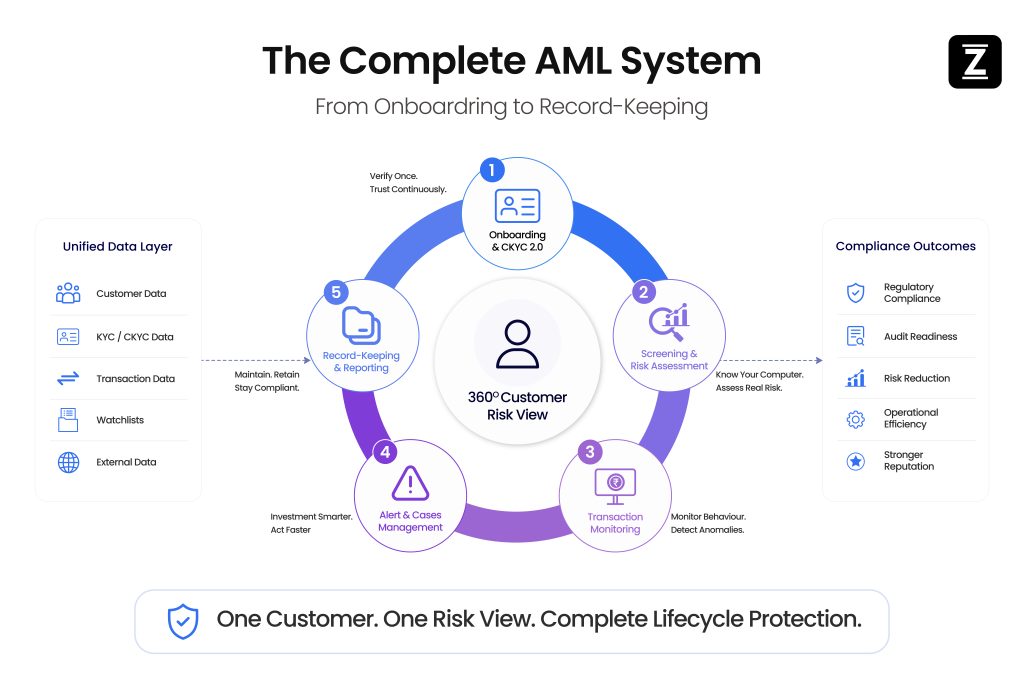
ZIGRAM’s “The Complete AML System” solutions, including PreScreening.io and Entity Hero, can ingest CKYC feeds via API and normalize them into standardized risk profiles consumed by all downstream modules.
Integrating AML Triggers: From Static Checks to Dynamic Surveillance
AML triggers are events requiring re-assessment of customer risk or enhanced due diligence. CKYC 2.0 serves as one of several trigger sources that must be wired into a unified surveillance system to help in mitigating risks associated with financial crime.
Effective due diligence processes help financial institutions detect patterns of suspicious activity, such as layering and smurfing, which are common techniques used in money laundering. Financial institutions are required to report suspicious transactions through Suspicious Activity Reports (SARs) to relevant financial agencies for further investigation.
Main trigger categories:
Category | Examples | System Response |
|---|---|---|
Onboarding triggers | Document-CKYC mismatch, adverse media at first check | Block onboarding, escalate to EDD |
Behavioral triggers | Unusual transaction patterns, geolocation anomalies, device fingerprint mismatches | Generate alert, adjust risk score |
Regulatory triggers | Sanctions updates, domestic watchlist changes, new FATF grey/black list decisions | Bulk re-screening, portfolio risk review |
Lifecycle triggers | Account dormancy, reactivation, beneficial ownership changes, product tier upgrades | Risk re-assessment, potential relationship review |
A unified AML engine uses CKYC identifiers to correlate these triggers to a customer ID, linking name screening, transaction monitoring, and case management alerts.
In 2024, addresses connected to illicit activity sent nearly $51 billion worth of cryptocurrency. highlighting growing financial crime concerns in the crypto space. The decentralized nature of cryptocurrencies complicates the implementation and enforcement of anti money laundering regulations, as traditional frameworks designed for centralized financial institutions are often inadequate.
Global regulatory standards, such as those set by the Financial Action Task Force (FATF), are designed to combat both money laundering and terrorist financing. The FATF has introduced the Travel Rule, requiring collection and sharing of beneficiary information for cross-border cryptocurrency transactions, aiming to increase transparency and accountability in the crypto market.
Deceased Customer Flagging and Account Delinking: Closing the Loop
Holistic risk management must cover the exit side of customer relationships, death, off-boarding, and account closures, which frequently represent weak points in AML programs.
Deceased customer flagging requirements:
Integration with external death registries or government databases, where available
Use of CKYC and internal IDs ensures death status updates propagate across savings, loans, investment, and insurance accounts
Automated controls preventing post-deceased account misuse, fraudulent claims, or money mule activity
Delinking in AML terms means cleanly closing and unlinking accounts for exited customers while preserving immutable audit trails and record keeping for statutory retention periods, typically 5-10 years depending on jurisdiction.
What goes wrong without integrated flagging:
Dormant deceased customer accounts exploited for layering in documented 2022-2023 fraud cases
KYC/CKYC records not updated at closure, causing false positives during 2024-2026 regulatory inspections
Business operations disrupted by manual reconciliation efforts after audit findings
A unified platform like “The Complete AML System” can propagate deceased flags and closure status instantly to screening, monitoring, and case systems while freezing further KYC refresh and transactional activity. Appropriate record retention continues for audit and legal needs.
Unified Risk Assessment: Single Customer View and Dynamic Risk Scoring
The concept of a “single risk spine” provides one consolidated profile per customer or entity drawing from CKYC 2.0, onboarding checks, transactional behavior, adverse media, sanctions, ESG scores, and crypto exposure.
Effective risk assessment involves analyzing potential risk factors, establishing the probability of occurrence, and evaluating the potential impact of each risk event. This unified profile enables:
Consistent application of risk-based approaches across products and geographies
Prevention of contradictory risk classifications (e.g., “low risk” in retail banking but “high risk” at the wealth or crypto desk for the same client)
More accurate decision making for relationship continuation or exit
Dynamic risk scoring specifications:
Onboarding baseline: Age, occupation, geography, PEP/sanction status, CKYC integrity score
Continuous adjustment factors: Large cash deposits, cross-border flows, negative news, ESG controversies
Override handling: Manual compliance team overrides with time-stamped justifications for audit purposes
Risk avoidance involves changing plans to bypass a risk completely, such as exiting a high-risk market. Risk acceptance means acknowledging the risk and preparing for potential impact if mitigation cost is prohibitive. Risk transfer involves shifting risk to a third party, often through an insurance company; for example, purchasing insurance is a common way organizations transfer risk. Risk sharing is another strategy, where responsibilities or potential losses are divided among parties: outsourcing, risk pooling, or joint ventures are typical methods. A good example of risk sharing is a corporation, where investors pool capital and share risk accordingly. Risk retention accepts residual exposure after other strategies are applied.
Entity Hero acts as ZIGRAM’s central entity risk assessment engine, while crypto risk modules and ESG risk modules contribute specialized sub-scores feeding composite enterprise risk ratings.
Record-Keeping as a Strategic AML Asset, Not Just a Regulatory Burden
AML record keeping in 2026 means comprehensive, time-stamped storage of KYC/CKYC data, screening results, transaction data, alerts, investigations, and final decisions, maintained for legally mandated periods, typically 5-10 years after the relationship ends.
Effective risk management ensures compliance with complex legal and regulatory requirements, avoiding penalties. Regulatory expectations are shaped by guidelines and international standards such as ISO 31000 and FATF recommendations, which provide structured frameworks for record-keeping and risk management practices. Concrete regulatory expectations include:
FATF Recommendation 11 on record-keeping of transactions and CDD information
EU AMLD record-retention requirements
RBI/SEBI circulars on KYC and transaction data retention
US Bank Secrecy Act rules on suspicious activity documentation
Proactively addressing issues through risk management helps avoid incidents that could erode stakeholder and customer trust. In an integrated system:
CKYC 2.0 records, risk assessments, transaction alerts, and case notes all link to the same entity ID
Deceased flags and delinked accounts maintain immutable historical records for supervisory reviews
Internal processes support rapid response to regulatory inquiries
Benefits beyond regulatory compliance:
Effective risk management builds confidence among stakeholders, including investors, employees, and customers.
Faster internal investigations and portfolio reviews
Evidence foundation for defending enforcement actions or customer disputes
Data infrastructure for future AI/ML models enhancing detection accuracy
Improved cross-border information sharing with international organization counterparts
Data objects requiring storage and logical connection:
Data Type | Source System | Retention Trigger |
|---|---|---|
CKYC records | Central registry, internal KYC | Relationship end + statutory period |
Screening results | Name screening engine | Each screening event |
Transaction history | Core banking/payments | Relationship end + statutory period |
Alert records | Transaction monitoring | Case closure |
Investigation notes | Case management | Case closure + statutory period |
SAR/STR filings | Regulatory reporting | Filing date + statutory period |
ZIGRAM's "The Complete AML System" with CKYC at Its Core
ZIGRAM delivers a complete AML and financial crime compliance platform unifying CKYC data, screening, monitoring, investigations, and record keeping into one ecosystem. Financial services utilize risk reduction for cyberattacks and risk transference to manage market volatility—ZIGRAM enables similar strategic control over AML operations.
“The Complete AML System” mapping to lifecycle stages:
PreScreening.io: Name screening, sanctions/PEP checks, and CKYC enrichment at onboarding
Entity Hero: Continuous entity risk assessment drawing on CKYC, internal data, ESG, and crypto risk signals
Transact Comply: Transaction monitoring across banking, payments, and virtual assets
Along with this, we provide a host of solutions designed for any financial institution
Dragnet Alpha and SATOC: Ongoing adverse media and news risk monitoring
DueDiliger: Deep due diligence reports and EDD cases
Doss Engine: Secure storage, link caching, and document interaction, enhancing audit trails
Single source of truth implementation:
One customer/entity ID linking all modules across the organization
Central risk registry capturing CKYC 2.0 records, deceased/closure flags, and risk score history
Unified audit layer for regulatory bodies, internal audit teams, and independent reviewers
Contingency planning involves establishing predefined actions triggered when risks materialize. ZIGRAM supports this through configurable escalation workflows and automated response protocols.
Implementation patterns:
API-first integrations with core banking, LOS/LMS systems, and CKYC registries
Managed services helping institutions define risk models, map CKYC attributes, and configure triggers
Support for institutions across India, Middle East, Africa, Europe, and APAC
The integrated approach delivers improved detection rates, lower false positives, and smoother examination experiences for the aml compliance officer and compliance department.
Implementation Roadmap: Moving from Siloed KYC to Integrated AML
Different industries apply tailored risk management strategies to address their specific threats. Healthcare focuses on risk reduction to prevent patient injuries and ensure health regulation compliance. Financial institutions require equally systematic approaches to supply chain risk management across their compliance infrastructure.
Phase 1 (0-3 months): Discovery and Current-State Mapping
Document existing CKYC, screening, transaction monitoring, and record keeping systems
Map data flows and identify integration gaps
Assess technology infrastructure readiness
Establish baseline metrics for alert volumes, false positive rates, and onboarding TAT
Phase 2 (3-6 months): Central Risk Layer Integration
Integrate CKYC 2.0 data into central risk repository
Establish single customer ID across all systems
Implement basic risk scoring using CKYC attributes
Connect screening results to customer profiles
Phase 3 (6-12 months): Dynamic Trigger Connection
Wire transaction monitoring alerts to unified risk layer
Integrate adverse media feeds for continuous re-scoring
Connect case management for investigation tracking
Implement deceased flagging and delinking workflows
Phase 4 (12+ months): Optimization and Enhancement
Add ESG and crypto risk modules
Deploy advanced analytics and reporting for regulators and boards
Tune models based on operational feedback
Expand coverage to new employee training and business development initiatives
Effective risk management processes deliver valuable insights into the potential implications of different business decisions, improving strategic decision making.
Governance requirements:
Joint working group including AML, information technology, risk, and business operations
Clear RACI matrix for risk model owners, data stewards, and system owners
Regular steering committee reviews of identified risks and control effectiveness
Target KPIs:
Reduction in duplicate alerts and manual case rework
Decreased onboarding turnaround time
Improved STR/SAR quality scores from regulator feedback
Enhanced internal audit ratings for AML program maturity
ZIGRAM supports each phase with technology and managed services, including data migration, rule tuning, and staff training, implementing strategies that align with institutional risk management standards and business strategy.
Conclusion and Next Steps: Turning Integrated AML into a Competitive Edge
Effective risk management is a catalyst for growth and stability. When CKYC 2.0, integrated triggers, deceased customer flagging, delinking protocols, and robust record keeping operate as one continuous system, institutions build a defensible, efficient, and audit-ready AML posture that regulators respect and criminals cannot easily penetrate.
A comprehensive risk management plan that connects onboarding to exit represents more than regulatory obligation—it reduces losses from fraud and fines, improves customer trust through faster onboarding, and enables confident participation in cross-border and digital financial services. The overall risk exposure decreases while operational efficiency increases.
ZIGRAM serves as the partner of choice for institutions seeking a single, globally capable AML platform with CKYC-aware risk management built in. Whether you operate in India, the Middle East, Africa, Europe, or APAC, integrated AML is no longer optional; it’s the foundation for competing effectively while managing business risks across an increasingly complex regulatory landscape.
Ready to assess risks across your AML lifecycle?
Book a Demo to see how ZIGRAM’s integrated platform connects CKYC, screening, monitoring, and record keeping
Schedule a discovery call to review your current architecture and identify integration opportunities that support long-term regulatory compliance and risk analysis improvements
The institutions that manage risk most effectively will be those treating CKYC 2.0, AML triggers, and record keeping not as separate compliance activities, but as one unified system protecting customers, stakeholders, and the broader financial system from external events and internal vulnerabilities alike.