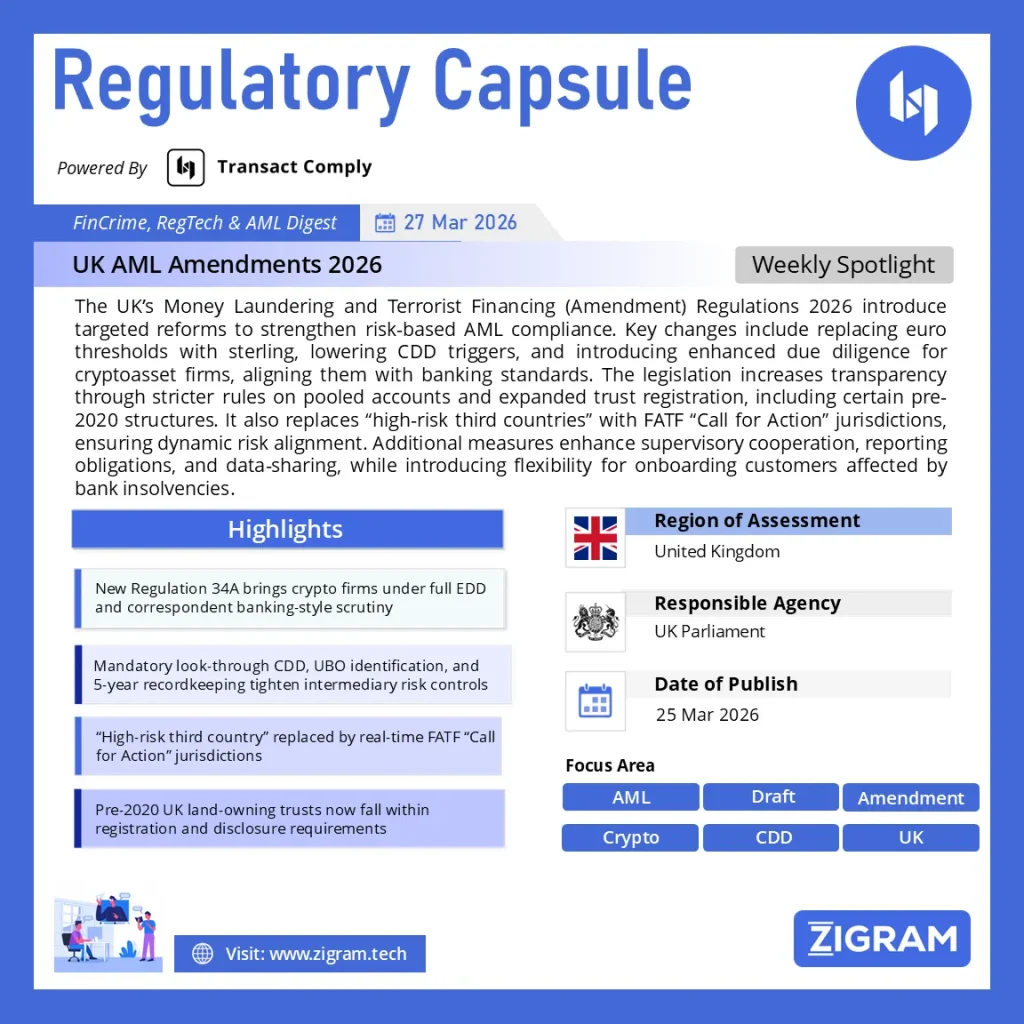
Regulation Name: Money Laundering and Terrorist Financing (Amendment) Regulations 2026
Date Of Issue: 25 Mar 2026
Region: United Kingdom
Agency: UK Parliament
UK AML Regulatory Overhaul 2026: Full Breakdown of Amendments to the MLR 2017
The Money Laundering and Terrorist Financing (Amendment) Regulations 2026 mark one of the most comprehensive upgrades to the UK’s AML/CFT framework since the 2017 MLRs.
This draft statutory instrument introduces targeted but high-impact amendments across:
- Customer Due Diligence (CDD) and Enhanced Due Diligence (EDD)
- Cryptoasset regulation
- Trust transparency
- Supervisory cooperation and data-sharing
- Risk definitions aligned with FATF
- Operational flexibility for crisis scenarios (e.g., bank insolvencies)
For AML leaders, this is not incremental—it is a systemic recalibration toward risk precision, digital finance oversight, and enforcement readiness.
Here is a line-by-line regulatory change tracker tailored for AML compliance, legal, and implementation teams. It maps each amendment → what changed → what it means → what you must do.
Line-by-Line Regulatory Change Tracker (Implementation Ready)
PART 1: GENERAL & COMMENCEMENT
Regulation | Change | What It Means | Action Required |
Reg 1 | Staggered implementation (incl. crypto in 2027) | Phased compliance timelines | Build multi-phase implementation roadmap (2026 vs 2027 readiness) |
PART 2: CORE MLR 2017 AMENDMENTS
- DEFINITIONS & INTERPRETATION
Regulation | Change | Impact | Action |
Reg 3 | Introduces “cryptoasset business”; replaces € with £ | Aligns AML with UK + crypto scope | Update policy definitions, screening logic, thresholds |
- BUSINESS RELATIONSHIP SCOPE
Regulation | Change | Impact | Action |
Reg 4 | Adds new services (incl. off-the-shelf firms) | Expands onboarding scope | Update CDD triggers for TCSP clients |
- APPLICATION & COVERAGE
Regulation | Change | Impact | Action |
Reg 8 | Pooled accounts brought into AML scope | New risk category | Identify all pooled accounts across business lines |
- SECTOR-SPECIFIC SCOPE CHANGES
Regulation | Change | Impact | Action |
Reg 10 | Excludes reinsurance | Narrows AML scope slightly | Update product classification logic |
Reg 12 | Adds “off-the-shelf firm” definition | Targets shell structures | Enhance UBO + company lifecycle checks |
Reg 13–14 | €10k → £10k thresholds | Currency shift | Update transaction monitoring rules |
- EXCLUSIONS
Regulation | Change | Impact | Action |
Reg 15 | Expands exclusions + £1,000 threshold | Minor scope recalibration | Review exemption logic |
- RISK LANGUAGE MODIFICATION
Regulation | Change | Impact | Action |
Reg 19 & 19A | “Unusually complex or unusually large given nature” | Contextual risk-based AML | Re-tune scenario models & alerts |
- FCA REPORTING OBLIGATIONS
Regulation | Change | Impact | Action |
Reg 23 | Mandatory update within 30 days for changes/inaccuracies | Continuous compliance | Build regulatory reporting workflows + alerts |
CUSTOMER DUE DILIGENCE (CDD)
- THRESHOLDS & TRIGGERS
Regulation | Change | Impact | Action |
Reg 27 | €1,000 → £800; other threshold updates | More transactions captured | Adjust CDD trigger engines + onboarding rules |
- POOLED ACCOUNTS (MAJOR CHANGE)
Regulation | Change | Impact | Action |
Reg 29 | Full CDD + risk assessment + recordkeeping for pooled accounts | High-risk intermediary structures now transparent | |
Must identify underlying clients + UBOs | Removes opacity layer | Build look-through capability | |
5-year recordkeeping requirement | Audit trail enforcement | Enhance data retention systems | |
Law enforcement access mandatory | Increased disclosure obligations | Create rapid response workflows |
- SIMPLIFIED DUE DILIGENCE
Regulation | Change | Impact | Action |
Reg 37 | SDD linked with pooled account controls | SDD becomes conditional | Re-define low-risk classification logic |
TIMING & EXCEPTIONS
- INSOLVENT BANK CUSTOMERS (NEW REGIME)
Regulation | Change | Impact | Action |
Reg 30ZA (new) | Allows onboarding before full CDD | Crisis flexibility | Create exception onboarding workflows |
Reg 30 & 30A | Delay verification + discrepancy reporting | Reduced friction during insolvency events | Add scenario-based compliance playbooks |
ENHANCED DUE DILIGENCE (EDD)
- FATF ALIGNMENT
Regulation | Change | Impact | Action |
Reg 33 | “High-risk third country” → FATF Call for Action | Dynamic risk lists | Integrate real-time FATF list feeds |
- CRYPTO CORRESPONDENT EDD (CRITICAL)
Regulation | Change | Impact | Action |
Reg 34A (new) | Full EDD for crypto correspondent relationships | Crypto = banking-level scrutiny | |
Requires: reputation checks, AML controls, senior approval | Governance upgrade | Implement crypto onboarding frameworks | |
Prohibits shell bank exposure | High-risk restriction | Add counterparty screening rules | |
Requires downstream CDD assurance | Indirect risk visibility | Build KYCC (Know Your Customer’s Customer) capability |
ELECTRONIC MONEY & CRYPTO TRANSFERS
- THRESHOLD ADJUSTMENTS
Regulation | Change | Impact | Action |
Reg 38 | € thresholds → £150 / £50 | Minor adjustment | Update e-money monitoring rules |
Reg 64C / 64G | Crypto transfer threshold → £800 | Travel Rule tightening | Update crypto transaction monitoring |
TRUST TRANSPARENCY
- TRUST REGISTRATION EXPANSION
Regulation | Change | Impact | Action |
Reg 42, 45, 45ZA | Pre-2020 land-owning trusts now in scope | Backdated transparency | Conduct retrospective trust reviews |
New deadlines (e.g., Sept 2027) | Compliance window | Build remediation plan |
- TRUST ACCESS & CLASSIFICATION
Regulation | Change | Impact | Action |
Reg 45ZB | Adds Type C trusts | Broader access | Update data access controls |
- EXCLUDED TRUSTS EXPANSION
Regulation | Change | Impact | Action |
Schedule 3A | Low-value + temporary trusts excluded | Reduced burden | Reclassify low-risk trusts |
SUPERVISION & DATA SHARING
- REGULATORY COOPERATION
Regulation | Change | Impact | Action |
Reg 50 | Adds Companies House (Registrar) | Stronger corporate transparency | Integrate Companies House data feeds |
- DISCLOSURE EXPANSION
Regulation | Change | Impact | Action |
Reg 52 | Adds Financial Services Act investigator | Broader intelligence sharing | Update data-sharing policies |
- CONFIDENTIALITY FRAMEWORK
Regulation | Change | Impact | Action |
Reg 52A | Extends to crypto firms + aligns with FSMA | Crypto under full AML secrecy regime | Update confidentiality policies |
Reg 52B | Easier defence (either condition sufficient) | Legal risk recalibration | Update legal advisory frameworks |
CRYPTO REGULATORY TRANSFORMATION
- CHANGE IN CONTROL (SCHEDULE 6B)
Area | Change | Impact | Action |
Ownership thresholds | ≥10%, 20%, 30%, 50% triggers | Formal control regime | Build ownership monitoring systems |
FSMA alignment | Crypto treated like regulated firms | Regulatory parity | Align governance frameworks |
FCA oversight | Mandatory notifications | Increased scrutiny | Create regulatory notification workflows |
Criminal liability | Non-compliance penalties | Enforcement risk | Strengthen compliance controls |
PRIMARY LEGISLATION AMENDMENTS
- TERRORISM ACT 2000 & POCA 2002
Change | Impact | Action |
Currency updates (€ → £) | Consistency across AML laws | Align enterprise-wide thresholds |
Off-the-shelf firms included | Corporate misuse prevention | Enhance corporate onboarding checks |
FINAL IMPLEMENTATION PRIORITIES (FOR TEAMS)
Immediate (0–3 Months)
- Threshold updates (£ conversions)
- FATF list integration
- FCA reporting workflows
- Policy updates (definitions, crypto inclusion)
Medium-Term (3–9 Months)
- Pooled account frameworks
- Trust registration remediation
- Enhanced transaction monitoring recalibration
Long-Term (2027 Readiness)
- Crypto correspondent EDD
- Change-in-control governance (Schedule 6B)
- KYCC and network analytics capabilities
Bottom Line for AML Leaders
This is not just a regulatory update—it is an operational transformation blueprint:
- CDD → Contextual & deeper
- Crypto → Fully regulated
- Transparency → Expanded across trusts & accounts
- Supervision → Data-driven and interconnected
Detailed Explanation
Part 1: Foundational Structural Changes
- Legal Basis and Scope Expansion
The regulation is introduced under the Sanctions and Anti-Money Laundering Act 2018, reinforcing its alignment with UK sanctions and global AML frameworks.
Key Implementation Timelines:
- General provisions: 21 days post-enactment
- Crypto EDD (Regulation 34A): 1 February 2027
- Crypto control regime (Schedule 6B): phased until October 2027
Strategic Insight:
This staggered rollout signals regulatory prioritisation of crypto oversight while allowing institutions time to adapt.
Part 2: Core Amendments to the MLR 2017
- Currency Standardisation: Euro → Sterling Shift
A major structural change replaces euro-denominated thresholds with sterling equivalents (1:1 conversion) across the regime.
Examples:
- €10,000 → £10,000
- €1,000 → £800 (risk-calibrated adjustment in some cases)
Why It Matters:
- Aligns with post-Brexit regulatory independence
- Ensures FATF compliance while recalibrating thresholds to UK risk context
- Expansion of Scope: “Off-the-Shelf Firms”
Amendment:
Trust or Company Service Providers (TCSPs) now explicitly include:
- Selling off-the-shelf firms (inactive or minimally active companies)
Risk Impact:
- Addresses shell company misuse
- Closes loopholes in corporate structuring for ML/TF
- Clarification of Complex Transactions
Language updated from:
- “complex or unusually large” →
- “unusually complex or unusually large given the nature of the transaction”
Impact:
- Introduces contextual risk assessment
- Forces institutions to adopt risk-based, not rule-based monitoring
Part 3: Customer Due Diligence (CDD) Overhaul
- Revised CDD Thresholds
Key Changes:
- Occasional transaction threshold reduced: €1,000 → £800
- Other thresholds aligned to £12,000 / £10,000 depending on use case
Implication:
- More transactions fall under CDD scope
- Increased operational burden but improved detection
- Pooled Accounts: New AML Risk Category
New Requirements (Regulation 29):
Financial institutions must:
- Understand purpose and usage
- Verify consistency with customer risk profile
- Apply risk-based controls
- Maintain auditability and documentation
Customers must:
- Provide beneficial ownership details
- Maintain 5-year transaction records
- Share data with law enforcement upon request
Strategic Insight:
This is a major shift toward transparency in intermediary structures (e.g., law firms, brokers).
- Simplified Due Diligence (SDD) Recalibration
SDD now explicitly incorporates:
- Pooled account risk considerations
Impact:
SDD is no longer “light-touch”—it becomes risk-adjusted simplification.
Part 4: Crisis-Based Flexibility – Insolvent Bank Customers
- Introduction of Regulation 30ZA
A completely new framework allows:
- Account opening before full CDD completion for customers of failed banks
- Mandatory:
- Identity verification upfront
- Full CDD as soon as practicable
Safeguards:
- Transactions restricted if risk triggers emerge
- Applies only within 30 days of insolvency event
Strategic Value:
Balances:
- Financial stability
- AML risk control
Part 5: Redefining High-Risk Jurisdictions
- “High-Risk Third Country” → FATF Call for Action
Key Change:
- UK now directly references FATF “Call for Action” list
Why It Matters:
- Moves from static lists → dynamic global alignment
- Ensures real-time AML responsiveness
Part 6: Cryptoasset Regulation – The Biggest Shift
- New Regulation 34A: Crypto Correspondent EDD
Applies to:
- Crypto exchanges
- Custodian wallet providers
Mandatory Measures:
- Full due diligence on counterparties
- Reputation and supervision assessment
- Senior management approval
- Documented responsibilities
- Verification of downstream customers
Prohibitions:
- No relationships with shell banks
- No indirect exposure to shell bank usage
Strategic Impact:
This aligns crypto with:
- Traditional correspondent banking standards (FATF Rec 13)
- Technology risk controls (FATF Rec 15)
- Crypto Ownership & Control (Schedule 6B Overhaul)
Major Changes:
- Applies FSMA-style control thresholds to crypto firms:
- ≥10% ownership
- Voting power thresholds
- Significant influence
Introduces:
- Mandatory notification of control changes
- Fit-and-proper tests
- Criminal liability for non-compliance
Strategic Insight:
Crypto is no longer “lightly supervised”—it is entering full financial regulatory parity.
Part 7: Trust Transparency Expansion
- Expanded Trust Registration Requirements
Now includes:
- Trusts holding UK land before Oct 2020 and still active
Additional Changes:
- Expanded categories (Type C trusts)
- Removal of SDRT trigger for registration
- New deadlines (e.g., Sept 2027)
- Expansion of Excluded Trusts
New exclusions include:
- Low-value trusts (<£2,000 assets, <£5,000 income)
- Temporary post-death structures
- Estate variation trusts
Impact:
- Reduces administrative burden
- Focuses compliance on material risk structures
Part 8: Supervisory Cooperation & Data Sharing
- Inclusion of Companies House (Registrar)
Regulation 50 now includes:
- Registrar of Companies in AML cooperation framework
Implication:
- Stronger corporate transparency enforcement
- Integration with beneficial ownership data
- Expanded Disclosure Gateways
- Inclusion of Financial Services Act investigators
- Enhanced FCA information-sharing powers
- Confidentiality Framework Expanded
Now applies to:
- Cryptoasset businesses alongside banks
Also:
- Aligns with FSMA disclosure provisions
- Loosens criminal defence requirements (either condition sufficient)
Part 9: Reporting, Accuracy & Governance
- Mandatory Updates to FCA
Firms must:
- Report material changes or inaccuracies within 30 days
Impact:
- Continuous compliance obligation
- Reduces stale regulatory data risk
Part 10: Miscellaneous but High-Impact Changes
- Insurance Scope Narrowing
- Reinsurance excluded from AML scope
- Electronic Money Threshold Adjustments
- £150 / £50 limits updated
- Crypto Travel Rule Adjustments
- Thresholds aligned to £800
- Professional Body Update
- Updated supervisory authority list
Global AML Implications
This legislation positions the UK as:
- A leader in crypto AML regulation
- A pioneer in dynamic FATF alignment
- A driver of data-sharing-based compliance ecosystems
Global Ripple Effects:
- Multinational firms must harmonise UK AML with EU + FATF frameworks
- Crypto firms face global standardisation pressure
Key Strategic Takeaways for AML Leaders
- Risk-Based Compliance is Now Enforced
Static thresholds are replaced with contextual judgement requirements
- Crypto is Fully Mainstreamed into AML
Expect:
- Bank-level scrutiny
- Regulatory parity
- Transparency is Expanding Rapidly
Focus areas:
- Trusts
- Beneficial ownership
- Pooled accounts
- Supervisory Integration is Deepening
Data-sharing is no longer optional—it is structural
Conclusion
The UK AML Amendment Regulations 2026 represent a precision upgrade rather than a wholesale rewrite—but their impact is profound.
They:
- Close structural loopholes
- Strengthen enforcement readiness
- Integrate crypto into core AML
- Shift compliance toward intelligence and accountability
For AML professionals, the message is clear:
The future of compliance is real-time, risk-based, and deeply interconnected.
Read about the amendments here.
Read about the product: Transact Comply
Empower your organization with ZIGRAM’s integrated RegTech solutions – Book a Demo
- #AML
- #UKRegulation
- #FinancialCrime
- #CryptoAML
- #CDD
- #EDD
- #FATF
- #RegTech
- #Compliance
- #RiskManagement
- #TrustTransparency
- #KYC
- #FinCrime
- #AML2026
- #CryptoRegulation