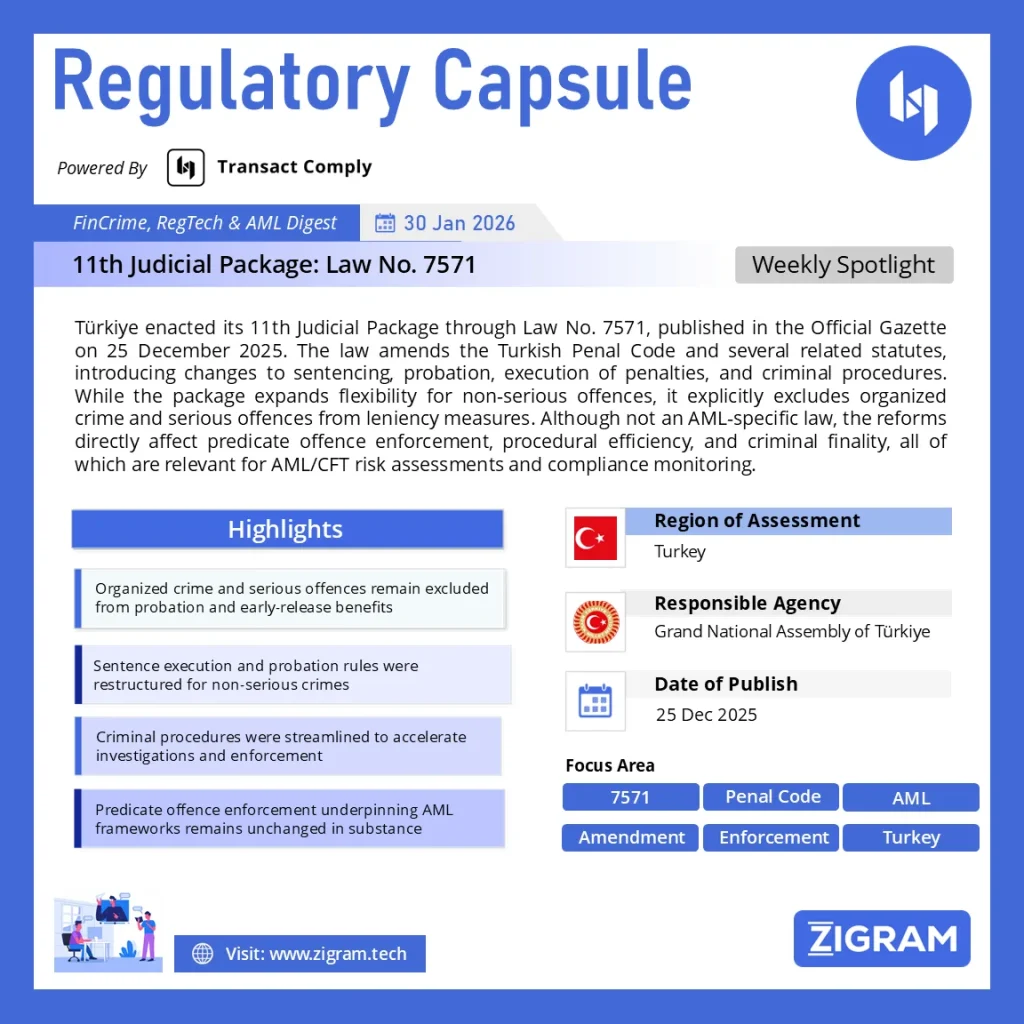
Regulation Name: 11th Judicial Package (Law No. 7571)
Date Of Issue: 25 Dec 2025
Region: Turkey
Agency: Grand National Assembly of Türkiye
Türkiye Enacts the 11th Judicial Package: What Law No. 7571 Means for Criminal Enforcement and Predicate Offences
Türkiye has enacted its 11th Judicial Package through Law No. 7571, officially titled “Law on Amendments to the Turkish Penal Code and Certain Laws and Decree Law No. 631.” The law was published in the Official Gazette on 25 December 2025 and entered into force on the same date.
Although not an AML-specific statute, the law introduces wide-ranging amendments to criminal offences, sentencing, execution of penalties, probation, and procedural rules—all of which are directly relevant to predicate offence enforcement under AML/CFT frameworks.
Legal Status and Scope
Law No. 7571 is a final and binding law, adopted by Parliament and published in the Official Gazette. It amends multiple core statutes, including:
- The Turkish Penal Code (Law No. 5237)
- The Criminal Procedure Code
- Laws governing execution of sentences, probation, and detention
- Sector-specific legislation affecting enforcement powers and sanctions
The law is part of Türkiye’s broader judicial reform agenda but has concrete implications for financial crime enforcement, organized crime, fraud, and other predicate offences.
Key Changes Relevant to Predicate Offences
- Sentence Execution and Probation Rules
The law revises how custodial sentences are executed, including:
- Conditions for probation and supervised release
- Rules governing transfer between closed and open prisons
- Execution thresholds based on the nature and seriousness of the offence
Crucially, serious offences remain excluded from leniency mechanisms. Crimes such as organized crime, serious violence, and other high-impact offences continue to be subject to stricter execution regimes.
- Amendments to Criminal Offences and Penalty Ranges
Law No. 7571 introduces changes to penalty ranges and offence definitions across several articles of the Turkish Penal Code. These include amendments affecting:
- Fraud-related offences
- Endangerment of public safety
- Crimes involving abuse of authority or misuse of professional roles
Such amendments affect how predicate offences are charged, sentenced, and enforced, with downstream implications for confiscation, enforcement cooperation, and criminal records.
- Strengthened Procedural and Enforcement Powers
The law modifies procedural rules to:
- Accelerate criminal investigations and trials
- Reduce delays in enforcement of final judgments
- Clarify authorities’ powers during investigation and execution phases
Faster procedural finality strengthens the effectiveness of financial crime enforcement, particularly where criminal convictions underpin AML actions such as account freezes, asset recovery, and de-risking decisions.
Who Is Affected
- Courts and prosecutors implementing revised procedural and sentencing rules
- Law enforcement and prison authorities responsible for execution of penalties
- Individuals and entities convicted of financial and economic crimes
- Financial institutions and compliance teams relying on criminal justice outcomes for AML risk assessments
Why This Matters for AML and Compliance
Predicate offence enforcement is a cornerstone of AML/CFT systems. Law No. 7571:
- Maintains strict treatment of serious and organized crimes
- Adjusts execution and probation rules without decriminalising offences
- Improves procedural efficiency, supporting timely enforcement and asset measures
For AML purposes, the law signals procedural reform rather than substantive weakening of financial crime controls.
What Compliance and Risk Teams Should Do
- Monitor how revised execution rules affect criminal exposure assessments
- Continue applying enhanced scrutiny for organized crime and serious offences
- Update internal country risk narratives to reflect judicial efficiency reforms
- Avoid assuming leniency for predicate offences—exclusions remain explicit
Conclusion
Law No. 7571, Türkiye’s 11th Judicial Package, is a comprehensive judicial reform with meaningful implications for criminal enforcement and predicate offences. While expanding flexibility for non-serious crimes, it preserves strict controls for organized and serious offences, reinforcing the foundations on which Türkiye’s AML/CFT framework relies.
Read about the guidance here.
Read about the product: Transact Comply
Empower your organization with ZIGRAM’s integrated RegTech solutions – Book a Demo
- #AML
- #CFT
- #PredicateOffences
- #FinancialCrime
- #OrganizedCrime
- #Türkiye
- #JudicialReform
- #Compliance
- #RiskManagement
- #RiskBasedApproach
- #FATF
- #RegulatoryUpdate