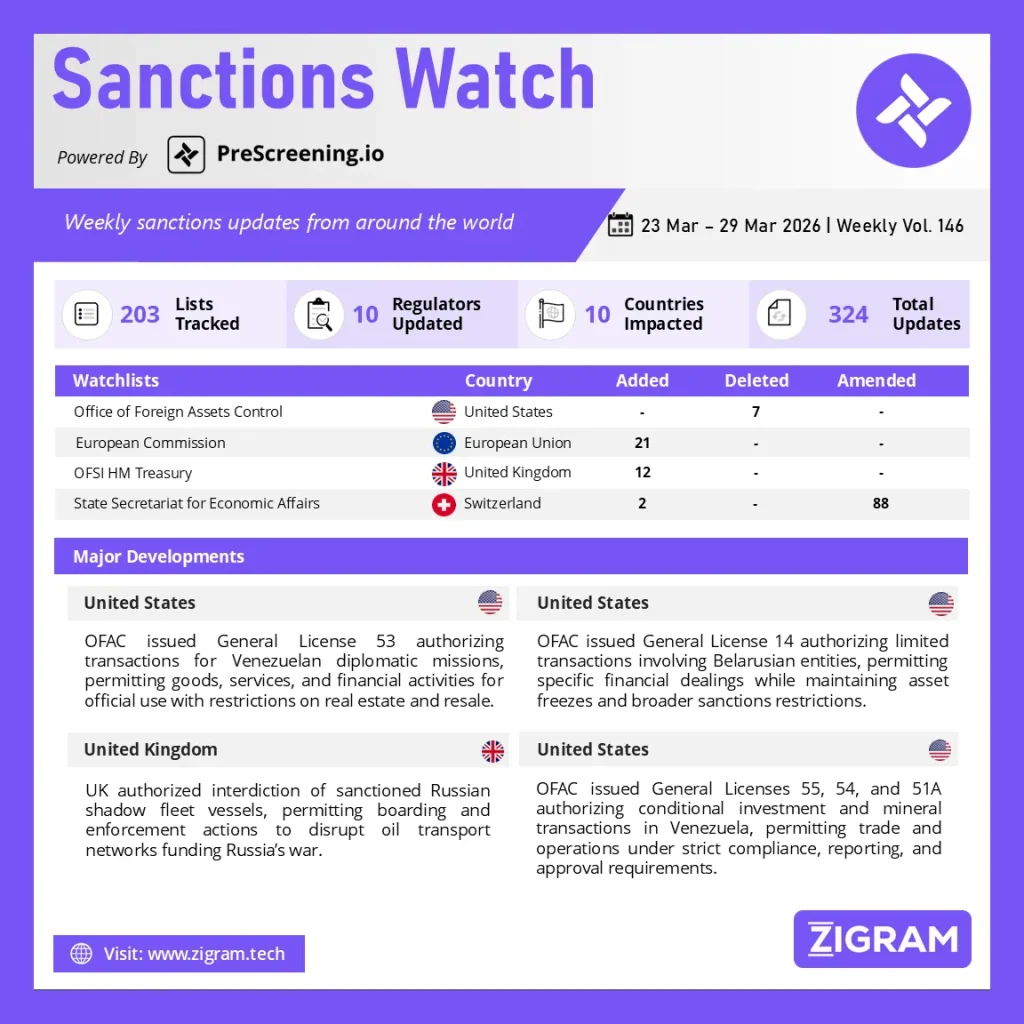
Sanctions Watch Vol 146
In the latest edition of our Sanctions Watch weekly digest, we present significant updates on sanction watchlists and regulatory developments.
OFAC Authorizes Limited Transactions for Venezuelan Diplomatic Missions in the U.S. Under General License
The U.S. Department of the Treasury’s Office of Foreign Assets Control (OFAC) issued General License No. 53 under the Venezuela Sanctions Regulations to clarify permitted activities involving official Venezuelan missions in the United States. The license authorizes certain transactions that would otherwise be prohibited, specifically those related to the provision and payment of goods and services necessary for the functioning of Venezuela’s official and permanent missions to international organizations in the U.S.
Under this authorization, goods and services may be provided for official mission activities or for the personal use of mission employees and their immediate household members, provided such goods are not intended for sale. However, the license explicitly excludes transactions involving the purchase, sale, or financing of real estate, and all activities must remain compliant with other applicable laws.
Additionally, U.S. financial institutions are permitted to maintain accounts, extend credit, and process transactions for these missions and their personnel, within the defined limits. This measure ensures that diplomatic operations can continue without disruption despite broader sanctions.
Overall, the license reflects a targeted easing within the sanction’s framework, allowing routine diplomatic and personal transactions while maintaining restrictions on broader financial and commercial activities. Issued on March 24, 2026, the guidance reinforces the U.S. approach of balancing sanctions enforcement with the practical needs of diplomatic engagement.
OFAC Issues General License Allowing Limited Dealings with Belarusian State-Linked Entities
The U.S. Department of the Treasury’s Office of Foreign Assets Control (OFAC) issued General License No. 14 under the Belarus Sanctions Regulations, introducing limited sanctions relief for specific Belarusian entities. The license authorizes transactions that would otherwise be prohibited if they involve Belarussian Bank of Development and Reconstruction Belinvestbank, along with affiliated entities such as Belinvest-Engineering and CJSC Belbizneslizing, including entities owned 50 percent or more by these parties.
However, authorization comes with important restrictions. The license does not permit the unblocking of any property previously frozen under U.S. sanctions, nor does it allow transactions involving other sanctioned persons or entities not explicitly covered by the license. All other prohibitions under the Belarus Sanctions Regulations remain in force unless separately authorized.
This move reflects a targeted and conditional easing of sanctions, enabling certain financial and commercial activities with designated Belarusian institutions while maintaining broader restrictions. Issued on March 26, 2026, the license underscores OFAC’s approach of applying selective flexibility within the sanctions regime without undermining overall enforcement objectives.
UK Authorizes Boarding of Sanctioned Russian “Shadow Fleet” Vessels in Territorial Waters
The United Kingdom has escalated its sanctions enforcement against Russia by authorizing its armed forces and law enforcement agencies to board and interdict sanctioned “shadow fleet” vessels transiting UK waters. The move targets a network of aging ships used by Russia to transport oil and evade international sanctions, a key revenue source funding its war in Ukraine.
Announced alongside the Joint Expeditionary Force (JEF) Summit in Helsinki, the decision aligns the UK with allies such as Finland, Sweden, and Estonia, which have already undertaken similar maritime enforcement actions in the Baltic region. By extending interdiction measures to UK waters, including critical routes like the English Channel, authorities aim to disrupt these operations and increase logistical and financial pressure on Russia.
The policy allows for case-by-case assessments before action is taken, with authorities prepared for complex scenarios including non-compliant or surveilled vessels. Detained ships may face legal proceedings, with potential consequences for owners, operators, and crew under UK sanctions law.
With an estimated 75% of Russian crude transported through this shadow fleet, the UK’s move represents a significant tightening of enforcement. The government also called for greater coordination among allies to expand vessel seizures, signaling a broader international effort to curtail Russia’s ability to bypass sanctions and sustain its military campaign.
U.S. Expands Venezuela Sanctions Relief to Enable Conditional Investment and Mineral Trade
The U.S. Department of the Treasury’s Office of Foreign Assets Control (OFAC) has issued a series of general licenses—Nos. 55, 54, and 51A—introducing coordinated, conditional relief measures targeting Venezuela’s minerals sector, including gold. Collectively, the licenses allow limited commercial engagement while maintaining strict controls over financial flows and sanctioned actors.
General License 55 authorizes negotiations and entry into contingent contracts for new investments in Venezuela’s minerals sector, including exploration, mining, and joint ventures. However, execution of such contracts remains subject to separate OFAC approval, ensuring oversight over any actual investment activity.
General License 54 permits U.S. persons to provide goods, services, and logistical support for existing mineral operations, including maintenance and production activities. These transactions must comply with strict contractual and payment conditions, including routing payments to designated U.S.-controlled accounts and adhering to reporting requirements.
Meanwhile, General License 51A authorizes the trade and transportation of Venezuelan-origin minerals by established U.S. entities, including due diligence, shipping, and refining activities. It replaces the earlier GL 51 and introduces tighter compliance obligations, including detailed reporting and restrictions on dealings involving certain jurisdictions or prohibited processing locations.
Overall, the measures signal a calibrated approach by the U.S., allowing limited economic activity in Venezuela’s mining sector while preserving core sanctions restrictions and enhancing compliance oversight.
Know more about the product: PreScreening.io
Click here to book a free demo.
Sanctions Watch is a weekly recap of events and news related to sanctions around the world.
- #Sanctions
- #OFAC
- #RussiaSanctions
- #UKSanctions
- #EnergySecurity
- #GlobalTrade
- #Compliance
- #Geopolitics