Sanctions Watch Vol 144
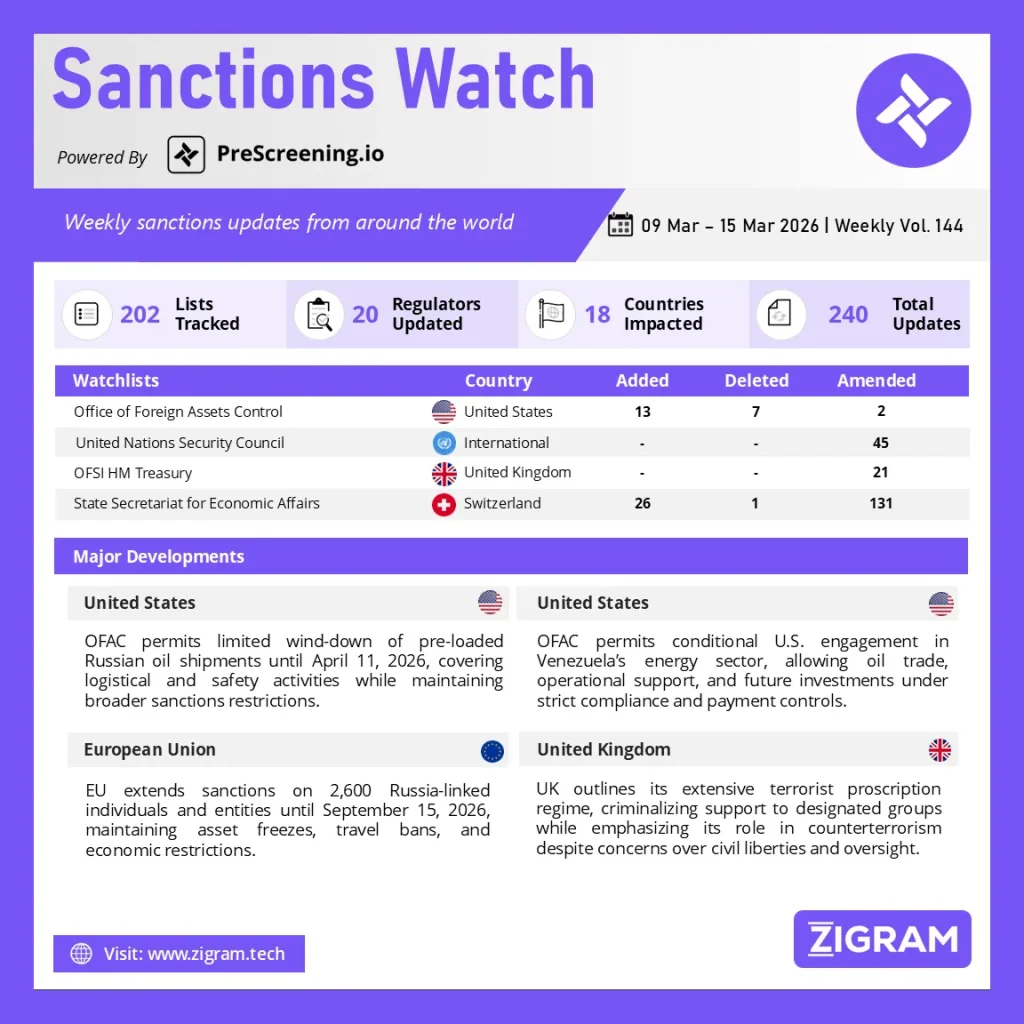
In the latest edition of our Sanctions Watch weekly digest, we present significant updates on sanction watchlists and regulatory developments.
1. U.S. OFAC Issues General License 134 Allowing Limited Wind-Down of Russian Oil Shipments Until April 11, 2026
The U.S. Department of the Treasury’s Office of Foreign Assets Control (OFAC) issued General License No. 134 on March 12, 2026, authorizing limited transactions related to Russian-origin crude oil and petroleum products under the Russian Harmful Foreign Activities Sanctions Regulations and the Ukraine-/Russia-Related Sanctions Regulations. The license permits activities ordinarily incident and necessary to the sale, delivery, or offloading of crude oil or petroleum products of Russian Federation origin loaded onto vessels on or before 12:01 a.m. EDT on March 12, 2026, with the authorization valid until 12:01 a.m. EDT on April 11, 2026.
The authorization covers operational and logistical activities required to complete shipments already in transit. These include transactions related to safe docking and anchoring of vessels carrying the cargo, protection of crew health and safety, emergency repairs, environmental mitigation, and maritime services such as vessel management, crewing, bunkering, piloting, registration, flagging, insurance, classification, and salvage.
However, the license does not authorize any other transactions or activities prohibited under other executive orders or sanctions regulations not referenced in the license. In particular, it excludes transactions involving Iran, the Government of Iran, or Iranian-origin goods or services that remain restricted under the Iranian Transactions and Sanctions Regulations, except where specifically authorized.
The license therefore provides a time-limited authorization allowing previously loaded Russian oil shipments to be delivered and offloaded, while maintaining the broader U.S. sanctions restrictions targeting Russia and other sanctioned jurisdictions.
2. OFAC Issues General Licenses 46B, 48A, and 49A Authorizing Limited Oil, Energy, and Investment Activities in Venezuela Under Strict Conditions
The U.S. Department of the Treasury’s Office of Foreign Assets Control (OFAC) issued General Licenses 46B, 48A, and 49A on March 13, 2026, introducing limited authorizations under the Venezuela Sanctions Regulations (31 CFR part 591) to allow certain transactions involving Venezuela’s oil, gas, petrochemical, and electricity sectors while maintaining key sanctions restrictions.
General License 46B authorizes established U.S. entities (formed on or before January 29, 2025) to engage in transactions related to the lifting, exportation, sale, transport, refining, storage, or marketing of Venezuelan-origin oil and petrochemical products for import into the United States. Contracts must be governed by U.S. law, and payments to blocked persons must be directed to Foreign Government Deposit Funds or other accounts specified by the U.S. Treasury.
General License 48A permits U.S. persons to supply goods, technology, software, and services necessary for the exploration, development, and production of oil, gas, petrochemical products, and electricity operations in Venezuela, including maintenance and logistics support. The license requires commercially reasonable payment terms and mandates detailed reporting of transaction parties, goods, values, and payments to Venezuelan authorities.
General License 49A authorizes negotiations and entry into contingent contracts for new investment in Venezuela’s oil, gas, petrochemical, and electricity sectors, provided the contracts become effective only after obtaining separate OFAC authorization.
Across all three licenses, OFAC maintains restrictions on transactions involving certain jurisdictions such as Russia, Iran, North Korea, Cuba, and certain China-linked entities, and continues to prohibit dealings with blocked vessels or the unblocking of sanctioned property.
3. EU Renews Restrictive Measures Against Russia-Linked Targets Over Ukraine’s Territorial Integrity
The Council of the European Union announced on 14 March 2026 that it has extended its restrictive measures targeting individuals and entities responsible for undermining or threatening the territorial integrity, sovereignty, and independence of Ukraine for an additional six months, until 15 September 2026.
The sanctions framework will continue to apply to approximately 2,600 individuals and entities designated in response to Russia’s ongoing military aggression against Ukraine. These restrictive measures include travel bans for individuals, asset freezes, and prohibitions on making funds or other economic resources available to listed persons and entities.
As part of the periodic review of the sanctions list, the Council also decided not to renew the listings of two individuals and to remove five deceased persons from the sanctions register.
The EU first introduced sanctions against Russia following its actions in Ukraine and significantly expanded them after 24 February 2022, when Russia launched a full-scale invasion. The measures aim to weaken Russia’s economic capacity, restrict access to critical technologies and markets, and reduce its ability to sustain the war.
The European Union reiterated its continued and unwavering support for Ukraine’s independence, sovereignty, and territorial integrity within its internationally recognized borders and confirmed that it will maintain comprehensive political, financial, humanitarian, military, and diplomatic support for Ukraine in coordination with international partners. The EU also emphasized its commitment to maintaining and increasing pressure on Russia to end its aggression and pursue meaningful peace negotiations.
4. UK Maintains Broad Terror Proscription Regime Covering Global Extremist Group
The UK House of Commons Library published a research briefing on 11 March 2026 outlining the legal framework and application of proscribed terrorist organizations under the Terrorism Act 2000. The legislation empowers the Home Secretary to designate organizations as “concerned in terrorism” if they commit, prepare, promote, or support terrorist acts. Proscription applies broadly to formal and informal groups, including diffuse international networks, and is used as a key counterterrorism tool.
Once an organization is proscribed, a range of criminal offences apply, including membership, support, promotion, organizing meetings, or displaying symbols linked to the group. These measures function similarly to sanctions by restricting financial flows, activities, and public support. The UK maintains an extensive list of proscribed organizations, including Islamist extremist groups, separatist movements, and far-right networks, with periodic additions such as Hizb ut-Tahrir, Terror gram, and others in recent years.
The framework also provides mechanisms for appeals and de-proscription; however, removal is generally application-based and infrequent. Reviews by independent experts have raised concerns about proportionality, lack of periodic reassessment, and potential impacts on civil liberties and humanitarian operations. Despite these concerns, the UK government continues to rely on proscription as a central instrument to disrupt terrorist activity, support international counterterrorism efforts, and signal political opposition to extremist organizations.
Know more about the product: PreScreening.io
Click here to book a free demo.
Sanctions Watch is a weekly recap of events and news related to sanctions around the world.
- #OFAC
- #VenezuelaSanctions
- #UKSanctions
- #SanctionsCompliance
- #IranSanctions
- #UKSanctions
- #GlobalSanctions
- #FinancialCrime
- #ExportControls
- #TradeSanctions
- #GlobalSanctions
- #OFACLicenses