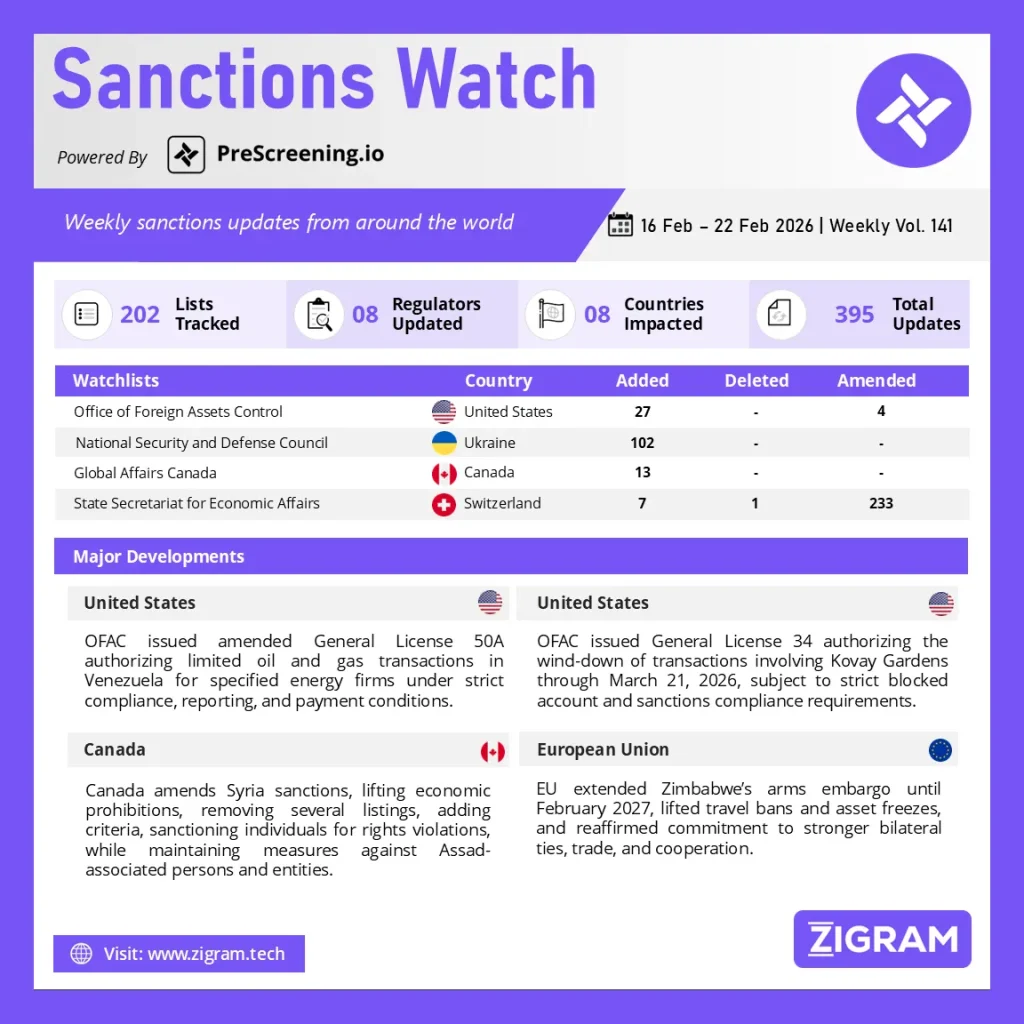
Sanctions Watch Vol 141
In the latest edition of our Sanctions Watch weekly digest, we present significant updates on sanction watchlists and regulatory developments.
1. U.S. Treasury Expands Authorization for Key Energy Firms Under Amended Venezuela General License 50A
The U.S. Department of the Treasury’s Office of Foreign Assets Control (OFAC) issued amended General License 50A, authorizing certain transactions related to oil and gas sector operations in Venezuela for specified international energy companies. The updated license replaces and supersedes General License 50 in its entirety and provides a structured compliance pathway for continued operations by major global firms including BP PLC, Chevron Corporation, Eni S.p.A., Repsol S.A., Shell PLC, and Maurel & Prom.
Under GL 50A, authorized transactions involving the Government of Venezuela and Petróleos de Venezuela, S.A. (PdVSA) must adhere to strict conditions. Contracts must be governed by U.S. law with dispute resolution in the United States, and monetary payments to blocked persons—excluding local taxes and fees—must be directed into designated Foreign Government Deposit Funds. The license maintains safeguards by prohibiting debt swaps, gold payments, digital currency transactions (including the petro), and dealings involving certain restricted jurisdictions.
Additionally, companies must submit detailed transaction reports within ten days of initiating activity and every 90 days thereafter. The amendment reflects a calibrated regulatory approach balancing sanctions enforcement with structured energy sector engagement.
2. U.S. Treasury Authorizes Wind-Down of Transactions Involving Kovay Gardens Under General License 34
The U.S. Department of the Treasury’s Office of Foreign Assets Control (OFAC) issued General License No. 34, authorizing the orderly wind-down of transactions involving Kovay Gardens under the Global Terrorism Sanctions Regulations (31 CFR part 594) and the Illicit Drug Trade Sanctions Regulations (31 CFR part 599).
The general license permits all transactions ordinarily incident and necessary to wind down activities involving Kovay Gardens or any entity in which it owns, directly or indirectly, a 50 percent or greater interest. This authorization remains in effect through Eastern Daylight Time on March 21, 2026.
Importantly, any payments made to blocked persons must be directed into a blocked account in accordance with applicable sanctions regulations. The license does not authorize new business dealings or transactions otherwise prohibited under the GTSR or IDTSR, including dealings with other blocked individuals or entities unless separately authorized.
This action provides clarity and a defined compliance pathway for affected parties, enabling them to responsibly conclude outstanding obligations while maintaining the integrity of U.S. sanctions enforcement.
3. Canada Eases Broad Syria Sanctions, Imposes New Targeted Measures on Human Rights Violators
Canada’s Minister of Foreign Affairs, Anita Anand, announced significant amendments to the Special Economic Measures (Syria) Regulations. The changes lift broad economic sanctions that had been in place since May 2011 and were linked to the former Assad regime. The amendments ease restrictions on the import and export of goods, investment activities, and the provision of financial and other services, including telecommunications monitoring and petroleum-related transactions.
Canada has also removed 24 entities and one individual from its sanctions list to reduce barriers to economic activity and facilitate transactions with state-affiliated institutions critical to Syria’s recovery.
At the same time, Canada introduced two new listing criteria to target individuals and entities responsible for gross and systematic human rights violations or actions undermining Syria’s peace, security, and stability. Under these new measures, six individuals have been newly sanctioned. Four are linked to sectarian violence in March 2025, while two were involved in financing the Assad regime’s chemical and ballistic missile programs.
Sanctions remain in place against 32 entities and 229 individuals associated with the former regime. Canada reaffirmed its commitment to supporting Syria’s recovery while holding perpetrators of human rights abuses accountable.
4. EU Renews Arms Embargo on Zimbabwe Until 2027, Lifts Travel Bans and Asset Freezes
The European Union has completed its annual review of restrictive measures concerning Zimbabwe, announcing a balanced policy update. The Council has decided to extend the existing arms embargo for another year, until 20 February 2027, maintaining its longstanding position on security-related concerns. At the same time, the EU has lifted all provisions related to the possibility of imposing travel bans and asset freezes, signaling a shift toward a more constructive and forward-looking engagement with Zimbabwe.
The decision reflects the EU’s intention to recalibrate its approach while preserving targeted measures deemed necessary. The arms embargo remains in place in view of the situation in Zimbabwe, consistent with Council Decision (CFSP) 2026/383 and Council Regulation (EU) 2026/384 adopted on 17 February 2026. These measures update and amend the existing framework originally established in 2002 and revised in 2011.
The EU reaffirmed its commitment to strengthening bilateral relations with Zimbabwe across areas of mutual interest, including trade, investment, and development cooperation. Officials emphasized continued monitoring of the situation and the effectiveness of the measures, underscoring the EU’s readiness to adapt its policies in response to future developments.
Know more about the product: PreScreening.io
Click here to book a free demo.
Sanctions Watch is a weekly recap of events and news related to sanctions around the world.
- #OFAC
- #VenezuelaSanctions
- #PdVSA
- #EnergySectorCompliance
- #GlobalSanctions
- #KovayGardens
- #CanadaSanctions
- #SyriaRegulations
- #EUArmsEmbargo
- #ZimbabwePolicy