Sanctions Watch Vol 138
In the latest edition of our Sanctions Watch weekly digest, we present significant updates on sanction watchlists and regulatory developments.
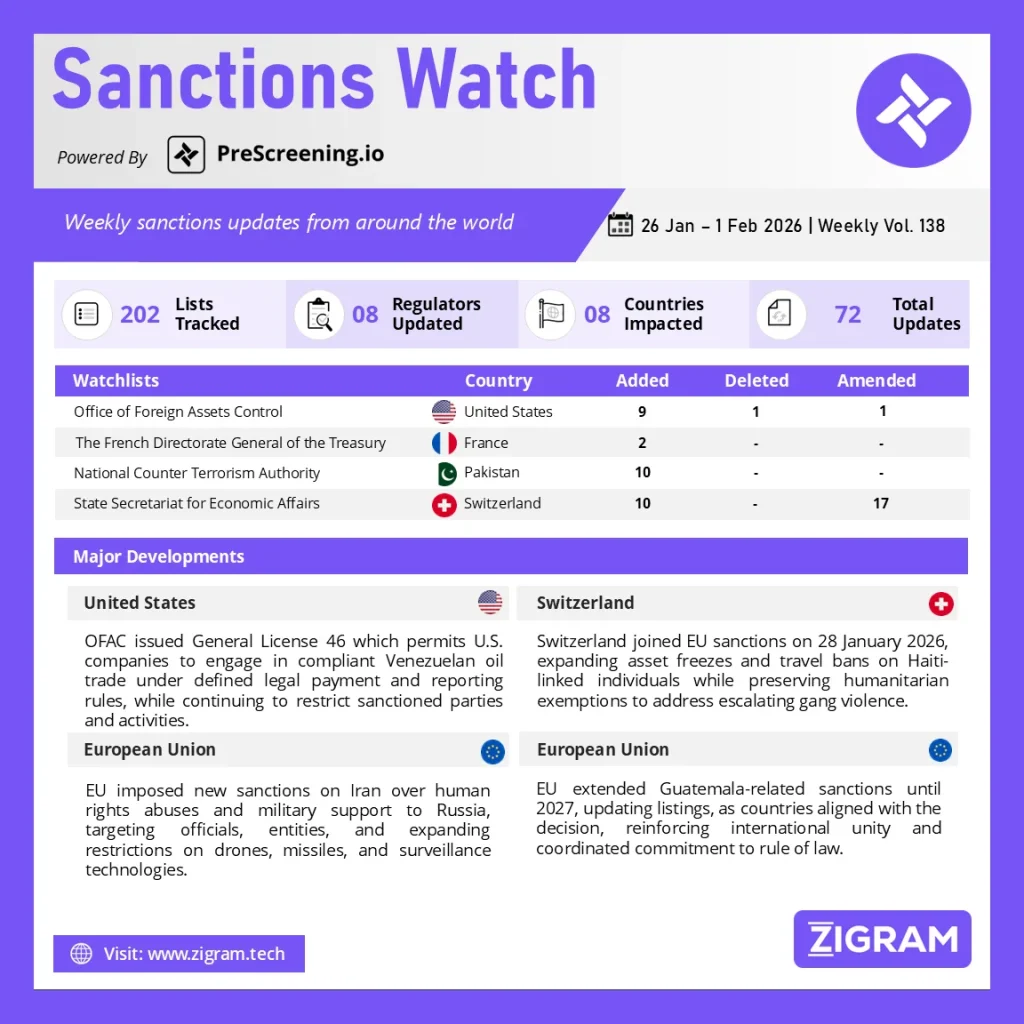
U.S. Eases Venezuela Oil Sanctions with General License 46, Enabling Regulated Energy Trade
The U.S. Department of the Treasury’s Office of Foreign Assets Control (OFAC) issued General License No. 46 (GL 46) on January 29, 2026, authorizing certain transactions involving Venezuelan-origin oil. The license allows established U.S. entities to engage in activities such as the lifting, export, refining, transportation, storage, and sale of Venezuelan oil, including dealings with Petróleos de Venezuela, S.A. (PdVSA) and the Government of Venezuela, under clearly defined compliance conditions.
GL 46 is designed to support lawful energy trade while maintaining strong safeguards. Contracts must be governed by U.S. law, disputes must be resolved within the United States, and payments to blocked parties must be routed through designated government deposit accounts. The license also permits related logistics services such as shipping, marine insurance, and port operations, enabling smoother operational execution for compliant firms.
Importantly, the authorization includes strict exclusions: transactions involving sanctioned jurisdictions (such as Russia, Iran, or North Korea), digital currency payments, gold payments, or blocked vessels remain prohibited. Reporting obligations further enhance transparency for exports beyond the U.S. market.
Overall, GL 46 represents a pragmatic step toward stabilizing energy supply chains while preserving the integrity of U.S. sanctions enforcement—a constructive signal for compliant energy and compliance-focused organizations.
Switzerland Strengthens International Cooperation by Joining EU Sanctions to Support Stability in Haiti
Switzerland has reinforced its commitment to international peace and security by joining the European Union’s sanctions framework aimed at curbing escalating gang violence in Haiti. On 28 January 2026, the Swiss Federal Council decided to extend the existing Ordinance on Measures Concerning Haiti, aligning it with the EU’s targeted restrictive measures. The new provisions entered into force at 11:00 pm on the same day.
The Ordinance, initially introduced in December 2022, was previously limited to United Nations sanctions. These UN measures include a nationwide arms embargo, as well as asset freezes and travel bans imposed on eleven individuals and entities linked to destabilizing activities in Haiti. With the latest extension, Switzerland will now apply asset freezes and travel restrictions to an additional ten individuals and entities designated under the EU sanctions regime.
This decision reflects Switzerland’s proactive response to the worsening security situation and the severe humanitarian crisis affecting the Haitian population. Importantly, the Federal Council has reaffirmed its strong support for humanitarian efforts. The Ordinance continues to provide broad humanitarian exemptions, ensuring that life-saving aid and relief operations remain unaffected by the sanctions.
By joining the EU measures, Switzerland underscores its role as a responsible global actor, supporting coordinated international action to promote stability, protect civilians, and encourage a path toward peace and recovery in Haiti.
EU Takes Strong Stand: New Sanctions on Iran Signal Firm Commitment to Human Rights and European Security
In a decisive move to uphold human rights and safeguard European security, the Council of the European Union adopted a new package of sanctions against Iran on 29 January 2026. The measures target both serious human rights violations within Iran and Tehran’s continued military support to Russia’s war of aggression against Ukraine.
On the human rights front, the EU imposed restrictive measures on 15 individuals and six entities involved in the violent repression of peaceful protests in Iran. Those sanctioned include senior officials, judicial authorities, and security force commanders responsible for arbitrary detentions, intimidation, and abuse of demonstrators. Several entities linked to censorship, internet shutdowns, surveillance technologies, and disinformation campaigns were also listed, reinforcing the EU’s commitment to freedom of expression and access to information. With this decision, EU human-rights-related sanctions on Iran now cover 247 individuals and 50 entities.
In parallel, the EU expanded sanctions related to Iran’s military support to Russia, targeting four individuals and six entities involved in Iran’s drone, missile, and UAV programmes. The Council also strengthened export restrictions on sensitive technologies used in missile and drone development.
Overall, these measures send a clear and positive signal: the EU stands firmly with the Iranian people, defends international law, and remains resolute in countering threats to peace, human dignity, and European security.
EU Extends Guatemala Sanctions as 11 Countries Align, Reinforcing United Front on Rule of Law
The European Union has reaffirmed its commitment to promoting democracy, accountability, and the rule of law in Guatemala by extending its restrictive measures until 13 January 2027. On 9 January 2026, the Council adopted Decision (CFSP) 2026/881, renewing the existing sanctions framework and updating the listings of five individuals subject to targeted measures. These actions are aimed at addressing ongoing concerns related to governance and the rule of law situation in the country.
In a strong show of international solidarity, eleven countries—Albania, Armenia, Bosnia and Herzegovina, Iceland, Liechtenstein, Moldova, Montenegro, North Macedonia, Norway, Serbia, and Ukraine—have formally aligned themselves with the EU’s decision. By committing to bring their national policies into conformity with the Council Decision, these countries underscore a shared dedication to upholding international norms and coordinated foreign policy responses.
The European Union has welcomed this alignment, noting it as a positive signal of unity and cooperation beyond its member states. Such collective action enhances the credibility and effectiveness of restrictive measures, sending a clear message of support for democratic principles and accountability. Overall, the decision highlights sustained international engagement with the situation in Guatemala and reflects a broad consensus on the importance of coordinated measures to encourage positive change.
Know more about the product: PreScreening.io
Click here to book a free demo.
Sanctions Watch is a weekly recap of events and news related to sanctions around the world.
- #SanctionsUpdate
- #OFAC
- #EnergySanctions
- #EUSanctions
- #HumanRights
- #GlobalSecurity
- #InternationalTrade
- #Compliance
- #RuleOfLaw
- #Geopolitics