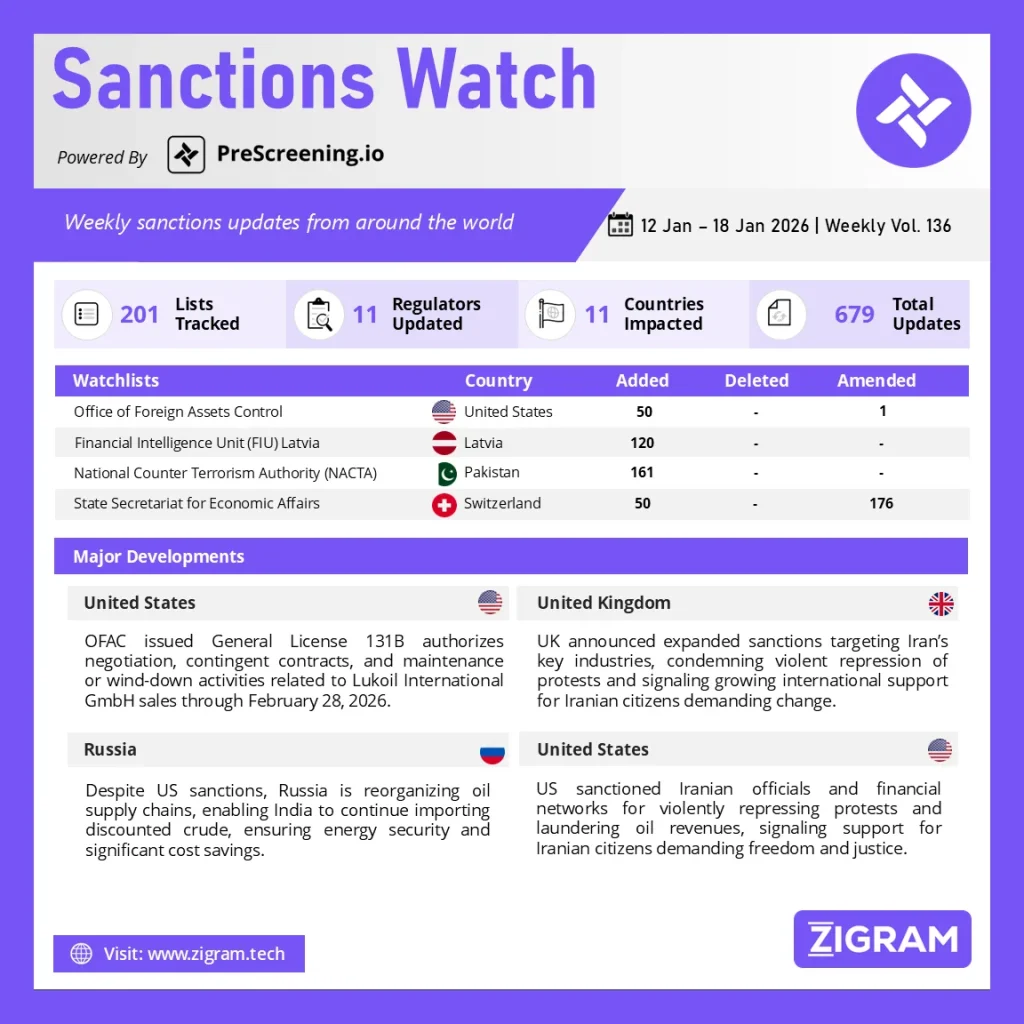
Sanctions Watch Vol 136
In the latest edition of our Sanctions Watch weekly digest, we present significant updates on sanction watchlists and regulatory developments.
OFAC Grants Extended Authorization for Negotiation and Maintenance Activities Related to Lukoil International GmbH Sale
The U.S. Department of the Treasury’s Office of Foreign Assets Control (OFAC) has issued General License No. 131B, providing extended regulatory relief by authorizing certain transactions related to the potential sale of Lukoil International GmbH (LIG) and its majority-owned entities. This license permits activities that are ordinarily incident and necessary for the negotiation and entry into contingent contracts, as well as the maintenance or wind-down of LIG operations, through February 28, 2026
Importantly, the authorization allows parties to engage in preparatory and contractual discussions—such as memoranda of understanding, bids, or agreements in principle—provided that the execution of any final sale remains expressly contingent on separate OFAC approval. This ensures continued compliance with Executive Order 14024 while enabling structured exit or divestment planning
The license also allows the use of blocked accounts for limited operational maintenance and wind-down activities, offering practical flexibility to stakeholders managing existing obligations. However, it maintains strict safeguards by prohibiting fund transfers to Russia and transactions involving other blocked persons unless separately authorized.
Overall, General License 131B reflects OFAC’s balanced approach—supporting orderly divestment and risk mitigation while preserving the integrity of U.S. sanctions enforcement.
Global Pressure Mounts on Iran as UK and EU Back Protesters with Sweeping Sanctions
The international pressure on Iran is intensifying as the UK and European Union move decisively to support protesters facing violent repression. The UK has announced “full and further sanctions” targeting Iran’s key industries, including finance, energy, transport, and software, signalling a strong and coordinated response to the killings and mass arrests linked to ongoing demonstrations. Foreign Secretary Yvette Cooper confirmed that new legislation will expand existing measures against Iran’s oil, nuclear, and financial systems, reinforcing the UK’s commitment to accountability and human rights.
In a significant diplomatic step, the Iranian ambassador was summoned by the UK Foreign Office, underlining Britain’s condemnation of the regime’s actions. Cooper rejected Iran’s claims that the protests are driven by foreign interference, calling them propaganda and reaffirming that the world is closely watching Tehran’s response to its own citizens.
Momentum is also building across Europe. European Commission President Ursula von der Leyen announced that the EU will swiftly propose additional sanctions against those responsible for suppressing demonstrations. Germany’s chancellor, Friedrich Merz, went further, stating that a regime reliant on force to survive may be nearing its end.
Together, these developments mark a strengthening international stance, offering renewed hope and solidarity to Iranians demanding change and accountability.
India Secures Affordable Energy as Russian Oil Supplies Adapt to Sanctions Pressure
India’s access to affordable energy is set to remain stable despite intensified US sanctions on Russian oil, offering reassurance to both policymakers and industry. Although recent sanctions targeting major Russian exporters such as Rosneft and Lukoil initially reduced India’s crude imports, market analysts indicate that Russia is rapidly restructuring its supply chains to keep oil flowing to key partners like India.
New intermediary exporters have emerged, allowing Indian refineries to continue sourcing Russian crude without directly violating sanctions. As a result, most of India’s large refineries remain operationally secure, with expectations that import volumes will soon rebound to earlier levels. This adaptability underscores the resilience of global energy trade and India’s ability to safeguard its national interests.
Crucially, Russian oil continues to be significantly cheaper—by $9–10 per barrel—than Middle Eastern alternatives, translating into potential annual savings of nearly $4 billion for Indian refiners. For a country that imports around 90% of its oil, these cost advantages support economic stability, help contain inflation, and protect consumers from energy price shocks.
Market confidence reflects this outlook, with global oil prices easing as traders discount the likelihood of sustained supply disruption. Overall, India’s energy security remains strong, supported by diversified sourcing, pragmatic policy, and evolving global supply chains.
US Takes Strong Action to Support Iranian Protesters, Sanctions Officials Behind Crackdown
The United States has taken a decisive step in support of the Iranian people by imposing new sanctions on senior Iranian security officials and financial networks accused of violently repressing peaceful anti-government protests. Announced by US Treasury Secretary Scott Bessent, the measures target individuals allegedly responsible for orchestrating a brutal crackdown, as well as shadow banking networks accused of laundering billions of dollars in oil revenues abroad.
Among those sanctioned is Ali Larijani, secretary of Iran’s Supreme Council for National Security, along with several regional commanders of Iran’s law enforcement and Revolutionary Guard units. According to US authorities, these officials played key roles in directing force against demonstrators, particularly in Fars and Lorestan provinces, where hospitals were reportedly overwhelmed by gunshot victims.
In addition to targeting security officials, the sanctions also designate 18 individuals and entities involved in complex financial networks operating through countries such as the UAE, Singapore, and the UK. These networks are accused of diverting massive oil revenues while ordinary Iranians face severe economic hardship.
The sanctions freeze any US-based assets and bar American entities from doing business with those designated, while also warning foreign financial institutions of potential secondary sanctions. US officials emphasized that the action reflects Washington’s commitment to standing with the Iranian people in their pursuit of freedom, justice, and accountability.
Know more about the product: PreScreening.io
Click here to book a free demo.
Sanctions Watch is a weekly recap of events and news related to sanctions around the world.
- #Sanctions
- #OFACUpdates
- #IranProtests
- #HumanRights
- #GlobalSanctions
- #EnergySecurity
- #RussianOil
- #UKandEUSanctions
- #USForeignPolicy
- #FinancialCrime