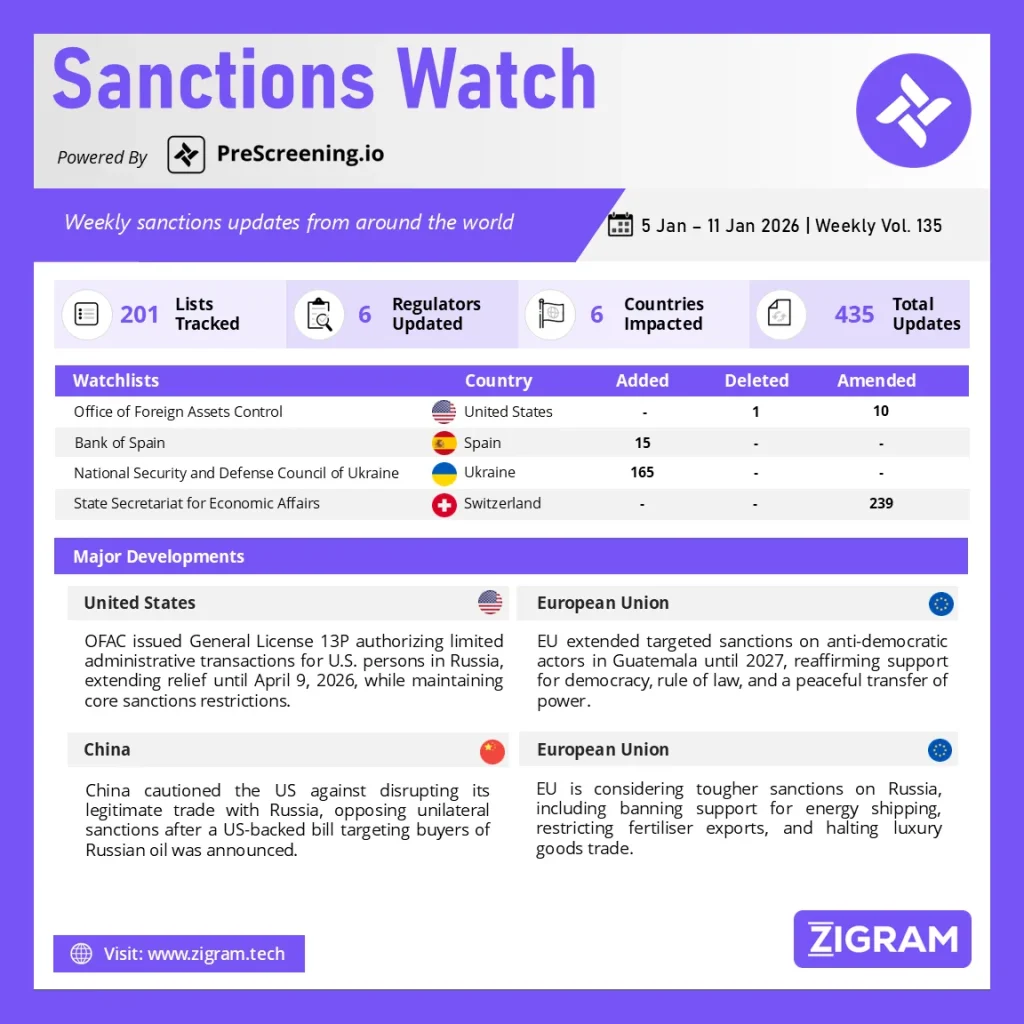
Sanctions Watch Vol 135
In the latest edition of our Sanctions Watch weekly digest, we present significant updates on sanction watchlists and regulatory developments.
OFAC Issued Amended Russia-Related General License, Extending Operational Relief for U.S. Businesses Until 2026
The U.S. Department of the Treasury’s Office of Foreign Assets Control (OFAC) has issued General License No. 13P, an amended Russia-related general license that provides continued regulatory clarity and operational relief for U.S. persons and U.S.-owned or controlled entities operating in the Russian Federation
Under this amended license, U.S. persons are authorized to engage in certain administrative and compliance-related transactions that would otherwise be prohibited by Directive 4 of Executive Order 14024. These permitted activities include the payment of taxes, fees, and import duties, as well as the purchase or receipt of permits, licenses, registrations, certifications, and tax refunds, provided they are ordinarily incident and necessary for day-to-day operations in Russia. Importantly, the authorization is valid through 12:01 a.m. EDT on April 9, 2026, offering long-term certainty for affected entities.
The license maintains key safeguards by excluding any debits to accounts held by the Central Bank of the Russian Federation, the National Wealth Fund, or the Ministry of Finance of the Russian Federation, and it does not override prohibitions involving blocked persons under the Russian Harmful Foreign Activities Sanctions Regulations.
Effective January 6, 2026, General License 13P replaces and supersedes General License 13O, ensuring continuity while reinforcing compliance boundaries. Overall, the amendment is a positive development, enabling lawful business continuity while preserving the integrity of U.S. sanctions policy.
- EU
Reaffirms Support for Democracy in Guatemala by Extending Targeted Sanctions Against Anti-Democratic Actors
The European Union has renewed its targeted restrictive measures against individuals and entities responsible for undermining democracy, the rule of law, and the peaceful transfer of power in Guatemala, extending them until 13 January 2027. This decision underscores the EU’s continued commitment to safeguarding democratic institutions while ensuring that sanctions remain narrowly focused and do not harm Guatemala’s population or economy.
The measures currently apply to eight individuals and one entity. Those listed face travel bans within the EU and are subject to asset freezes, with EU citizens and companies prohibited from providing them with financial resources. Importantly, these actions are designed to hold accountable only those directly responsible for anti-democratic conduct, reinforcing the principle of targeted accountability rather than broad economic sanctions.
The renewal builds on the EU’s broader engagement with Guatemala, including the deployment of an EU Election Observation Mission in 2023, firm support for the election results, and ongoing assistance for good governance and human rights. Looking ahead, the EU plans to accompany key institutional selection processes in 2026, including appointments to the Supreme Electoral Tribunal, Constitutional Court, and the Attorney General’s office.
Overall, the extension of these measures sends a positive signal of international support for Guatemala’s democratic transition and reinforces the EU’s long-term partnership aimed at promoting stability, rule of law, and inclusive development.
China Firmly Rejects U.S. Interference in Trade with Russia Amid New Sanctions Bill Push
China has issued a strong diplomatic warning to the United States, urging Washington not to interfere in its economic and trade relations with Russia after reports emerged that President Donald Trump had backed a bipartisan sanctions bill targeting Moscow. Beijing reiterated its long-standing principle of opposing “illicit and unilateral sanctions,” with Foreign Ministry spokeswoman Mao Ning emphasizing that China’s normal commercial ties with Russia are legitimate, lawful, and should not be disrupted.
The proposed U.S. legislation, championed by Senator Lindsey Graham alongside colleagues from both parties, seeks to give the U.S. president expanded authority to penalize countries that buy discounted Russian oil, a measure intended to weaken the financial support for Moscow’s war in Ukraine. The bill could potentially put pressure on major energy importers such as China, India, and Brazil, according to comments by the senator.
China’s warning reflects broader tensions over secondary sanctions and the use of trade policy as leverage in geopolitical disputes. Beijing has maintained that its economic engagement with Russia is based on mutual benefit and does not target third parties, while stressing that its sovereign trade decisions should not be subject to external coercion.
EU Moves Toward Stronger Sanctions as Sweden Pushes to Cut All Support to Russian Energy Shipping
The European Union is preparing to significantly tighten its sanctions regime against Russia, following a strong push from Sweden to close remaining loopholes in the energy and trade sectors. Sweden’s Foreign Minister Maria Malmer Stenergard has urged the EU to introduce a comprehensive ban on all European support services for Russian oil, gas, and coal shipping fleets. This would include prohibitions on transport assistance, ship-to-ship transfers, insurance coverage, port repairs, and other logistical services that enable Russia’s energy exports.
As the EU drafts its 20th sanctions package since Russia’s invasion of Ukraine in 2022, the proposed measures signal a decisive step toward reducing Moscow’s revenue streams. Energy exports remain Russia’s primary source of income, and cutting off shipping support would directly weaken its ability to move commodities to global markets.
Sweden has also called for sanctions on Russian fertiliser exports, which represent Russia’s third-largest export to the EU. While tariffs were imposed in 2025, full sanctions would further reduce dependency and reinforce supply-chain resilience. Additionally, the proposal seeks to end EU luxury goods exports to Russia, addressing concerns over ongoing high-end consumer trade despite the conflict.
Overall, these developments reflect growing EU unity and resolve to increase economic pressure on Russia through stricter enforcement, broader sectoral coverage, and reduced tolerance for sanctions circumvention.
Know more about the product: PreScreening.io
Click here to book a free demo.
Sanctions Watch is a weekly recap of events and news related to sanctions around the world.
- #Sanctions
- #GlobalSecurity
- #MilitaryIndustrialComplex
- #InternationalLaw
- #ArmsProliferation
- #DefenseIndustry
- #GeopoliticalTensions
- #HumanRights
- #EconomicPressure
- #GlobalStability