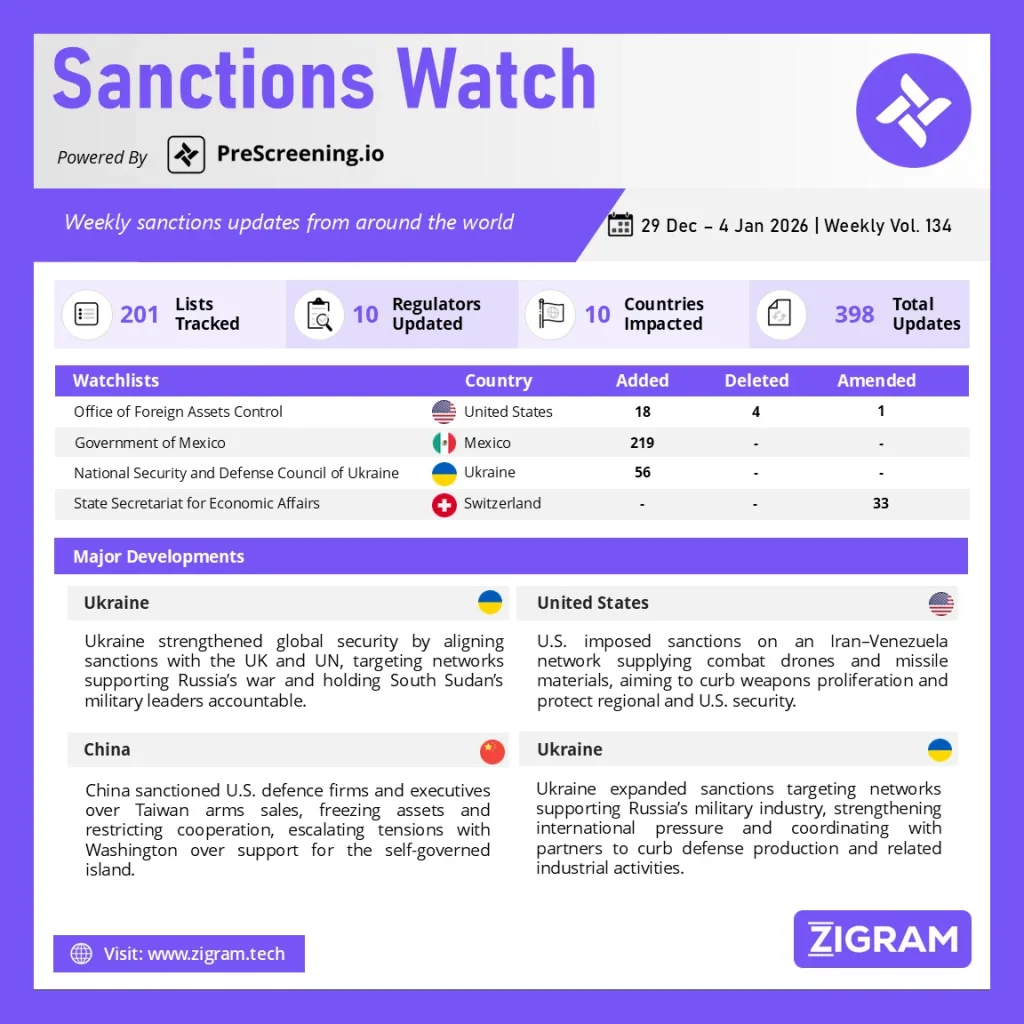
Sanctions Watch Vol 134
In the latest edition of our Sanctions Watch weekly digest, we present significant updates on sanction watchlists and regulatory developments.
Ukraine Strengthens Global Security Ties by Aligning Sanctions with UK and Upholding UN Resolutions
The Ukraine has taken a significant step in reinforcing international security and accountability by synchronizing its sanctions regime with the United Kingdom and implementing restrictions in line with United Nations Security Council resolutions. President Volodymyr Zelenskyy signed two decrees enacting decisions of the National Security and Defense Council, underscoring Ukraine’s commitment to coordinated global action against aggression and human rights abuses.
The first decision aligns Ukrainian sanctions with those of the UK, targeting eight individuals and 40 legal entities involved in serious violations, including the forced deportation and so-called “re-education” of Ukrainian children and the supply of electronics and dual-use components used in Russian missile and drone production. The sanctioned entities span multiple jurisdictions, reflecting Ukraine’s determination to disrupt international networks that help Russia evade sanctions, support its military-industrial complex, and sustain illicit energy and shadow-fleet operations. In total, Ukraine has now synchronized 14 sanctions packages with key international partners in 2025, demonstrating growing diplomatic coordination.
The second decision reinforces Ukraine’s support for international law by imposing sanctions pursuant to UN Security Council and EU decisions concerning South Sudan. These measures target senior military leaders responsible for prolonging conflict and committing grave acts of violence against civilians. Together, these actions highlight Ukraine’s role as a responsible global actor committed to peace, justice, and the protection of human rights.
U.S. Sanctions Disrupt Iran–Venezuela Drone Supply Network
The United States Treasury Department has announced a new round of sanctions targeting a network involved in the procurement, sale and assembly of Iranian-designed drones supplied to Venezuela, marking a significant step in curbing illicit weapons proliferation. The sanctions, unveiled on December 31, focus on 10 entities and individuals linked to Iran’s military-industrial complex and its cooperation with Caracas.
Among those designated are Iran’s Qods Aviation Industries (QAI) and its chair, accused of coordinating drone exports with Iran’s already-sanctioned Ministry of Defense and Armed Forces Logistics. Venezuela’s Empresa Aeronáutica Nacional SA and its chair were also sanctioned for negotiating the import, assembly and maintenance of Iranian-made unmanned aerial vehicles used by the Venezuelan armed forces, including drones capable of deploying air-to-ground guided munitions.
In addition, the U.S. sanctioned three Iran-based individuals and multiple chemical companies involved in procuring missile-related chemicals on behalf of Parchin Chemical Industries, a key player in Iran’s defense sector.
U.S. officials emphasized that the measures aim to cut off access to the American financial system for those enabling the spread of advanced weapons. The State Department warned that Iran’s continued transfer of combat drones and missile components to Venezuela undermines regional stability and violates international restrictions, reaffirming Washington’s commitment to countering such threats.
China Sanctions 30 US Defence Firms and Executives Over Taiwan Arms Deal
China has imposed sanctions on 30 United States entities and individuals in response to Washington’s latest arms sale to Taiwan, intensifying already strained US-China relations over the self-governed island. Beijing’s Ministry of Foreign Affairs announced that 20 US defence companies and 10 senior executives are being targeted for their involvement in an $11.1bn weapons package approved by the US for Taiwan—one of the largest such deals in recent years.
The sanctions include asset freezes within China and a ban on cooperation between the targeted firms and Chinese individuals or organisations. Affected companies reportedly include Boeing’s St Louis branch, Northrop Grumman Systems Corporation, L3Harris Maritime Services, and Lazarus AI. China will also seize China-based assets of sanctioned individuals and prohibit them from entering the country. The measures took effect on December 26.
Beijing described the US arms sale as a “dangerous” provocation, warning that actions crossing China’s red lines on Taiwan would be met with firm retaliation. The weapons package includes HIMARS rocket systems, ATACMS missiles, self-propelled howitzers, and drones, aimed at strengthening Taiwan’s self-defence capabilities.
The US State Department strongly objected to the sanctions, reiterating its legal obligation to support Taiwan’s defence and urging China to pursue dialogue rather than military or economic pressure. Taiwan welcomed the deal, calling it vital for maintaining deterrence amid rising regional tensions.
Ukraine Strengthens Global Pressure on Russia’s War Machine with New Sanctions Push
The Ukrainian President Volodymyr Zelenskyy has taken another decisive step to curb Russia’s war-making capacity by signing a decree imposing sanctions on 95 individuals and 70 legal entities linked to Russia’s military-industrial complex. The move reinforces Ukraine’s broader strategy of weakening the economic and technological backbone supporting Russia’s aggression.
According to the presidential office, the sanctions target people and companies involved in servicing Russia’s state defense order, including enterprises producing communications equipment, electronic warfare systems, and microelectronics for military and security agencies. The measures also extend to major industrial sectors such as chemicals, extractive industries, metallurgy, and the fuel and energy complex—areas critical to sustaining military operations.
Most of those sanctioned are Russian citizens or residents, underlining the focus on domestic networks that enable the production and supply of military hardware. Importantly, Ukraine emphasized that these actions are not being taken in isolation. Kyiv is actively coordinating with international partners to ensure sanctions are synchronized across allied jurisdictions.
In a positive signal of growing international alignment, Ukrainian officials noted that several of these listings are expected to be included in the European Union’s forthcoming 20th sanctions package. This development highlights increasing global unity and sustained pressure aimed at limiting Russia’s ability to prolong the conflict.
Know more about the product: PreScreening.io
Click here to book a free demo.
Sanctions Watch is a weekly recap of events and news related to sanctions around the world.
- #Sanctions
- #GlobalSecurity
- #MilitaryIndustrialComplex
- #InternationalLaw
- #ArmsProliferation
- #DefenseIndustry
- #GeopoliticalTensions
- #HumanRights
- #EconomicPressure
- #GlobalStability