Nepal’s AML/CFT System in Numbers: Inside the Annual Report 2024-25, STRs Hit 9,565 as Digital Reporting Took Over
Why Nepal’s AML Numbers Matter in 2024/25
In February 2025, Nepal entered the FATF “Jurisdictions under Increased Monitoring” list, putting unprecedented pressure on its anti-money laundering and counter-terrorist financing (AML/CFT) system. Against this backdrop, the Financial Intelligence Unit of Nepal (FIU-Nepal) published an unusually data-heavy annual report for FY 2024/25, explicitly focusing on statistics, volumes, and operational outputs rather than institutional narrative.
The numbers tell a clear story: reporting surged, digital coverage expanded nationwide, and financial intelligence dissemination reached record levels — even as analytical capacity remains stretched.
This OSIN breaks down the year entirely through numbers.
- STRs Cross a Psychological Threshold
The headline figure of the year is unmistakable:
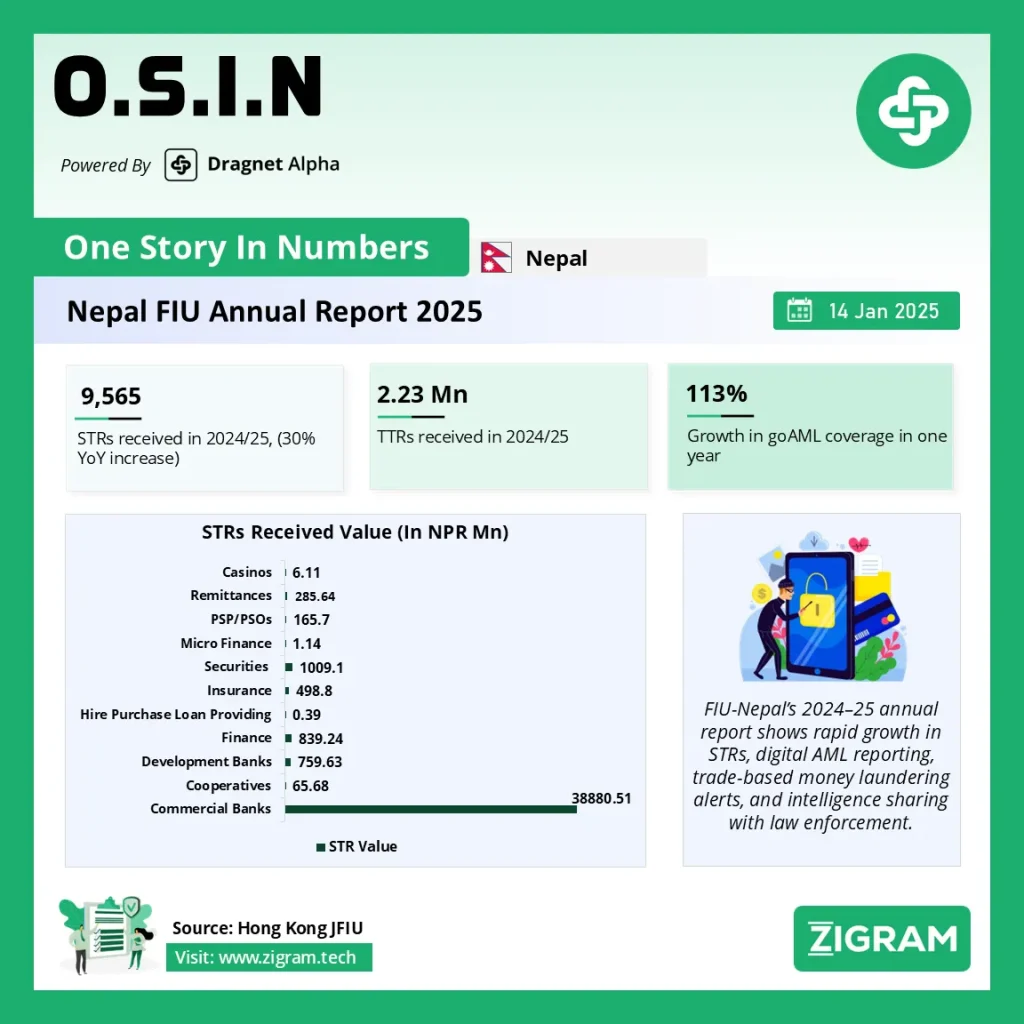
9,565 Suspicious Transaction / Activity Reports (STRs/SARs) were filed in FY 2024/25 — a 30% year-on-year increase from 7,338 in FY 2023/24 .
This continues a five-year growth curve:
Fiscal Year | STRs/SARs |
2020/21 | 1,533 |
2021/22 | 2,780 |
2022/23 | 5,935 |
2023/24 | 7,338 |
2024/25 | 9,565 |
In just four years, STR volumes increased more than six-fold, reflecting both rising compliance and rising risk exposure.
- Digital Reporting Reaches Full Penetration
For the first time since the launch of Nepal’s goAML system, 100% of STRs/SARs were submitted digitally.
- 98.37% of TTRs (Threshold Transaction Reports) were also filed via goAML
- Only 36,445 TTRs were submitted via hard copy, down sharply from 151,916 the previous year
This transition matters because FIU-Nepal’s analytical capacity is directly tied to digital intake — paper-based reporting previously delayed triage and case linkage.
- Reporting Entities Nearly Double in One Year
The number of entities integrated into goAML jumped from 1,639 to 3,497 in a single fiscal year — an increase of 113.36%.
The growth was especially pronounced in non-financial and high-risk sectors:
- Cooperatives: 1,010 → 1,766
- Dealers in Precious Metals & Stones: 121 → 1,121
- Money Changers: 128 → 203
- Payment Service Providers / Operators: 3,260 → 13,922 TTRs reported
By October 2025, 4,098 entities (REs, LEAs, and supervisors combined) were connected to the system nationwide.
- STR Reporting Is No Longer Bank-Only
Commercial banks still dominate STR reporting — but less so than before.
In FY 2024/25:
- Commercial banks filed 7,303 STRs, accounting for 76.4% of all STRs
- This share declined from 84.2% the year before, as insurance companies, securities firms, PSPs, and cooperatives increased reporting
This diversification is critical for FATF effectiveness outcomes, which emphasize DNFBP and non-bank coverage.
- Total TTRs Surge Past 2.2 Million
FIU-Nepal received 2,236,067 TTRs in FY 2024/25 — a 31.7% increase from the previous year.
Key contributors:
- BFIs: 1.11 million
- Securities companies: 768,741
- Insurance companies: 260,631
- PSPs/PSOs: 13,922
Notably, TTRs from non-bank entities now account for ~50% of all TTRs, up from 35% the year before — a structural shift in Nepal’s AML data landscape .
- Analysis Capacity Lags Reporting Growth
While reporting volumes exploded, analysis capacity struggled to keep pace:
- 2,282 STRs/SARs were analyzed, representing ~24% of total submissions
- This was a 39.6% increase from the previous year, but still far below intake growth
- 1,337 STRs/SARs were postponed due to low risk, incomplete data, or insufficient suspicion
The report explicitly acknowledges capacity constraints and the need for automation and AI-assisted triage.
- Dissemination Reaches Record Highs
FIU-Nepal disseminated 945 intelligence reports to law enforcement and regulators — the highest annual figure to date.
After removing duplicates sent to multiple agencies:
- 908 unique STRs/SARs were disseminated
Five-year trend:
- 2020/21: 192
- 2021/22: 409
- 2022/23: 505
- 2023/24: 889
- 2024/25: 908
This near-five-fold increase since 2020 reflects growing operational maturity.
- Nepal Police Absorb the Bulk of Intelligence
Agency-wise dissemination shows a heavy investigative concentration:
- Nepal Police: 845 disseminations
- Inland Revenue Department: 30
- Department of Revenue Investigation: 17
- CIAA (anti-corruption): 6
- Nepal Insurance Authority: 2
This highlights Nepal Police as the primary downstream consumer of AML intelligence .
- Predicate Offences Shift Toward Fraud and Tax
STRs/SARs increasingly reflect economic crime rather than generic ML labels.
Top predicate offence categories in FY 2024/25 include:
- Money & banking offences
- Tax-related offences
- Fraud-related offences
- Firm/company misuse
- Corruption and bribery
Importantly, new categories appeared for the first time, including:
- Virtual currency-related STRs
- Hundi-related informal value transfer
- Undue transactions
- Trade-Based Money Laundering (TBML) Detection Improves
TBML-related STRs nearly doubled, rising from 22 to 43 year-on-year.
Although TBML is not a standalone predicate offence under Nepalese law, FIU-Nepal introduced dedicated reporting fields for A-class banks, resulting in:
- Better typology capture
- Granular sub-categories (over-/under-invoicing, fake documents, phantom shipments)
What the Numbers Ultimately Say
Nepal’s AML/CFT system in FY 2024/25 shows three simultaneous realities:
- Compliance and coverage expanded rapidly
- Digital infrastructure reached maturity
- Analytical depth remains the bottleneck
The numbers demonstrate progress — but also explain why FATF continues to demand effectiveness over volume.
For OSIN readers, the message is clear: Nepal is reporting more than ever — the next test is converting data into convictions.
Click here to read the full report.
Please read about our product: Dragnet Alpha
Click here to book a free demo
- #STR
- #CFT
- #HongKong
- #STR
- #FinancialCrime
- #MoneyLaundering
- #Nepal
- #FIU
- #Compliance
- #FinancialIntelligence