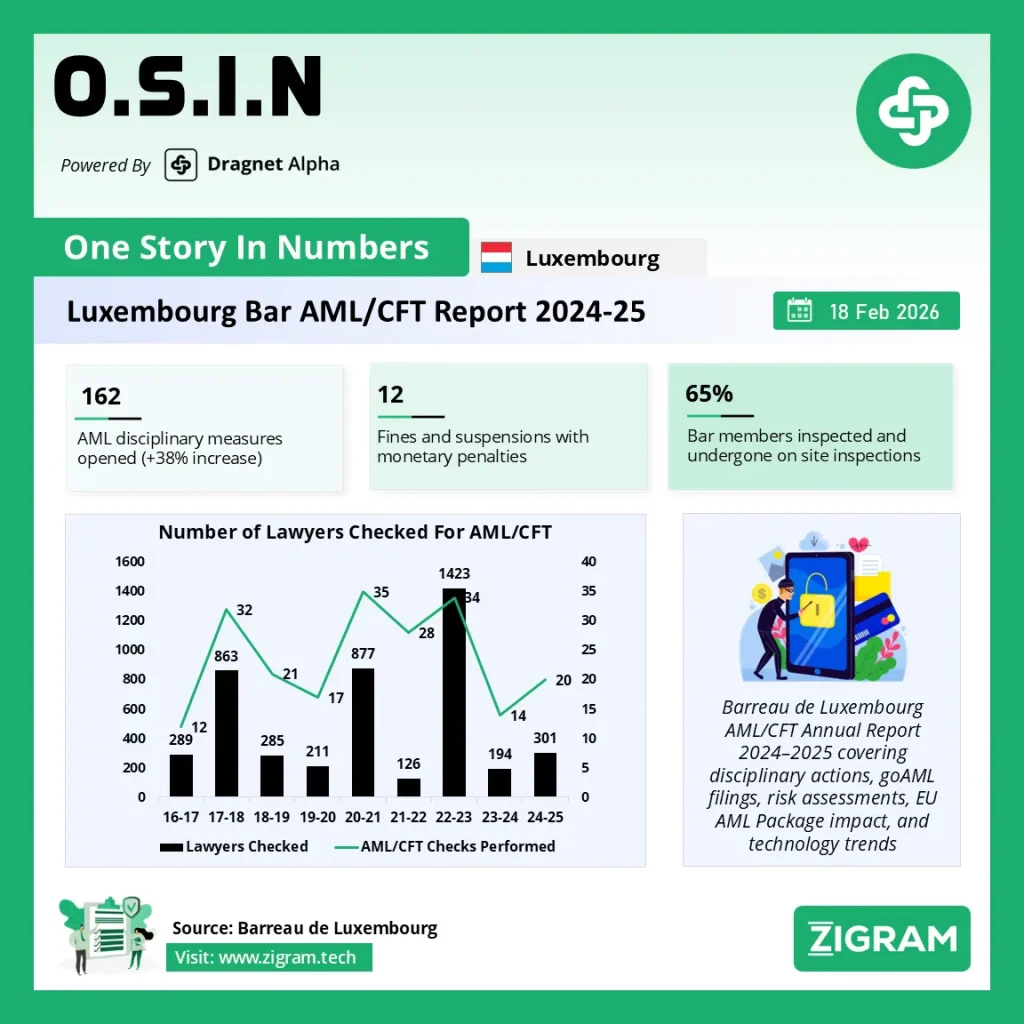
Luxembourg Bar AML/CFT Report 2024–2025: Supervisory Trends, Sanctions, goAML Reporting & What Compliance Leaders Must Prepare For
Executive Overview
The Barreau de Luxembourg’s AML/CFT Annual Report 2024–2025 provides one of the most detailed supervisory disclosures among EU self-regulatory bodies. Issued pursuant to Article 8-14 of Luxembourg’s AML Law, the report outlines enforcement statistics, risk assessments, suspicious transaction reporting trends, supervisory methodology, and preparations for the EU AML Package reforms .
For compliance professionals — particularly within legal, fiduciary, and non-financial sectors — this report offers three critical signals:
- Supervision is intensifying and becoming increasingly data-driven.
- Non-cooperation is treated as a material compliance breach.
- Preparation for the EU AML Authority (AMLA) and AMLR/AMLD6 reforms is already underway.
This article distills the findings into actionable intelligence.
- Legislative & Regulatory Developments: A Rapidly Evolving Framework
The 2024–2025 judicial year saw significant amendments to Luxembourg’s AML/CFT framework , including:
- Creation of a Committee for Prevention of Money Laundering and Terrorist Financing
- Amendments expanding predicate offences to all crimes and misdemeanors
- Changes affecting the Register of Beneficial Owners (RBE)
- Expanded provisions relating to restrictive measures and sanctions coordination
- Preparation for implementation of the EU AML Package (AMLR, AMLD6, AMLA)
Key EU Development
The EU AML Regulation (AMLR) will become directly applicable from 10 July 2027, alongside AMLD6 transposition requirements .
Why this matters for compliance leaders:
- Supervisory architecture will change.
- National public authorities must oversee self-regulatory bodies.
- Obligations for lawyers and non-financial gatekeepers will expand.
- Risk-based supervision will be formalised and harmonised at EU level.
Luxembourg is already structurally preparing for this transition.
- Enforcement & Disciplinary Actions: The Compliance Cost of Non-Response
The report reveals a marked supervisory assertiveness.
162 AML Disciplinary Procedures Opened (2024–2025)
This represents a 3.8% increase year-on-year .
Breakdown of Sanctions
- 162 disciplinary procedures opened
- 6 fines imposed
- 6 temporary suspensions
- 6 publications of decisions
- 5 referrals to disciplinary council
- 1 appeal before CDAA
What Triggered Most Actions?
The majority stemmed from:
- Failure to respond to mandatory AML questionnaires
- Non-cooperation during supervisory reviews
This demonstrates a key supervisory philosophy:
Failure to cooperate = AML/CFT breach
For compliance officers, this reinforces the operational necessity of:
- Centralised questionnaire management
- Defined accountability ownership
- Escalation frameworks
- Evidence retention systems
- goAML Reporting: Suspicious Activity Reporting Trends
Between 15 September 2024 and 14 September 2025:
- 76 declarations were submitted by lawyers to the CRF
- 66 suspicious activity reports
- 2 suspicious transaction reports
- 8 follow-up information reports
The Bâtonnier forwarded 75 out of 76 reports (98.7%) to the Financial Intelligence Unit .
Registration Coverage
- 1270 persons registered on goAML
- 1085 reporting entities linked
- 90.5% of law firms registered
- 99.5% registration rate confirmed after verification campaign
Trend Analysis
- +12% increase in declarations compared to prior year
- Long-term growth in reporting engagement
- Quality of reports improving (as noted by CRF)
Strategic Takeaway
Luxembourg’s legal profession shows:
- High reporting engagement
- Strong adoption of digital reporting
- Improved qualitative reporting standards
For other jurisdictions, this provides a benchmark model for self-regulated professions.
- Risk-Based Supervision: Data, Algorithms & Targeted Controls
On-Site Controls Since 2016
- 213 AML/CFT on-site inspections conducted
- 2,225 lawyers covered
- 65% of members inspected in nine years
In 2024–2025 alone:
- 20 on-site AML controls
- 301 lawyers covered (8.4% of bar members)
Mandatory Online Questionnaires (Three in 2024–2025)
- Sub-sectoral PSSF mandates review
- Infrastructure questionnaire
- General AML annual questionnaire
Algorithmic Risk Scoring
The Bar uses Strix™ AML, a supervisory risk assessment tool with:
- Off-site questionnaire module
- Risk evaluation module
- Statistical analysis module
This allows:
- Sectoral risk analysis
- Individualised risk scoring
- Resource allocation optimisation
- Targeted inspection selection
This represents mature supervisory RegTech adoption.
- Identified Compliance Weaknesses
The supervisory commission highlighted recurring gaps :
- Inadequate understanding of business relationships
- Weak critical analysis of collected KYC data
- Insufficient individual risk assessment
- Limited understanding of terrorist financing risks
- Internal procedure updates lagging behind legislative changes
- Training gaps for AML compliance officers
Implications for Law Firms
Firms should review:
- Client risk scoring methodology
- Beneficial ownership verification processes
- TF-specific risk mapping
- Internal AML training curriculum
- Policy update governance cycles
- Whistleblowing & Reporting Channels
Only one AML-related whistleblowing report was received during the period .
While usage remains limited, the existence of a formal channel demonstrates compliance with Article 8-3 AML Law requirements.
- Training & Capacity Building
The Bar delivered:
- 11 AML/CFT training sessions
- Monthly thematic sessions
- Targeted sessions on:
- Targeted financial sanctions (TFS)
- Beneficial ownership
- Individual risk assessment
- Cooperation with authorities
- Initial due diligence measures
A new mandatory e-learning platform will launch in Q1 2026, including:
- Mandatory base module
- Tiered expertise modules
- Centralised AML training repository
This is consistent with FATF expectations around continuous professional development.
- FATF & International Positioning
The report confirms:
- No specific negative findings regarding Bar supervision in Luxembourg’s FATF MER
- Recognition of strong domestic coordination
- 100% technical compliance score in horizontal review of gatekeepers
However:
The next FATF evaluation cycle has already begun.
Supervisory intensity is therefore unlikely to decrease.
- What This Means for Compliance Professionals
Key Strategic Conclusions
- Supervisory digitalisation is accelerating.
Risk-scoring tools, structured questionnaires, and statistical monitoring are now core.
- Cooperation failures are heavily sanctioned.
Administrative non-response can lead to suspension and publication.
- goAML registration is nearly universal.
Digital STR submission maturity is high.
- EU AML reforms will structurally reshape supervision.
Self-regulatory bodies will face oversight from national public authorities under AMLA architecture.
- Risk-based supervision is fully embedded.
Inspection targeting is no longer random — it is algorithmic.
Frequently Asked Questions (AEO Optimised)
How many AML disciplinary procedures were opened in Luxembourg in 2024–2025?
162 procedures were opened, mainly due to non-response to AML questionnaires .
How many suspicious reports did lawyers file?
76 reports between September 2024 and September 2025 .
What percentage of lawyers have been inspected since 2016?
65% of members have undergone AML on-site inspection .
Is Luxembourg preparing for AMLA supervision?
Yes. The report confirms active preparation for AMLR, AMLD6, and the new EU supervisory framework .
Final Outlook: A Model of Structured Self-Regulation
The Luxembourg Bar’s AML/CFT framework reflects:
- Advanced supervisory maturity
- Strong integration of RegTech
- High cooperation rates
- Systematic risk-based oversight
- Proactive EU AML Package preparation
For compliance leaders across Europe, this report serves as both:
- A benchmark of best practice
- A preview of what AMLA-driven supervision will require
As the EU AML architecture transitions toward centralised oversight, Luxembourg’s structured self-regulation model may become a blueprint for the non-financial sector.
Source: AML Report 2024-25
Please read about our product: Dragnet Alpha
Click here to book a free demo
- #OSIN
- #DataProtection
- #Privacy
- #CNIL
- #GDPR
- #Fines2025
- #Compliance