CNIL 2025: Fewer Sanctions, Nine Times the Fines
France’s Data Protection Enforcement Enters a High-Impact Phase
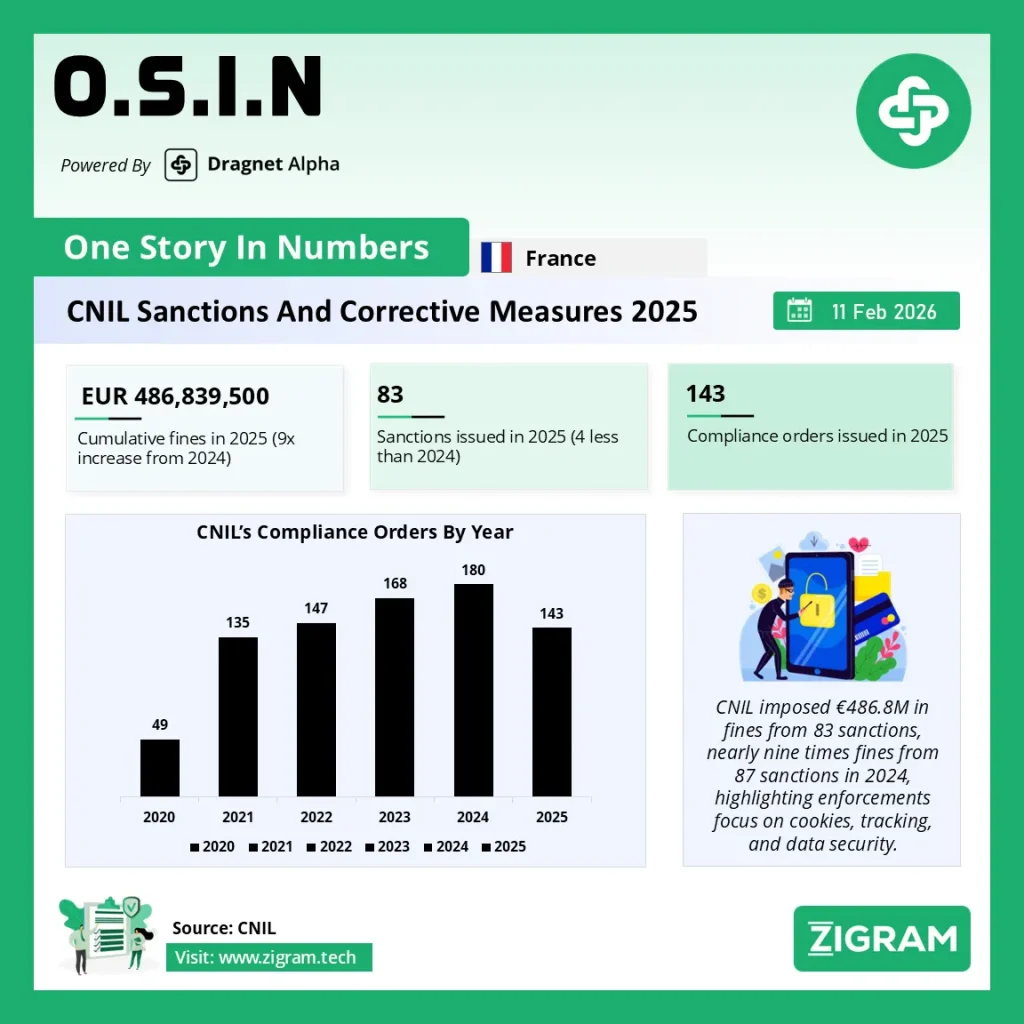
In 2025, France’s data protection authority, the Commission Nationale de l’Informatique et des Libertés (CNIL), fundamentally altered the financial weight of GDPR enforcement. While the number of sanctions remained broadly stable year-on-year, the monetary consequences escalated dramatically.
According to CNIL’s official 2025 enforcement publication, the regulator imposed:
- 83 sanctions
- Total fines of €486,839,500
By comparison, in 2024 CNIL recorded:
- 87 sanctions
- Total fines of €55,212,400
- 331 corrective measures overall (including reprimands and compliance orders)
The numerical contrast is stark: 2025 fines were nearly nine times higher than 2024, despite slightly fewer sanction decisions.
This is not an increase in activity. It is an increase in impact.
The Core Shift: From Volume to Financial Signal
At face value, enforcement volume remained stable:
- 2024: 87 sanctions
- 2025: 83 sanctions
A decline of just four decisions.
However, the average financial weight per sanction shifted sharply:
- 2024 average fine per sanction ≈ €634,600
- 2025 average fine per sanction ≈ €5.86 million
This reflects a structural pivot toward:
- Larger penalties per case
- More strategic, high-visibility enforcement
- Concentration of total fine value in fewer high-profile decisions
In regulatory terms, CNIL appears to have transitioned from broad corrective signalling to capital-intensive deterrence.
Where Enforcement Focused in 2025
CNIL’s 2025 enforcement themes concentrated around:
- Cookie and tracker consent failures
- Data security weaknesses
- Employee monitoring practices
- Transparency and lawful basis issues
Cookies and tracking mechanisms remain a long-running CNIL priority, but 2025 demonstrates that non-compliance in this area now carries materially higher financial consequences.
Employee monitoring also continues to be scrutinised, particularly where employers deploy disproportionate or insufficiently disclosed surveillance mechanisms.
Data security failures — especially in large-scale data processing environments — continue to drive financial penalties.
The shift is not thematic; it is economic.
Corrective Measures vs Monetary Sanctions
The 2024 dataset provides an important benchmark: while fines totalled €55.2 million, CNIL issued 331 corrective measures across the year.
This shows that:
- Enforcement is not exclusively punitive.
- CNIL maintains a layered toolkit: warnings, reprimands, compliance orders, and fines.
- Monetary sanctions represent only one part of the enforcement architecture.
By contrast, 2025’s defining feature is that the financial component overshadowed the corrective volume narrative.
The enforcement model appears to be evolving toward:
- Maintaining routine corrective oversight.
- Deploying large fines selectively to reshape market behaviour.
Concentration Risk: The Power of a Few Large Decisions
A key analytical insight in 2025 is that a limited number of large penalties account for a substantial share of the €486.8 million total.
This creates two implications:
- Enforcement financial totals can spike dramatically without a proportional increase in case numbers.
- Regulatory risk for large technology and digital ecosystem actors is disproportionately higher than for smaller controllers.
This is typical of mature GDPR enforcement cycles: early years emphasise compliance education and corrective action; later cycles escalate financial deterrence.
2025 suggests CNIL is firmly in the latter stage.
Procedural Mechanics: Simplified Sanctions Continue
Both 2024 and 2025 relied heavily on simplified sanctioning procedures, which CNIL uses for clearer or less complex cases.
This indicates:
- Operational efficiency in processing violations.
- Continued emphasis on procedural standardisation.
- A mature enforcement pipeline.
The surge in total fines is therefore not a function of procedural overhaul — but of substantive enforcement choice.
What This Means for Organisations
- Financial Exposure Has Escalated
The jump from €55 million to €486 million in one year fundamentally alters board-level risk perception.
GDPR penalties are no longer an abstract compliance cost — they represent strategic financial exposure.
- Cookie Compliance Is No Longer Tactical
CNIL’s continued focus on tracking technologies demonstrates that web compliance is not peripheral. It is core enforcement terrain.
- High-Risk Themes Are Stable
The regulatory priorities did not radically change between 2024 and 2025:
- Consent
- Transparency
- Security
- Monitoring
What changed was the penalty magnitude attached to breaches in these domains.
- Large Digital Actors Face Disproportionate Risk
Given that a handful of large fines drive most of the 2025 total, global technology companies and high-volume data processors face structurally higher enforcement exposure.
Systemic Interpretation
The numbers point to three structural conclusions:
- Enforcement intensity has matured.
CNIL is no longer building jurisprudence — it is scaling financial deterrence. - Regulatory signalling has shifted from frequency to force.
Stable sanction counts but exponential fine growth indicates strategic calibration. - Data protection enforcement is entering a capital-risk phase.
The cost of non-compliance now competes with other major regulatory exposures such as competition law and financial misconduct penalties.
The One Story in Numbers
- 83 sanctions in 2025.
- €486.8 million in fines.
- 87 sanctions in 2024.
- €55.2 million in fines.
- Nearly 9× increase in financial impact.
The story is not about more cases.
It is about bigger consequences.
Source: CNIL official sanctions summaries 2025 and 2024
Please read about our product: Dragnet Alpha
Click here to book a free demo
- #OSIN
- #DataProtection
- #Privacy
- #CNIL
- #GDPR
- #Fines2025
- #Compliance