Botswana ML/TF National Risk Assessment 2025: Key AML Risks, Sectoral Vulnerabilities, and Strategic Insights for Compliance Leaders
Introduction: Why Botswana’s NRA 2025 Matters for AML Professionals
Botswana’s Money Laundering and Terrorist Financing National Risk Assessment (NRA) 2025 represents a critical benchmark in understanding evolving financial crime risks across Southern Africa. Conducted using the World Bank Risk Assessment Tool, the NRA evaluates threats, vulnerabilities, and systemic gaps across financial institutions, DNFBPs, and emerging sectors.
For AML compliance leaders, the report provides actionable intelligence on:
- Key predicate offences driving illicit proceeds
- Sector-specific vulnerabilities
- Regulatory and institutional effectiveness
- Emerging risks such as virtual assets and environmental crimes
Country Context and Financial System Overview
Botswana is a landlocked Southern African economy with:
- Population: ~2.36 million (2022 Census)
- Strong GDP per capita and high Human Development Index
- A well-regulated financial sector dominated by banks and retirement funds
The financial ecosystem includes:
- 9 commercial banks (mostly foreign-owned subsidiaries)
- 2 statutory banks
- Extensive non-bank financial institutions (insurance, securities, microlenders, MVTS)
- DNFBPs such as real estate agents, casinos, accountants, and legal practitioners
Additionally, Botswana has:
- ~141,252 legal persons and 1,971 legal arrangements
- A centralized beneficial ownership registry (OBRS)
- A national ID system (“Omang”) for customer verification
Overall ML/TF Risk Rating: Medium with Structural Exposure
The NRA concludes that:
- Overall Money Laundering Risk: Medium
- ML Threat: Medium | ML Vulnerability: Medium
Key Risk Drivers:
- Cross-border illicit financial flows
- Transnational organised crime
- Weak deterrence due to lenient sanctions
- Limited financial intelligence dissemination
- Resource constraints in AML enforcement
Botswana’s porous borders and regional integration further amplify exposure to cross-border laundering schemes.
Top AML Statistics from Botswana NRA 2025
For AML compliance leaders, the Botswana NRA provides critical quantitative insights into the scale, typologies, and enforcement gaps in financial crime. Below are the most important statistics shaping the country’s AML risk landscape:
Overall Risk Metrics
- Overall ML Risk: Medium
- ML Threat Level: Medium
- ML Vulnerability Level: Medium
Scale of Illicit Proceeds
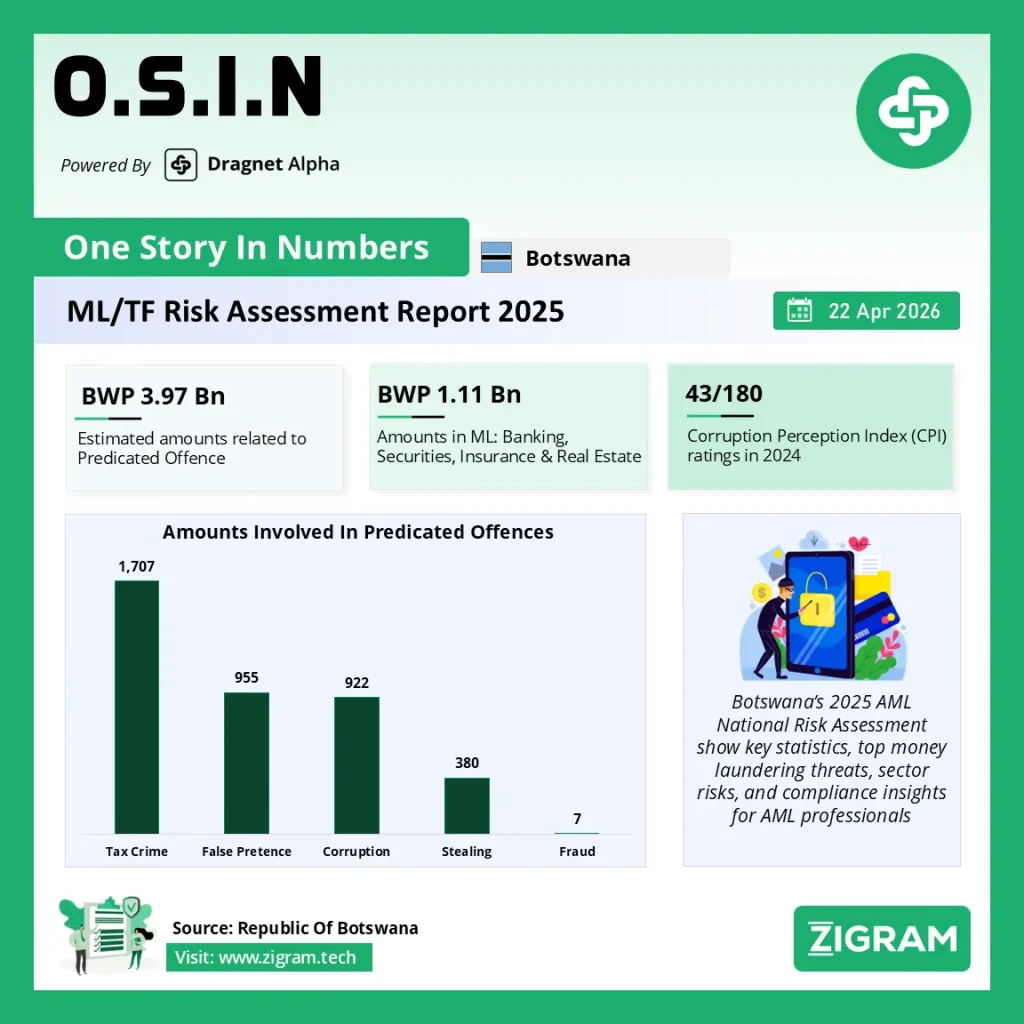
- Total estimated proceeds from predicate offences: BWP 6.29 billion
- Top 5 domestic offences generated: ~BWP 3.97 billion
Top Predicate Offences by Value
- Tax Crimes: BWP 1.7 billion (Highest contributor)
- Obtaining by False Pretence: BWP 955.8 million
- Corruption: BWP 922 million
- Stealing by Servant: BWP 380.4 million
- Fraud: BWP 6.8 million
Tax Crime Breakdown (Highest ML Driver)
- Total tax crime proceeds: BWP 1.7 billion
- Under-declaration of income cases: 1,451
- Non-remittance of PAYE: 61 cases
- Smuggling (non-declaration of goods): 1,936 cases
Fraud & Financial Crime Trends
- False pretence cases: 9,948 investigated
- Surge from 125 cases (2020) to 3,469 (2023)
- Fraud cases investigated: 19
- Fraud prosecutions: 0 (due to complexity and cross-border evidence issues)
Corruption Enforcement Data
- Total reported cases: 856
- Investigated: 163
- Prosecuted: 4
- Convictions: 3
Stealing by Servant
- Total cases: 1,003
- Total amount involved: BWP 380.4 million
- Total confiscated: ~BWP 877,000 (very low recovery rate)
Sectoral Exposure to Money Laundering
- Banking sector cases: 82 cases | BWP 649.7 million
- Securities sector: BWP 240 million
- Real estate: BWP 81.1 million
- Insurance: BWP 100.8 million
Sector Risk Ratings
- Highest ML Vulnerability: Real Estate
- Highest ML Threat Channel: Banking Sector
- High-risk emerging sector: Environment & Natural Resources (Medium-High risk)
Terrorist Financing Statistics
- Terrorist attacks recorded: 0
- Domestic TF threat: Very Low
- Overall TF risk: Medium (cross-border exposure driven)
Legal & Economic Structure
- Legal persons: 141,252
- Legal arrangements: 1,971
- Commercial banks: 9
- Statutory banks: 2
International Cooperation (2020–2024)
- Mutual Legal Assistance requests (outgoing): 281
- Extradition requests (outgoing): 50
- Extraditions granted: 6
Top Money Laundering Threats: Predicate Crimes Driving Illicit Flows
- Tax Crimes (Highest Risk Driver)
- Rated: Medium-High
- Largest contributor to illicit proceeds (~BWP 1.7 billion)
Key typologies:
- Under-declaration of income
- Non-remittance of PAYE
- Trade-based money laundering (TBML)
- Transfer pricing abuse and profit shifting
AML Insight: Tax crimes in Botswana are highly structured and often involve professionals (accountants, auditors), making detection complex.
- Obtaining by False Pretence
- Cases surged from 125 (2020) to 3,469 (2023)
Methods:
- Social engineering scams
- Fake online platforms
- Mobile and telecom-enabled fraud
Risk Signal: Digital fraud ecosystems are expanding rapidly, increasing exposure for banks and fintech channels.
- Corruption
- Rated: Medium risk
- 856 reported cases, but low prosecution and conviction rates
Patterns:
- Procurement corruption
- Abuse of public office
- Cross-border asset acquisition
- Stealing by Servant
- 1,003 cases recorded
- Weak internal controls and delayed detection increase risk
AML Gap: Low asset recovery rates due to delayed reporting and lack of parallel financial investigations.
- Fraud
- Increasing complexity, including pyramid schemes
- No prosecutions during the review period due to investigative challenges
External ML Threats: Transnational Crime Exposure
Wildlife Crime (High Risk)
- Linked to illegal ivory and rhino poaching
- Generates significant illicit proceeds
- Weak penalties reduce deterrence
Drug Trafficking (Medium Risk)
- Cross-border flows through regional trade routes
Strategic Insight: Environmental crime is emerging as a major AML priority, aligning with global FATF focus.
Sectoral Risk Assessment: Where the System is Most Vulnerable
Highest Risk Sectors
- Banking Sector
- Primary channel for laundering proceeds
- High exposure due to transaction volumes
- Real Estate
- Highest vulnerability sector
- Limited oversight + high-value transactions
- Enables layering and integration of illicit funds
- Precious Stones (Diamond Sector)
- High-value, cash-intensive transactions
- Weak traceability across the value chain
Moderate Risk Sectors
- Securities
- Insurance
- Legal structures
- MVTS and electronic payment systems
Lower Risk Sectors
- Casinos
- Accountants and auditors
- Trust service providers
- SACCOS and pension funds
Terrorist Financing Risk: Low Threat, Moderate Exposure
Key findings:
- No terrorist attacks recorded
- No confirmed domestic TF activity
- TF Threat: Very Low
However:
- Regional exposure (Mozambique insurgency) creates potential spillover risk
- Participation in SADC missions increases geopolitical exposure
Overall TF Risk:
- Medium (incoming, outgoing, transit)
- Medium-low (domestic)
Non-Profit Organisations (NPOs): Minimal Abuse Risk
- No evidence of misuse for terrorist financing
- Strong oversight mechanisms in place
Legal Persons & Beneficial Ownership Risks
Botswana has:
- A functioning BO registry via CIPA
- Access for reporting entities
Challenges:
- Limited access for some institutions
- Reliance on manual verification in certain cases
Virtual Assets and Emerging Risks
The NRA identifies Virtual Assets (VAs) and VASPs as emerging risk areas:
- Limited regulatory maturity
- Potential for cross-border anonymous transactions
AML Implication: Early-stage regulatory frameworks require strengthening to prevent exploitation.
Environmental and Natural Resource Crime Risks
Key sectors:
- Wildlife (poaching)
- Mining (illegal gold extraction)
- Forestry and waste management
Critical Issue:
- Lack of quantification of environmental crimes reduces AML effectiveness
Key AML/CFT Vulnerabilities Identified
Operational Weaknesses
- Limited forensic accounting expertise
- Delays in financial intelligence dissemination
- Weak parallel financial investigations
Regulatory Gaps
- Lenient penalties for ML offences
- Over-reliance on administrative sanctions (especially tax crimes)
- Inconsistent supervision across sectors
Systemic Risks
- Cash-intensive financial inclusion products
- Rapid cross-border fund movement
- Abuse of IFSC tax structures
Institutional Framework: Strong but Resource-Constrained
Key AML authorities:
- Financial Intelligence Agency (FIA)
- Directorate on Corruption and Economic Crime (DCEC)
- Bank of Botswana
- Directorate of Public Prosecutions (DPP)
Botswana also demonstrates:
- Active international cooperation (MLA, INTERPOL, Egmont)
- Regional engagement via ESAAMLG
Strategic Takeaways for AML Compliance Leaders
- Shift Toward Risk-Based Supervision
The NRA reinforces the need for:
- Sector-specific risk scoring
- Dynamic risk-based monitoring frameworks
- Focus on Tax Crime and Fraud Analytics
Given their dominance:
- Enhance transaction monitoring for tax evasion patterns
- Integrate behavioural analytics for fraud detection
- Strengthen Real Estate and DNFBP Oversight
- Improve KYC/EDD for property transactions
- Increase supervision of non-financial sectors
- Enhance Cross-Border Monitoring
- Deploy advanced AML tools for international transactions
- Monitor trade-based money laundering risks
- Build Capability in Financial Investigations
- Invest in forensic accounting and cybercrime expertise
- Improve asset tracing and recovery mechanisms
- Prepare for Emerging Risks
- Virtual assets
- Environmental crime financing
- Digital fraud ecosystems
Conclusion: A Balanced but Evolving Risk Landscape
Botswana’s AML/CFT framework is well-structured and institutionally mature, but its risk exposure remains shaped by:
- Economic openness
- Cross-border financial flows
- Emerging digital and environmental threats
The NRA 2025 underscores a critical message for compliance leaders:
The future of AML lies in proactive, data-driven, and cross-sector risk management.
For global AML professionals, Botswana offers a compelling case study of a “medium-risk jurisdiction with high strategic relevance”—where strengthening supervision, enforcement, and technological capabilities will define the next phase of compliance maturity.
If you want, I can now:
- Convert this into a ZIGRAM-style long-form newsletter (with “Read more”)
- Add meta title, description, keywords, and permalink
- Create infographic + banner copy for this article
- Or tailor it for FATF / regulator audience vs. marketing audience
- #AML
- #AntiMoneyLaundering
- #FinancialCrime
- #Compliance
- #RiskManagement
- #KYC
- #TransactionMonitoring
- #FinancialIntelligence
- #FraudPrevention
- #RegTech