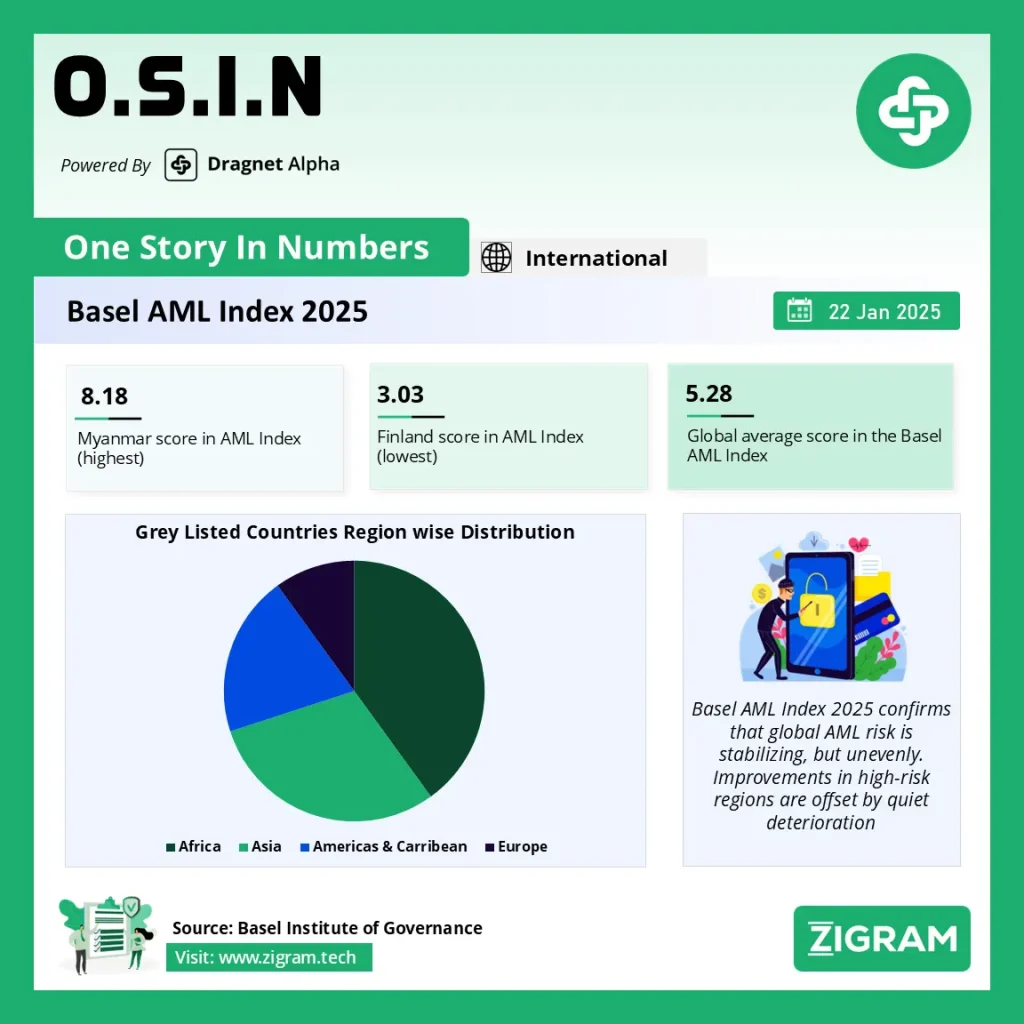
Basel AML Index 2025: The Numbers Behind Global Money-Laundering Risk
The Basel AML Index 2025, released in December 2025 by the Basel Institute on Governance, assesses 177 jurisdictions on their structural vulnerability to money laundering and related financial crimes, using a 0–10 risk scale (10 = highest risk).
Unlike FIU annual reports that focus on activity (STR volumes, investigations, penalties), the Basel AML Index measures systemic risk—how resilient or fragile a country’s institutions, governance, transparency, and legal frameworks are in preventing illicit finance.
For OSIN readers, this is a macro-risk lens that explains where AML systems are likely to fail, not where crime has already been detected.
- Global Risk in 2025: Flat, but Not Reassuring
The headline number for 2025:
- Global average risk score: 5.28
- 2024 global average: 5.30
The improvement is statistically insignificant, but important symbolically: global AML risk is not deteriorating further, even amid rising threats from virtual assets, cyber-enabled fraud, and geopolitical instability.
However, this global average masks two opposing trends:
- Improvements in higher-risk jurisdictions, especially in Sub-Saharan Africa
- Gradual deterioration among historically strong performers, particularly in parts of Europe and North America
The result, as Basel puts it, is a “slow drift towards the middle.”
- Coverage Expands, Risk Becomes More Nuanced
In 2025:
- 13 new jurisdictions were added due to improved data availability
- Total coverage increased to 177 jurisdictions
Basel also introduced a new three-tier risk categorisation, replacing the previously overcrowded middle band:
Risk Category | Score Range |
Lower risk | < 4.70 |
Medium risk | 4.70–6.08 |
Higher risk | > 6.08 |
This change is crucial for compliance teams because it supports proportional, risk-based AML controls, rather than binary “high-risk vs everyone else” thinking.
- Highest-Risk Jurisdictions in 2025
The top of the risk table remains dominated by jurisdictions with weak governance, limited enforcement capacity, and high corruption exposure.
Top 5 highest-risk jurisdictions (2025):
- Myanmar — 8.18
- Haiti — 8.12
- Democratic Republic of the Congo — 7.63
- Chad — 7.56
- Equatorial Guinea — 7.55
These countries are not necessarily major financial hubs, underscoring a core Basel insight:
Global ML risk is driven as much by institutional weakness as by financial scale.
- Lowest-Risk Jurisdictions: A New Leader
At the other end of the spectrum:
- Finland emerged as the lowest-risk jurisdiction globally in 2025, despite a modest score increase
- It is followed by Iceland and San Marino
Importantly, Basel stresses that “low risk” does not mean “no money laundering”—it means stronger resilience, transparency, and enforcement credibility.
Biggest Movers Up & Down (Year-on-Year)
One of the most OSIN-relevant sections of the report is the explicit list of top improvers and decliners, ranked by size of score change.
Top 10 Improvers (Risk ↓)
Jurisdiction | Direction |
Liberia | ↓ |
Mozambique | ↓ |
Burkina Faso | ↓ |
Nigeria | ↓ |
Mali | ↓ |
Tanzania | ↓ |
Côte d’Ivoire | ↓ |
Armenia | ↓ |
Philippines | ↓ |
Croatia | ↓ |
OSIN insight:
- 7 of the top 10 improvers are African countries
- Several improved sufficiently to exit the FATF grey list, reinforcing the link between action-plan implementation and structural risk reduction
📈 Top 10 Decliners (Risk ↑)
Jurisdiction | Direction |
Kazakhstan | ↑ |
Lithuania | ↑ |
Taiwan (Chinese Taipei) | ↑ |
Serbia | ↑ |
Costa Rica | ↑ |
Germany | ↑ |
Suriname | ↑ |
Barbados | ↑ |
Greece | ↑ |
Nicaragua | ↑ |
OSIN insight:
Risk deterioration is not confined to developing economies. Several advanced or mid-income jurisdictions saw worsening scores, largely driven by:
- Financial transparency weaknesses
- Corruption and fraud indicators
- Political and legal risk pressures
- Regional Patterns That Matter
Sub-Saharan Africa
- Regional average risk: 6.14 (still high)
- 70% of jurisdictions improved
- Six countries exited the FATF grey list in 2025
EU & Western Europe
- Roughly 40% of jurisdictions worsened
- Main weakness: financial transparency & standards
- Signals stagnation rather than collapse
South Asia
- Overall risk profile largely unchanged
- Financial transparency remains the weakest area
- No country in the region qualifies as “lower risk”
Bank-Facing OSIN Explainer
How Compliance Teams Actually Use the Basel AML Index
The Basel AML Index is not a regulatory list, but it is one of the most influential tools in institutional AML risk management.
Here’s how banks really use it.
Country Risk Rating (CRR) Calibration
Banks use Basel scores to cross-check internal country risk models.
- FATF status = regulatory signal
- Basel score = structural risk signal
If FATF compliance improves but Basel risk remains high, country risk ratings usually stay elevated.
Correspondent Banking Decisions
Basel AML Index data frequently appears in:
- Correspondent onboarding memos
- De-risking reviews
- Senior risk committee packs
A worsening Basel trajectory often triggers:
- Enhanced due diligence (EDD)
- Relationship caps or reviews
- Increased transaction scrutiny
Transaction Monitoring Calibration
Jurisdictions with higher Basel risk scores typically see:
- Lower alert thresholds
- Additional typology rules
- Stronger scrutiny in trade finance, remittances, PSP flows
This use is indirect but systematic.
Supporting Proportionate AML Controls
Basel’s new three-tier risk categorisation supports:
- Simplified measures for lower-risk jurisdictions
- Better resource allocation
- Reduced defensive over-reporting
This aligns closely with FATF’s renewed emphasis on proportionality.
Board and Regulator Communication
Because the Basel AML Index is:
- Independent
- Methodologically transparent
- Widely cited by policymakers
…it is often used to justify AML risk decisions during:
- Regulatory exams
- Internal audits
- Board-level risk discussions
What Basel Is Not Used For
❌ Not a sanctions substitute
❌ Not a trigger for STR filing
❌ Not a prediction of crime volumes
❌ Not a short-term operational metric
Basel is a strategic risk compass, not an enforcement scoreboard.
OSIN Bottom Line:
STRs show activity.
FATF shows compliance.
Basel shows vulnerability.
The Basel AML Index 2025 confirms that global AML risk is stabilizing, but unevenly. Improvements in high-risk regions are offset by quiet deterioration in traditionally strong systems, making continuous, evidence-based risk assessment essential.
Click here to read the full report.
Please read about our product: Dragnet Alpha
Click here to book a free demo
- #BaselAMLIndex
- #BaselInstitute
- #CountryRisk
- #Governance
- #Transparency
- #AML
- #CFT