Anti Money Laundering News (08 Dec – 14 Dec 2025)
Welcome to this week’s edition of the Global AML News Weekly Digest. Here are the top stories making headlines around the world:
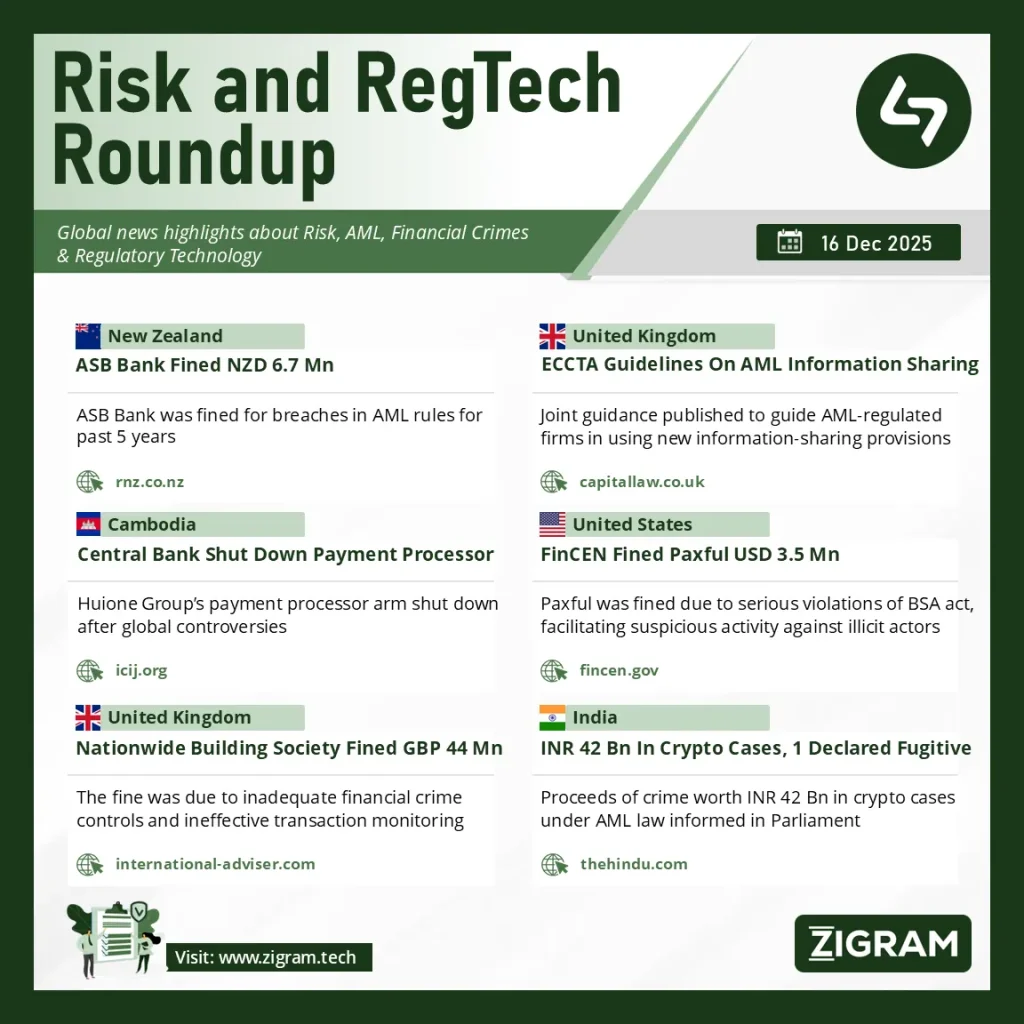
ASB Bank Agrees to NZ$6.7 Million Penalty for AML/CFT Rule Breaches
ASB Bank has admitted to seven breaches of New Zealand’s Anti-Money Laundering and Countering Financing of Terrorism (AML/CFT) rules, relating to failures in customer due diligence, transaction monitoring, suspicious activity reporting, and terminating business relationships, among other obligations. The Reserve Bank of New Zealand filed civil proceedings, and both ASB and the regulator have jointly recommended a penalty of NZ$6.7 million, with the final amount to be set by the High Court. ASB’s CEO acknowledged shortcomings in its systems and processes, apologised, and said the bank is enhancing its AML/CFT capabilities. It’s emphasised that there is no suggestion ASB was directly involved in money laundering or terrorism financing.
ECCTA Guidance on Anti-Money Laundering Information Sharing for AML-Regulated Firms
The Economic Crime and Corporate Transparency Act 2023 (ECCTA) introduced new information sharing provisions allowing anti-money-laundering (AML) regulated firms in the UK to share customer data with one another—either directly or via a third-party intermediary—to help prevent, detect, or investigate economic crime such as money laundering, terrorist financing, and fraud.
Updated joint guidance (published on 3 October 2025 by the Home Office, HM Treasury, the Ministry of Justice, Companies House, the Serious Fraud Office, and the Department for Business and Trade) clarifies how these voluntary measures work: firms can share information without fear of breaching confidentiality law or facing civil liability if certain conditions are met, but must still comply with UK GDPR and data protection requirements.
Key points include:
- The measures are voluntary, not mandatory.
- Legal protections do not override GDPR or apply overseas sharing.
- Most AML-regulated firms can share directly with each other, while a limited subset can share via intermediaries.
- Firms must satisfy conditions (such as having decided to take safeguarding action) to qualify for legal protection.
- The guidance also highlights practical considerations like maintaining logs, governance controls, risk assessment, and careful handling of Suspicious Activity Reports (SARs).
Cambodian Payment Processor Freezes Customer Funds Before Regulators Shut It Down
Huione Pay — the payments arm of Cambodia-based Huione Group and a focal point of the International Consortium of Investigative Journalists’ Coin Laundry investigation — was ordered to cease operations by the National Bank of Cambodia, which revoked its licence and began liquidating its assets following a surge in customer withdrawals that forced the company to freeze funds. Huione has been accused by the U.S. Treasury Department of moving money for criminal organisations, including Chinese scam networks and North Korean crypto hackers, and was designated a “primary money-laundering concern.” ICIJ found that despite this designation, Huione continued to use major exchanges like Binance and OKX to move hundreds of millions in cryptocurrency. Cambodian regulators reportedly told affected customers to visit the company’s Phnom Penh office to reclaim funds.
FinCEN Assesses $3.5 Million Penalty Against Paxful for Facilitating Suspicious Activity Involving Illicit Actors
The U.S. Department of the Treasury’s Financial Crimes Enforcement Network (FinCEN) has imposed a $3.5 million civil money penalty on Paxful, Inc. and Paxful USA for willful violations of the Bank Secrecy Act (BSA). The peer-to-peer virtual currency platform facilitated over $500 million in suspicious transactions involving illicit actors and high-risk jurisdictions such as Iran, North Korea, and Venezuela, as well as a site previously seized for facilitating prostitution and sex trafficking.
Paxful admitted it failed to register as a money services business (MSB), implement an effective AML programme, and file required suspicious activity reports (SARs). As part of the matter, the company ended its relationship with leadership responsible for the breaches and conducted reviews to report previously unreported suspicious activity. FinCEN underscored the importance of robust, risk-based AML frameworks for firms dealing in virtual assets and of timely compliance with reporting obligations.
FCA Fines Nationwide Building Society £44 Million for AML Failings
The UK’s Financial Conduct Authority (FCA) has imposed a £44 million fine on Nationwide Building Society for serious weaknesses in its anti-financial crime controls, spanning from October 2016 to July 2021. The regulator found that Nationwide’s systems and processes were inadequate for customer due diligence, risk assessments, and transaction monitoring, particularly failing to spot and manage money laundering risks among personal current account customers. Building society was also aware that some customers were using personal accounts for business purposes—contrary to its terms—but did not have proper controls to manage the resultant risks.
A notable case highlighted by the FCA involved a customer who received £27.3 million in fraudulent COVID-19 furlough payments, of which roughly £26 million was deposited over eight days; most was later recovered by HMRC, but about £800,000 remains unrecovered. Nationwide has since undertaken a large-scale financial crime transformation programme and cooperated with the regulator, which resulted in a roughly 30% reduction from a potential £63 million penalty under the FCA’s early resolution process.
The FCA stressed that firms must maintain effective systems to identify and mitigate financial crime risks and that the punishment underscores the importance of robust AML controls across the sector.
Enforcement Directorate Attaches ₹4,190 Crore in Crypto-Related Cases, Declares One Accused a Fugitive Economic Offender
India’s Enforcement Directorate (ED) has attached proceeds of crime totaling approximately ₹4,189.89 crore in multiple crypto-related money laundering cases under the Prevention of Money Laundering Act (PMLA), Parliament was informed by the government.
In the enforcement action, 29 individuals have been arrested and 22 prosecution complaints filed, while one accused has been formally declared a Fugitive Economic Offender under the Fugitive Economic Offenders Act. Parallel action by the Central Board of Direct Taxes (CBDT) uncovered ₹888.82 crore of undisclosed income from virtual digital asset (VDA) transactions and led to over 44,000 compliance notices to taxpayers for failure to report crypto trades in their income tax returns. The government noted that bringing VDAs within the scope of PMLA strengthens the legal framework for pursuing illicit crypto flows and enhancing AML enforcement.
Stay informed with our weekly digest, bringing you the most impactful news from around the globe. Thank you for reading!
Subscribe to our weekly Newsletter – Click Here
Empower your organization with ZIGRAM’s integrated RegTech solutions – Book a Demo
- #AML
- #CFT
- #FinancialCrime
- #RegTech
- #Compliance
- #Enforcement
- #Sanctions
- #MoneyLaundering
- #GlobalAML