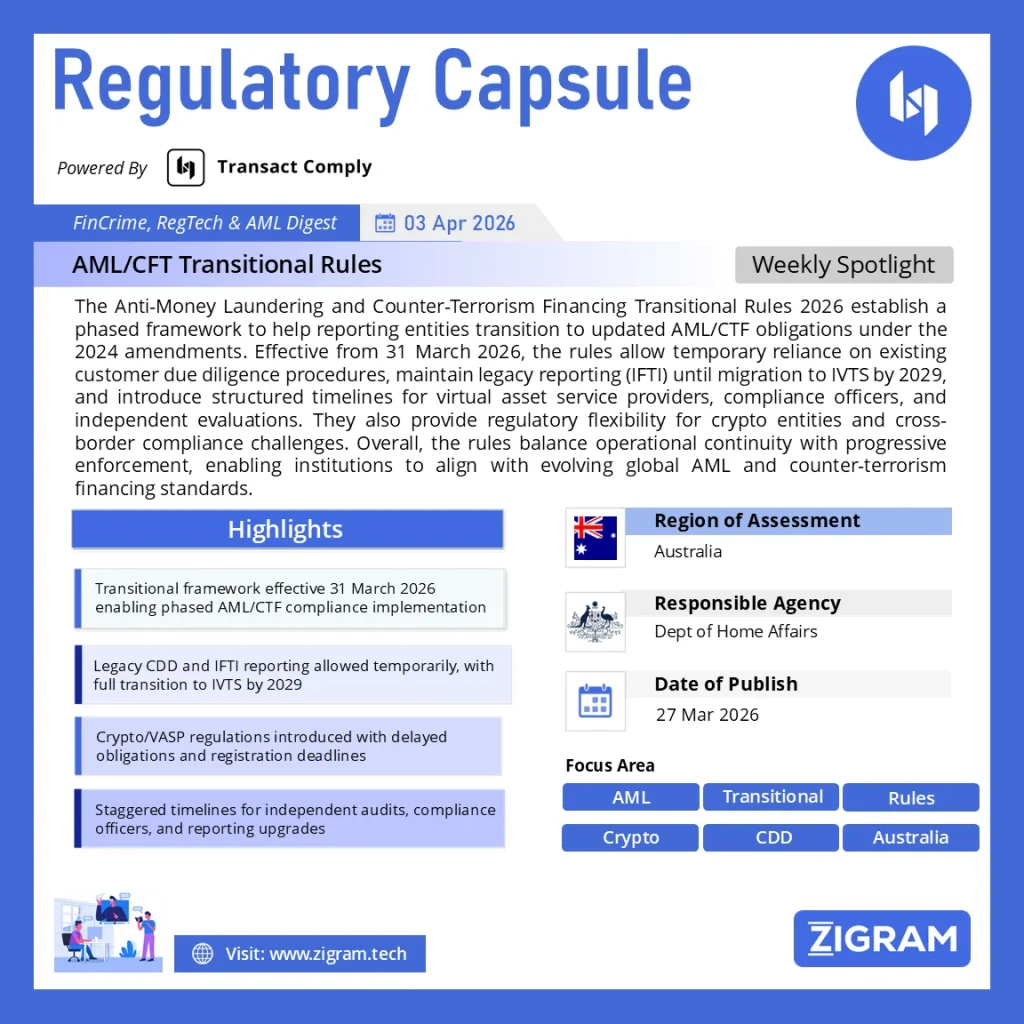
Regulation Name: Anti‑Money Laundering and Counter‑Terrorism Financing Transitional Rules 2026
Date Of Issue: 27 Mar 2026
Region: Australia
Agency: Department of Home Affairs
Anti-Money Laundering and Counter-Terrorism Financing Transitional Rules 2026: A Complete Compliance Guide for AML Leaders
Introduction
The Anti-Money Laundering and Counter-Terrorism Financing Transitional Rules 2026, introduced by the Australian Government and effective 31 March 2026, represent a critical regulatory bridge between legacy AML/CTF obligations and the expanded framework under the AML/CTF Amendment Act 2024.
For AML compliance leaders, financial institutions, fintechs, and virtual asset service providers (VASPs), these transitional rules are not merely procedural—they define timelines, compliance flexibility, and enforcement expectations during a multi-year regulatory transformation.
This article provides a deep, structured breakdown of every major provision, along with actionable insights for compliance strategy, regulatory alignment, and operational implementation.
- Regulatory Context and Strategic Importance
The Transitional Rules serve three core purposes:
- Ensure business continuity while new AML/CTF obligations phase in
- Provide compliance relief and flexibility during system upgrades
- Enable risk-based transition for both traditional financial institutions and emerging sectors like crypto
These rules operate under the authority of the AML/CTF Amendment Act 2024, reinforcing Australia’s alignment with FATF standards and global AML expectations.
- Key Commencement Timeline
- Effective Date: 31 March 2026
- Multiple provisions introduce staggered compliance deadlines extending to:
- 1 July 2026
- 31 March 2027
- 31 March 2029
- 30 September 2029
- 2030 (for independent evaluations)
👉 Insight for AML Leaders:
This phased approach requires multi-year compliance roadmaps, not one-time implementation.
- Registration Framework: Stability with Expansion
3.1 Remittance Sector Continuity
Existing registrations remain unaffected:
- Remittance network providers
- Independent remittance dealers
- Affiliates
👉 This ensures zero disruption to remittance ecosystems.
3.2 Transition to Virtual Asset Service Providers (VASPs)
- All registered digital currency exchanges automatically become VASPs from 31 March 2026
👉 Strategic Impact:
- Expands regulatory perimeter
- Brings crypto fully into AML supervision
- Aligns with FATF Travel Rule expectations
- Customer Due Diligence (CDD): Transitional Flexibility
4.1 Continued Use of Legacy KYC Procedures
Entities can continue using pre-2026 customer identification procedures if:
- AML policies clearly define:
- Customer classes
- Applicability timelines
- Procedures remain risk-based and proportionate
4.2 Transition Deadline
- Legacy CDD allowed until 31 March 2029
👉 Key Risk Insight:
Organizations delaying modernization risk compliance cliff effects in 2029.
4.3 Conditional Service Provision
- Services can begin before completing CDD (under legacy rules), provided verification follows promptly
👉 This supports customer onboarding efficiency, especially for fintechs.
- Reporting Obligations: Major Structural Shift
5.1 From IFTI to IVTS Reporting
The rules transition reporting from:
- International Funds Transfer Instructions (IFTI)
➡ to - International Value Transfer Services (IVTS)
5.2 IVTS Transition Timeline
- Default transition date: 31 March 2029
- Optional extension: up to 30 September 2029
⚠️ Exception:
- Entities dealing with virtual asset transfers cannot delay beyond 31 March 2029
5.3 Interim Reporting Rules
- IFTI obligations continue until transition
- Existing AML rules and exemptions remain valid
👉 Operational Insight:
Dual reporting frameworks may coexist—requiring parallel compliance systems.
- Crypto & Virtual Assets: Phased Regulatory Integration
6.1 Temporary Exemptions for VASPs
Until 1 July 2026, certain AML obligations do not apply:
- AML programs
- CDD
- Reporting
- Record-keeping
👉 This provides a regulatory onboarding window for crypto firms.
6.2 Registration Deadlines
- Must apply by 29 July 2026
- Can operate during application processing
6.3 Self-Hosted Wallet Reporting Delay
- Reporting obligations delayed until 31 March 2029
👉 Global Alignment Insight:
This reflects ongoing international uncertainty around unhosted wallet regulation.
- Financial Advisers: Temporary Classification Adjustment
- All services treated under a single category until 1 July 2026
👉 Simplifies early compliance but requires reclassification readiness post-deadline.
- Independent Evaluations: Extended Timelines
8.1 Existing Reporting Entities
- First evaluation deadline:
- 4 years from last review OR
- 31 March 2027
8.2 Newly Regulated Entities
Deadlines based on enrolment ID:
- Range: June 2029 – December 2030
👉 Strategic Insight:
This staggered approach reduces audit bottlenecks across the industry.
- AML Compliance Officer Requirements
- Existing entities must notify AUSTRAC by 30 May 2026
- Newly enrolled entities:
- Within 14 days OR by 29 July 2026
👉 Reinforces governance accountability early in transition.
- Foreign Law Defence Flexibility
- Entities can submit compliance conflict notices after the conduct occurs (until 30 June 2026)
👉 Important for:
- Cross-border institutions
- Multinational compliance conflicts
- Key Compliance Challenges and Risks
- Dual Framework Complexity
Running old + new AML regimes simultaneously increases:
- Operational cost
- Data fragmentation
- Reporting inconsistencies
- Deferred Risk Accumulation
Delayed compliance (e.g., CDD, IVTS) may create:
- Backlogs
- Regulatory scrutiny spikes near deadlines
- Crypto Compliance Uncertainty
VASPs must navigate:
- Rapid regulatory onboarding
- Evolving global standards
- Actionable Checklist for AML Compliance Leaders
Immediate (0–3 Months)
- Update AML/CTF policies for transitional provisions
- Map customer segments to legacy vs new CDD
- Identify reporting system gaps
Short-Term (3–12 Months)
- Build IVTS reporting capability
- Initiate VASP registration (if applicable)
- Appoint and notify AML compliance officer
Medium-Term (1–3 Years)
- Transition away from legacy CDD
- Align systems with new AML rules
- Prepare for independent evaluations
Long-Term (By 2029–2030)
- Complete IVTS migration
- Fully integrate AML framework
- Ensure audit readiness
- Strategic Takeaways for AML Leaders
- The rules are not just transitional—they are transformational
- Emphasis is on risk-based flexibility with eventual strict enforcement
- Institutions that front-load compliance investments will gain:
- Lower long-term costs
- Better regulatory relationships
- Stronger financial crime risk controls
Conclusion
The AML/CTF Transitional Rules 2026 mark a pivotal shift in Australia’s financial crime compliance landscape. By providing structured flexibility across CDD, reporting, crypto regulation, and governance, regulators have created a phased but firm path toward a modern AML regime.
For AML compliance leaders, the message is clear:
👉 Use the transition period strategically—or risk falling behind when enforcement tightens.
Read about the rules here.
Read about the product: Transact Comply
Empower your organization with ZIGRAM’s integrated RegTech solutions – Book a Demo
- #AML
- #CTF
- #AMLCompliance
- #FinancialCrime
- #AUSTRAC
- #RegTech
- #KYC
- #CDD
- #TransactionMonitoring
- #VASPs
- #CryptoRegulation
- #RiskManagement
- #ComplianceFramework
- #FinTech
- #GlobalCompliance