2026 National Money Laundering Risk Assessment: What Every AML Professional Needs to Understand Now
A Turning Point for AML Compliance
The 2026 National Money Laundering Risk Assessment (NMLRA) is not just another regulatory publication—it is a clear signal that the global financial crime landscape has fundamentally shifted. Built on data from 2024–2025, the report reflects a reality where money laundering is no longer confined to traditional criminal channels but is increasingly embedded within digital ecosystems, global fraud networks, and technology-driven crime.
For AML professionals, this assessment is critical because it reframes how risk should be understood. The report does not merely list threats; it reveals how these threats are evolving, converging, and scaling at unprecedented speed. It also underscores a key reality: financial institutions are no longer just intermediaries—they are frontline defenders in a rapidly expanding financial crime battlefield .
Fraud Has Become the Core of Modern Money Laundering
One of the most striking conclusions of the 2026 NMLRA is that fraud has firmly established itself as the largest and fastest-growing source of illicit proceeds. While drug trafficking and other traditional crimes remain significant, fraud now dominates both in scale and complexity.
In 2024 alone, reported fraud losses exceeded $16 billion, a figure that represents only a fraction of the true impact, which likely runs into tens or even hundreds of billions. Government fraud alone is estimated to cost between $233 billion and $521 billion annually, highlighting the systemic nature of the problem .
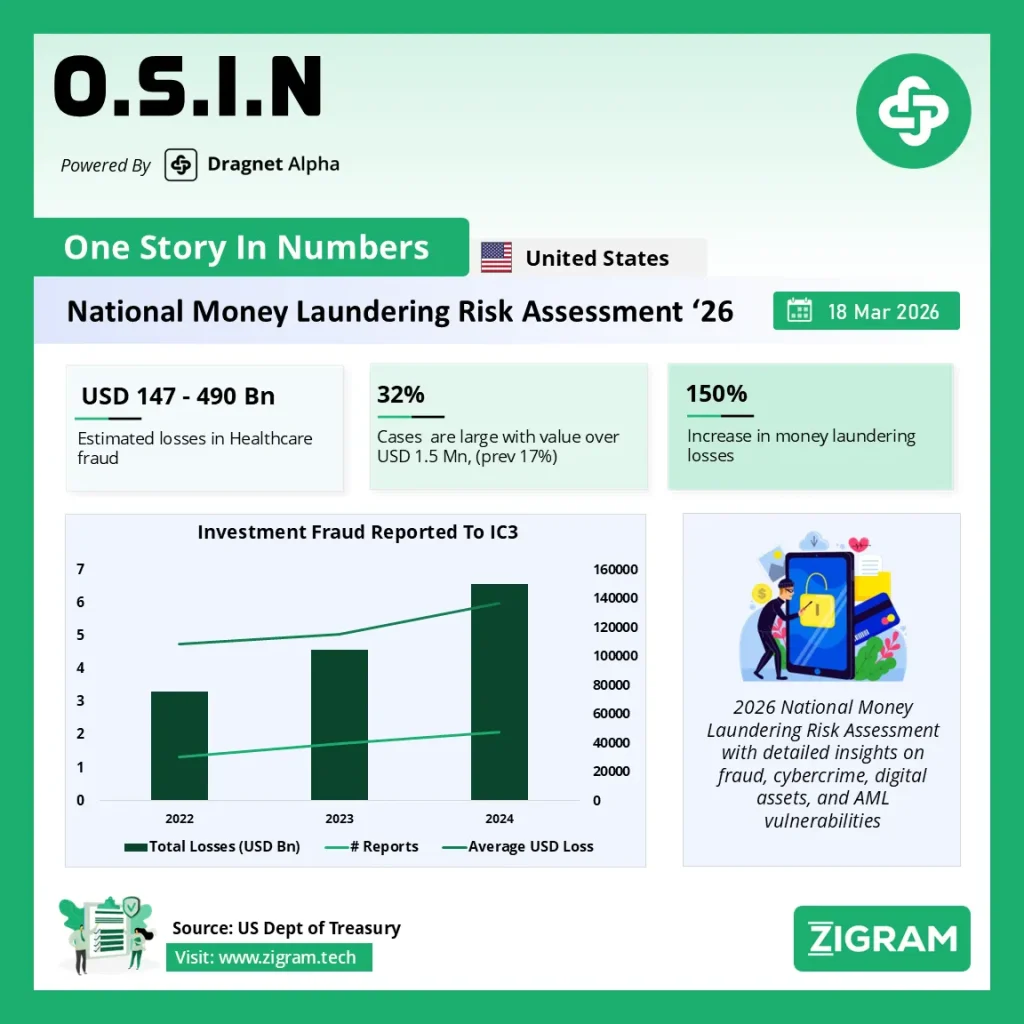
Investment fraud stands out as a particularly damaging category, generating $6.57 billion in losses in 2024, with a steady increase in both the number of cases and the average loss per victim. What makes this category especially concerning is its ability to blend legitimacy with deception—fraudsters mimic real investment platforms, exploit emerging technologies like AI, and manipulate investor psychology at scale.
At the same time, digital asset investment scams—often referred to as “pig butchering” schemes—have emerged as one of the most destructive forms of fraud, accounting for $5.8 billion in losses. These scams are not isolated operations; they are run by highly organized transnational criminal networks that operate like sophisticated businesses, complete with infrastructure, workforce, and global reach .
The Industrialization of Financial Crime: AI, Crypto, and Global Scam Networks
What differentiates today’s financial crime environment from previous decades is the industrial scale at which it operates. The NMLRA highlights how transnational criminal organizations (TCOs) have built large-scale scam operations, particularly in Southeast Asia, where thousands of individuals—often victims of human trafficking themselves—are forced to run fraud schemes targeting global victims.
These operations are highly structured. Victims are groomed over weeks or months through social media, messaging platforms, and dating apps before being introduced to fraudulent investment opportunities. Funds are then routed through a combination of bank accounts, shell companies, and digital asset wallets, making detection significantly more difficult.
One of the most alarming developments is the integration of artificial intelligence into fraud schemes. Criminals now use AI to generate realistic text, clone voices, and create convincing video content. In just the first seven months of 2025, more than 9,000 AI-related fraud complaints were recorded, spanning multiple scam types .
This combination of AI and digital assets has fundamentally changed the speed and scale of money laundering. Transactions can now be executed across borders in seconds, layered through multiple wallets, and obscured using increasingly sophisticated techniques.
Professional Money Laundering Networks: The Hidden Enablers
Another critical insight from the NMLRA is the growing role of professional money laundering networks, which act as enablers for a wide range of criminal activities. These networks, including Chinese Money Laundering Networks (CMLNs) and global money mule systems, provide specialized services that allow criminals to move and disguise illicit funds efficiently.
This development represents a structural shift in financial crime. Money laundering is no longer a secondary activity carried out by criminals themselves; it has become a specialized, outsourced service. These networks bring expertise, scalability, and operational efficiency, making it easier for criminals to monetize illicit activities while reducing their exposure to detection.
For AML professionals, this means that traditional transaction monitoring is no longer sufficient. Identifying individual suspicious transactions is less effective when the underlying activity is part of a coordinated, multi-layered network.
Beyond Fraud: The Persistent Role of Traditional Predicate Crimes
While fraud dominates the current landscape, the NMLRA makes it clear that traditional predicate crimes continue to generate vast amounts of illicit proceeds.
Drug trafficking remains a major contributor, producing hundreds of billions of dollars annually and fueling broader criminal ecosystems, including human trafficking and terrorism. Cybercrime has also expanded significantly, encompassing identity theft, ransomware attacks, and financial sextortion, all of which rely heavily on digital infrastructure and cryptocurrencies.
Human trafficking and smuggling present a particularly disturbing intersection with financial crime. In many cases, victims are forced to participate in scam operations, effectively becoming both victims and instruments of financial crime. Corruption, both domestic and foreign, further exacerbates these risks by enabling illicit financial flows and weakening institutional controls.
Illicit trade, including tariff evasion and trafficking in regulated goods, continues to generate billions of dollars annually, reinforcing the complexity and diversity of money laundering threats .
Systemic Vulnerabilities: Where the Financial System Is Exposed
The report provides a comprehensive view of the vulnerabilities that criminals exploit across the financial system. These vulnerabilities are not confined to a single sector but are distributed across institutions, products, and structures.
Banks remain a primary entry point for illicit funds, particularly through fraud proceeds and mule accounts. Money services businesses and certain digital asset platforms are frequently exploited due to gaps in AML controls or regulatory arbitrage. In some cases, even fraudulent entities have been able to register as legitimate financial businesses to gain credibility.
Cash continues to play a significant role despite the rise of digital finance. Bulk cash smuggling, funnel accounts, and cash-intensive businesses remain effective methods for placing and layering illicit funds.
Legal entities such as shell companies, front companies, and trusts are widely used to obscure beneficial ownership, making it difficult for institutions to identify the true actors behind transactions. Gatekeepers—including lawyers, accountants, and payment processors—can further complicate detection when they knowingly or unknowingly facilitate illicit activity.
High-value assets such as real estate, art, and luxury goods provide additional avenues for laundering, particularly in the integration phase, where illicit funds are reintroduced into the legitimate economy.
The Human Cost: Elder Fraud, Healthcare Fraud, and Social Impact
Beyond financial losses, the NMLRA highlights the profound social impact of financial crime. Elder financial exploitation alone resulted in $4.9 billion in reported losses in 2024, with older adults being disproportionately targeted due to perceived vulnerability .
Healthcare fraud represents another massive area of concern, with losses estimated between $147 billion and $490 billion annually. These schemes not only defraud taxpayers but also undermine the integrity of healthcare systems and patient care.
Confidence scams, including business email compromise (BEC), impersonation scams, and romance scams, continue to cause widespread harm. In 2024, these scams accounted for over $5.5 billion in losses, with BEC alone contributing $2.7 billion .
These figures underscore that money laundering is not just a financial issue—it is a societal one, affecting individuals, businesses, and national security.
A Clear Trend: Larger, More Complex, and More Damaging Cases
One of the most important statistical trends identified in the report is the increase in the scale of money laundering cases. Over the past five years, the median loss associated with sentenced money laundering cases has increased by more than 150%, rising from $208,000 to $526,000. At the same time, the proportion of cases involving losses over $1.5 million has nearly doubled, from 17% in 2019 to 32% in 2024 .
This shift reflects a broader trend toward larger, more sophisticated schemes that leverage technology and global networks to maximize impact.
What This Means for AML Compliance Programs
The implications of the 2026 NMLRA are profound. AML compliance can no longer rely on traditional frameworks that focus primarily on transaction monitoring and regulatory reporting. Instead, institutions must adopt a more holistic, intelligence-driven approach.
Fraud detection and AML are now inseparable. Institutions must integrate fraud signals into AML systems to identify underlying criminal activity. The rise of digital assets requires enhanced monitoring capabilities, including blockchain analytics and wallet-level intelligence.
Artificial intelligence must be embraced not only as a tool for efficiency but as a necessity for combating AI-driven crime. At the same time, institutions must strengthen their understanding of customer networks, beneficial ownership structures, and third-party relationships.
Perhaps most importantly, AML programs must shift from a reactive to a proactive mindset. The goal is no longer just to detect suspicious activity but to understand and disrupt the broader ecosystems that enable financial crime.
Key Statistical Trends Every AML Professional Must Know
- Median laundering case losses increased 150% (from $208K → $526K)
- Large cases (> $1.5M) doubled from 17% to 32%
- Elder fraud losses: $4.9B
- Healthcare fraud exposure: up to $490B
- Confidence scams: $5.5B losses
- BEC scams: $2.7B losses
Conclusion: The Future of AML Is Already Here
The 2026 NMLRA makes one thing clear: the nature of money laundering has fundamentally changed. It is faster, more complex, and more interconnected than ever before. Criminals are leveraging technology, global networks, and systemic vulnerabilities to operate at scale, while the financial system struggles to keep pace.
For AML professionals, this is both a challenge and an opportunity. Those who adapt—by embracing technology, enhancing intelligence capabilities, and rethinking traditional approaches—will be better positioned to protect their institutions and contribute to the integrity of the global financial system.
The future of AML will not be defined by compliance alone, but by capability, adaptability, and strategic insight.
Source: US Depatment of Treasury
Please read about our product: Dragnet Alpha
Click here to book a free demo
- #AML
- #MoneyLaundering
- #FinancialCrime
- #FraudRisk
- #CryptoCompliance
- #RegTech
- #KYC
- #KYB
- #FinCrime
- #AIinFinance
- #Cybercrime
- #Compliance
- #RiskManagement
- #DigitalAssets
- #FraudPrevention
- #NMLRA2026