Introduction
The Reserve Bank of India (RBI) Annual Report 2025-26 is far more than a review of India’s economy and banking sector. For banks, NBFCs, fintechs, payment service providers, insurers, and compliance professionals, it offers a clear roadmap of the RBI’s evolving expectations around anti-money laundering (AML), combating the financing of terrorism (CFT), Know Your Customer (KYC), fraud prevention, cyber resilience, artificial intelligence governance, and supervisory readiness.
The report demonstrates a significant shift in the RBI’s supervisory philosophy. Regulators are increasingly moving beyond policy documentation and focusing on whether institutions can demonstrate effective controls, evidence-based risk management, and measurable compliance outcomes. The message is clear: having AML policies is no longer sufficient. Financial institutions must prove that their KYC, transaction monitoring, fraud detection, sanctions screening, and customer due diligence frameworks work in practice.
For compliance leaders, risk managers, and financial crime teams, the RBI Annual Report 2025-26 provides valuable insights into regulatory priorities, enforcement trends, emerging risks, and future supervisory expectations.
This article analyzes the RBI Annual Report 2025-26 from a financial crime compliance perspective and examines:
Major AML and financial crime developments
Key statistics and regulatory updates
RBI’s AML, KYC and fraud prevention priorities
Department-wise agendas and supervisory focus areas
Cyber fraud and money mule prevention initiatives
AI governance and regulatory technology developments
Implications for banks, NBFCs, fintechs and payment providers
Action points for compliance teams
Key Economic and Banking Sector Highlights from RBI Annual Report 2025-26
India remained the world’s fastest-growing major economy during FY 2025-26, recording GDP growth of 7.6%, supported by strong domestic consumption, investment activity, and resilient corporate and banking sector balance sheets. Inflation moderated significantly to 2.1%, while the financial system remained stable despite global geopolitical uncertainty and volatile capital flows.
Several indicators highlight the resilience of India’s financial sector:
Bank credit growth accelerated to 15.9%.
Gross NPAs declined to multi-decadal lows.
Banks maintained capital adequacy well above regulatory requirements.
UPI transactions crossed 200 billion transactions.
RBI Digital Payments Index increased by 11%.
Foreign exchange reserves remained strong at US$691.1 billion.
These developments provide a strong foundation for financial stability, but they also increase the complexity of financial crime risks, requiring stronger AML, fraud prevention, and supervisory frameworks.
RBI's Regulatory Transformation: 11,000 Circulars Consolidated into 244 Master Directions
One of the most significant regulatory developments in FY 2025-26 was RBI’s large-scale regulatory simplification initiative.
The RBI reviewed and consolidated more than 11,000 regulatory instructions into 244 Master Directions covering 30 regulatory functions across 11 categories of regulated entities. Following this exercise, 9,445 circulars were repealed. More than 770 stakeholder comments were received during the consultation process.
This initiative aims to:
Reduce compliance complexity
Improve regulatory accessibility
Enhance consistency across regulated entities
Reduce compliance costs
Improve ease of doing business
For compliance teams, this means future examinations will increasingly focus on integrated compliance outcomes rather than fragmented compliance with individual circulars.
Key AML and Financial Crime Statistics from RBI Annual Report 2025-26
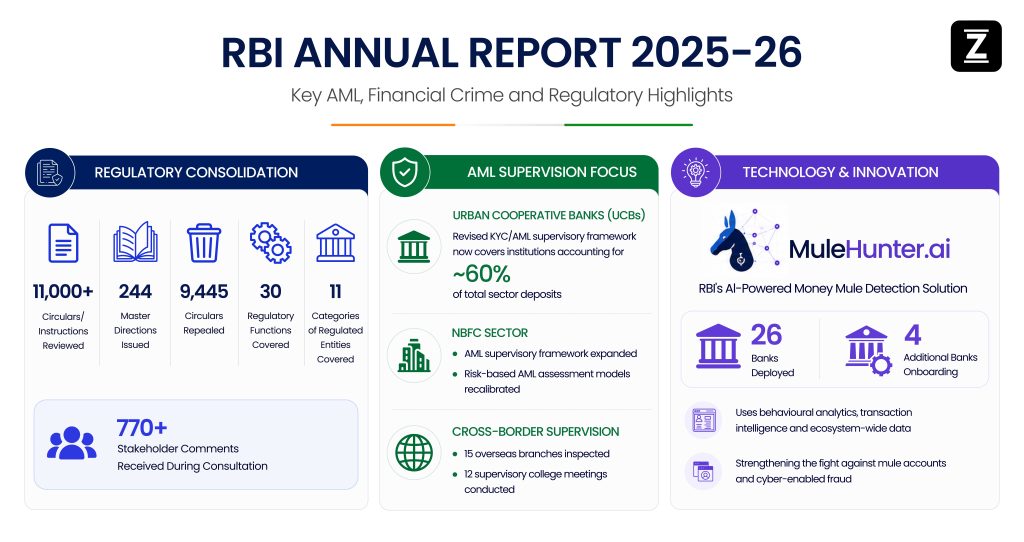
The report contains several important AML, fraud prevention, and supervisory metrics.
Regulatory Statistics
Metric | Figure |
|---|---|
Circulars reviewed | 11,000+ |
Master Directions issued | 244 |
Circulars repealed | 9,445 |
Regulatory functions covered | 30 |
Regulated entity categories covered | 11 |
Public comments received | 770+ |
AML Supervision Statistics
Urban Cooperative Banks
Revised KYC/AML supervisory framework now covers institutions accounting for approximately 60% of sector deposits.
NBFCs
AML supervisory framework expanded significantly.
Risk-based AML assessment models recalibrated.
Cross-Border Supervision
15 overseas branches inspected.
12 supervisory college meetings conducted.
Financial Crime Technology
MuleHunter.ai deployed in 26 banks.
Rollout underway in 4 additional banks.
RBI's Anti Money Laundering (AML), KYC and Financial Crime Priorities
The RBI Annual Report reinforces that AML compliance is no longer treated as a standalone compliance exercise. RBI’s 2024 guidelines also strengthened AML and terrorist-financing risk assessment for financial institutions in line with global standards and sector-specific risks. It is now integrated into enterprise-wide governance, risk management, fraud prevention, cyber resilience, and customer protection frameworks.
The RBI’s focus areas include:
Customer Due Diligence (CDD)
Enhanced Due Diligence (EDD)
Beneficial Ownership verification
Ongoing transaction monitoring
Suspicious Transaction Reporting (STR)
Politically Exposed Person (PEP) screening
Risk-based AML supervision
Fraud risk management
Sanctions compliance
Customer risk profiling
In practice, the RBI expects a risk-based approach, with controls calibrated to the level of risk and higher-risk relationships subject to greater scrutiny.
Financial institutions are expected to demonstrate that these controls are operating effectively and producing measurable risk outcomes.
Major AML and KYC Regulatory Developments
Consolidated KYC Directions, 2025
The RBI strengthened the KYC framework through the Consolidated KYC Directions, 2025.
Key objectives include:
Enhanced customer due diligence
Better risk classification
Stronger customer monitoring
Simplified KYC updates
Improved onboarding processes
Better detection of money mule accounts
The updated framework also introduced measures to improve financial inclusion and accessibility while maintaining AML safeguards.
Fraud Risk Management Framework
The Master Direction on Fraud Risk Management strengthens institutions’ ability to:
Detect suspicious activity
Monitor customer transactions
Identify mule accounts
Improve fraud reporting
Strengthen internal controls
This reflects RBI’s increasing focus on proactive fraud prevention rather than post-incident response.
Digital Payments Security Controls
With digital payments reaching unprecedented levels, RBI introduced enhanced cybersecurity and fraud prevention controls covering:
Transaction monitoring
Customer data protection
Payment security
Cyber resilience
Fraud detection
RBI's Fight Against Cyber-Enabled Fraud and Money Mules
One of the most important sections of the RBI annual report is its dedicated focus on cyber-enabled fraud and money mule networks.
The RBI notes that rapid growth in digital financial services has created new opportunities for criminals to exploit the banking ecosystem through the following:
Mule accounts
Account takeovers
Social engineering scams
Digital payment fraud
Identity fraud
Synthetic identities
To address these risks, RBI implemented a multi-layered strategy involving regulation, supervision, technology, public awareness, and inter-agency cooperation.
MuleHunter.ai: RBI's AI-Powered Anti-Money Mule Initiative
One of the most innovative developments highlighted in the report is MuleHunter.ai.
MuleHunter.ai uses:
Behavioural analytics
Transaction intelligence
Machine learning
Ecosystem-wide fraud patterns
to identify bank accounts that may be acting as money mule accounts.
As of March 2026:
26 banks have implemented MuleHunter.ai.
4 additional banks are onboarding the solution.
The initiative demonstrates RBI’s growing reliance on advanced analytics and AI-driven supervision to combat financial crime.
RBI's Risk-Based AML Supervision Framework for Banks and NBFCs
NBFC Sector
The RBI expanded and recalibrated its AML supervision framework for NBFCs. Its 2024 guidance also strengthened NBFC AML and TF risk management by requiring a more formal internal risk assessment aligned with global standards and sector-specific risks.
Key enhancements include the following:
Expanded supervisory coverage
Better risk segmentation
Improved off-site monitoring
Enhanced risk assessment methodologies covering money laundering, terrorist financing and proliferation financing risks
Greater focus on diverse business models
The central bank also conducted a sectoral AML risk assessment of NBFCs.
Urban Cooperative Banks
The revised AML supervisory framework for UCBs now covers institutions representing approximately 60% of sector deposits.
Enhanced assessments focus on:
KYC risks
Money laundering risks
Terrorist financing risks
Emerging sector-wide vulnerabilities
Department-Wise AML and Financial Crime Agenda
Department of Regulation (DoR)
Key priorities include:
KYC modernization
Digital lending governance
AI model risk management
Regulatory simplification
Digital banking frameworks
Consumer protection
Department of Supervision (DoS)
Focus areas include:
Risk-based AML supervision
Cyber risk reviews
Cross-border supervision
Fraud monitoring
Enhanced supervisory analytics
FinTech Department
Major initiatives include:
CBDC expansion
MuleHunter.ai deployment
AI governance framework
Unified Lending Interface (ULI)
Asset tokenisation
Enforcement Department
The Enforcement Department continues to strengthen the following:
Regulatory enforcement
Violation identification
Compliance monitoring
Consumer protection
FREE-AI Framework: AI Governance Comes to Financial Services
The RBI’s Framework for Responsible and Ethical Enablement of Artificial Intelligence (FREE-AI) is one of the most important future-facing developments in the report.
The framework introduces:
Seven foundational AI principles
Six strategic pillars
Twenty-six recommendations
The framework focuses on:
Innovation Enablement
AI infrastructure
AI sandboxes
Indigenous AI models
Integration with Digital Public Infrastructure
Risk Mitigation
AI governance
Data governance
Consumer protection
Cybersecurity
AI incident reporting
Business continuity planning
Financial institutions should expect AI governance to become a major area of supervisory focus in the coming years.
Technology, Data and Supervisory Analytics
The RBI’s supervisory model is increasingly data-driven.
Supervisors are expected to rely more heavily on:
SupTech
Artificial Intelligence
Machine Learning
Data Quality Frameworks
Automated Monitoring
Predictive Analytics
Financial institutions should prioritize controls that work across each banking channel, especially for electronic and digital transactions:
Real-time transaction monitoring
Automated sanctions screening
PEP screening
Beneficial ownership intelligence
Adverse media monitoring
Customer risk scoring
AI-enabled fraud detection
Screening should also promptly identify and remove designated individuals from transaction flows and customer relationships where required.
Effective AML controls also depend on ongoing monitoring so customer information, behavior, and risk ratings remain current over time. The future of AML compliance will increasingly depend on the quality, accessibility, and governance of compliance data.
Implications for Banks, NBFCs and Fintechs
Commercial Banks
Key priorities include:
AML modernization
Digital fraud prevention
Customer risk profiling
Transaction monitoring optimization
AI governance readiness
NBFCs
NBFCs face increasing scrutiny around:
AML risk assessments
Digital lending controls
Pricing transparency
KYC effectiveness
Risk-based supervision
Fintechs and Payment Providers
Areas of focus include:
Customer onboarding
Fraud prevention
Mule account detection
Payment security
Consumer protection
Cooperative Banks
Rising expectations include:
Cyber resilience
Data quality
AML monitoring
Risk-based supervision
How ZIGRAM Helps Financial Institutions Align with RBI Expectations
The RBI Annual Report 2025-26 clearly signals a future where AML, KYC, fraud prevention, sanctions compliance, cyber resilience, and AI governance are interconnected.
ZIGRAM enables regulated entities to operationalize these expectations through:
Sanctions screening
PEP screening
Watchlist monitoring
Adverse media screening
Risk-based transaction monitoring
Suspicious activity detection
AML alert management
STR workflow support
Beneficial ownership intelligence
Entity risk assessment
Corporate structure analysis
Enhanced Due Diligence
Investigations
Compliance documentation
Host of solutions, including:
Emerging risk monitoring
Adverse media intelligence
Financial crime risk identification
- Data assets focused on PEPs
- Crypto and virtual asset-related assets
- Country watchlist
These solutions help institutions align with RBI expectations around AML/CFT, fraud prevention, KYC compliance, transaction monitoring, and risk-based supervision.
Action Checklist for Compliance Teams
Financial institutions should consider the following priorities:
Immediate Actions
Review institution-wide AML risk assessments.
Align those reviews with the latest financial action task force expectations.
Refresh KYC and customer acceptance policies.
Validate beneficial ownership processes.
Review sanctions and PEP screening controls.
Test controls for prevention of money laundering and CFT, including checks linked to action task force fatf expectations.
Test transaction monitoring effectiveness.
Maintain documented procedures for ongoing monitoring and escalation of unusual activity.
Strengthen STR escalation procedures.
Review fraud risk management frameworks.
Strategic Actions
Implement AI governance frameworks.
Enhance cyber fraud detection capabilities.
Collaborate with the ministry of finance and sector bodies on cyber-fraud prevention and response initiatives.
Improve data quality and governance.
Strengthen board oversight of financial crime risks.
Require periodic financial literacy and fraud-awareness campaigns for customers and staff.
Invest in automated AML and fraud monitoring technologies.
Ensure programmes, inter alia, support stronger sanctions screening, transaction monitoring, and digital-fraud controls.
Prepare for increasingly data-driven supervision.
Conclusion
The RBI Annual Report 2025-26 marks a significant evolution in India’s AML and financial crime compliance landscape. The report highlights a clear transition toward risk-based supervision, technology-driven compliance, AI-enabled fraud detection, stronger KYC controls, and integrated financial crime risk management.
The RBI’s priorities, ranging from MuleHunter.ai and cyber fraud prevention to AML supervision of NBFCs and AI governance, indicate that financial institutions must move beyond checkbox compliance and embrace evidence-based, technology-enabled compliance frameworks.
For banks, NBFCs, fintechs, payment providers, and other regulated entities, the message is unambiguous: future supervisory assessments will increasingly focus on demonstrable outcomes, data quality, risk intelligence, and operational effectiveness.
Organizations that proactively strengthen their AML, KYC, fraud prevention, sanctions screening, and governance frameworks today will be best positioned to meet RBI’s evolving expectations and maintain resilience against emerging financial crime threats.