Table of Contents
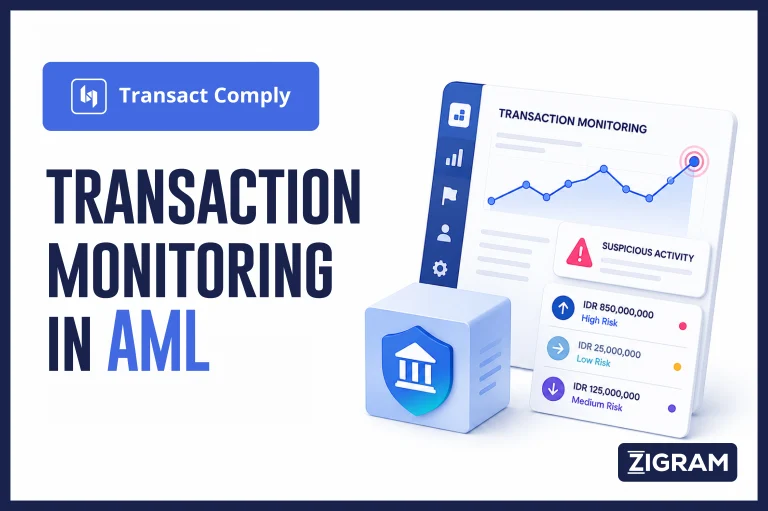
Transaction monitoring in AML is the continuous analysis of financial transactions to detect suspicious activity, prevent money laundering, and comply with regulatory requirements. Modern monitoring combines rules, risk scoring, and AI to identify unusual customer behaviour while reducing false positives.
Regulators including the Financial Action Task Force (FATF), FinCEN, FCA, and RBI expect robust monitoring systems as part of any anti money laundering AML programme. Modern approaches combine rules-based thresholds, risk-based methods, and AI-powered analytics to manage large transaction volumes while reducing false positives. Transaction monitoring is an ongoing process reviewing financial activity to detect suspicious behavior across every stage of the customer lifecycle.
This guide covers how transaction monitoring works, common red flags, monitoring approaches, operational challenges, and best practices. ZIGRAM, as a specialist RegTech partner in AML and financial crime compliance, provides the perspective throughout.
What is Transaction Monitoring in AML?
Transaction monitoring refers to the systematic surveillance of customer transactions to identify patterns or anomalies that may indicate money laundering, terrorist financing, sanctions evasion, or other financial crime. Automated systems analyze transactions like deposits, withdrawals, and transfers in AML to flag activity that warrants further investigation.
Unlike generic payment or fraud monitoring-which focuses on protecting institutions and customers from direct financial loss-anti money laundering transaction monitoring exists to meet regulatory requirements, support law enforcement through suspicious activity reports (SARs), and preserve institutional integrity.
An AML transaction monitoring system evaluates every transaction in context: the customer’s risk profile, historical behaviour, products used, channels, and geography. This makes it inseparable from KYC, customer due diligence (CDD), enhanced due diligence (EDD), and the broader Financial Crime Compliance framework. AML transaction monitoring is required for regulated institutions across virtually every jurisdiction.
Financial Institutions need the Best transaction monitoring providers in order to get Complete AML Compliance with regulatory bodies; otherwise, the consequences could be fatal for businesses.
Why Transaction Monitoring is Important for AML & Regulatory Compliance
Robust transaction monitoring is legally required under regimes including the Bank Secrecy Act (BSA) in the United States, EU AML Directives, UK Money Laundering Regulations, India Prevention of Money Laundering Act (PMLA) and the FATF Recommendations. These laws mandates reporting of suspicious activities, and firms must file suspicious activity reports when suspicious activity is detected.
Key objectives of AML monitoring include:
Early detection of suspicious activity such as structuring, layering, and cross-border risks
Prevention of money laundering and terrorist financing
Protection of customers, markets, and correspondent banking relationships
Ongoing customer risk management, confirming activity matches declared profiles and source of funds
Transaction monitoring helps identify financial crimes such as money laundering and fraud. It also helps prevent fraud and financial crime by catching illicit patterns before they escalate. Money laundering accounts for 2–5% of global GDP annually, making effective monitoring a matter of systemic importance.
The cost of failure is severe. In 2024, TD Bank paid over $3 billion for inadequate monitoring-one of the largest AML penalties in history. Metro Bank was fined $21.5 million for failing to monitor transactions. In March 2025, Robinhood paid $29.75 million for AML non-compliance. Block, Inc. paid $80 million in a multi-state settlement over AML programme failures including alert backlogs. These cases illustrate that weak transaction monitoring leads to enforcement actions, licence restrictions, and lasting reputational damage.
Strong transaction monitoring underpins accurate suspicious activity reports (SARs) and suspicious transaction report (STRs) filings to Financial Intelligence Units (FIUs). Without well-designed monitoring, reports lack context, and regulatory criticism follows.
Transaction Monitoring is also used for fraud detection and can be beneficial for both Fraud and AML compliance teams.
How Transaction Monitoring Works: End‑to‑End Process Flow
The AML transaction monitoring process follows a repeatable, data-driven workflow applied to every transaction. Effective transaction monitoring combines multiple data sources for better context at each stage.
Transaction Capture. Every transaction-wire transfers, ACH payments, card purchases, deposits, withdrawals-is recorded by core banking systems and payment gateways. Data collected includes amounts, timestamps, originator and beneficiary details, channel, geography, and currency.
Data Enrichment. Transactional data is joined with KYC and CDD information: customer risk ratings, PEP status, beneficial ownership, sanctions or watchlist status, transaction history, and geolocation. This data collection step is critical for contextual analysis.
Transaction Monitoring Rules. Predefined scenarios and transaction monitoring rules evaluate activity against thresholds, frequency patterns, geographic risk indicators, and counterparty flags. Monitoring rules should be dynamic and based on customer segments and geographic risks.
Risk Scoring. Each transaction and customer receives a dynamic risk score incorporating customer risk, product risk, counterparty risk, and geography risk. Risk scoring adjusts over time as customer behavior changes or new intelligence emerges.
Alert Generation. Alerts are generated when transactions violate rules or fall outside expected parameters. Each alert contains context: the customer profile, transaction data, reason for the flag, and related historical data.
Analyst Investigation. Compliance analysts evaluate alerts to identify false positives and true threats. They review source of funds, beneficiary relationships, and whether activity aligns with the customer’s declared business profile. Further investigation may involve document requests, watchlist checks, or network tracing.
Case Management. If investigation indicates potential illicit activity, a case is opened. Case management tools maintain audit trails, evidence, narrative drafts, and approval workflows with standardized procedures for investigations.
SAR/STR Filing. Suspicious Activity Reports (SARs) are filed when a transaction is deemed suspicious. The narrative must explain why the behaviour is suspicious, including risk factors and supporting evidence.
Regulatory Reporting and Feedback. Outcomes feed back into the system. Monitoring rules, thresholds, and models are adjusted based on SAR results, regulatory feedback, and backtesting. This continuous monitoring loop is what makes the AML transaction monitoring process effective over time.
Example scenario: An SME in United States that typically makes monthly domestic transfers of $200,000 suddenly initiates five international transfers in a single week, each exceeding $2 million, to a recently onboarded counterparty in a high-risk jurisdiction. The system captures these wires, enriches them with KYC data showing the counterparty is new and potentially a shell entity, triggers a rule for cross-border transfers above threshold, and elevates the risk score. An alert is generated and assigned to an analyst who investigates invoices, beneficial ownership, and sanctions status. If suspicion is confirmed, a SAR is filed.
Common Suspicious Transaction Patterns and Red Flags
Transaction monitoring rules and AI models are built around known money laundering typologies and behavioural red flags. Transaction monitoring systems analyze transaction patterns for anomalies across these categories:
Structuring (Smurfing): Structuring involves multiple transactions below reporting thresholds to avoid detection. The amounts may individually appear innocuous but collectively reveal intent.
Layering: Rapid movement of funds between multiple accounts, often across borders or through shell companies, with no clear economic rationale.
Round-tripping: Funds moving through a series of transactions and returning to the origin, often involving circular flows through multiple entities.
Large unexpected cash deposits: Unusual given customer history, especially in digital-native accounts.
Dormant or newly opened account activity: Sudden high-value or high-frequency transactions that contrast sharply with expected behaviour.
High transaction velocity: Unusual transaction volume indicates potential suspicious activity. High velocity funds movement obscures the source of funds.
Mule accounts: Third-party accounts receiving deposits and forwarding sums, commonly linked to scams or trafficking networks.
High-risk jurisdictions: Transactions involving high-risk jurisdictions raise red flags, particularly when combined with other anomalies.
Round value transactions: Round value transactions may indicate non-commercial activity, warranting closer review.
Crypto-specific patterns: Mixing services, rapid wallet hops, DeFi protocol layering, and cross-chain flows represent emerging threats.
Detection of a red flag does not automatically mean criminal activity. It triggers deeper investigation and, depending on context, potentially a suspicious transaction report filing.
Types of AML Transaction Monitoring Approaches
Financial institutions typically combine several monitoring types to achieve comprehensive coverage of financial crime risks.
Real time transaction monitoring evaluates payments as they are initiated. It can hold or decline transactions before settlement, making it crucial for high-risk channels like instant payments, cards, and crypto exchanges. AI-powered systems can analyze millions of transactions in real time through this approach.
Batch transaction monitoring reviews aggregated sets of transactions at end-of-day or intraday intervals. It suits lower-risk products or environments where infrastructure limits real time monitoring, and supports heavier analytics like peer-group comparisons.
Rule-based (scenario-driven) monitoring uses predefined transaction monitoring rules defining thresholds, frequency, velocity, geographies, and customer segments. It provides regulatory explainability and audit transparency.
Risk-based monitoring assigns dynamic customer risk scores and uses peer-group analysis and historical baselines to prioritise alerts. This risk based approach adjusts monitoring intensity based on the customer’s risk profile.
AI-powered monitoring applies anomaly detection, clustering, network analysis, and machine learning models alongside traditional rules to capture novel patterns that static rules miss.
Transaction Monitoring Across Different Industries
Although the core objective remains the same, monitoring priorities vary across industries depending on their products, customers, and risk exposure.
Industry | Primary Monitoring Focus |
Banking | Large cash deposits, wire transfers, correspondent banking |
FinTech & Payments | Instant payments, account takeovers, transaction velocity |
Insurance | Unusual premium payments, early policy surrenders |
Securities | Market manipulation, unusual trading patterns |
Crypto & VASPs | Wallet transfers, mixers, cross-chain transactions |
Modern transaction monitoring systems tailor rules and risk models to address the specific risks associated with each sector.
Rule‑Based vs AI‑Powered Transaction Monitoring
Most modern AML transaction monitoring systems use a hybrid model, combining explainable rule engines with AI and machine learning. Combining rules with behavioral analytics enhances transaction monitoring effectiveness.
Classic rule-based monitoring defines scenarios tuned to known typologies. Its strength lies in transparency-each alert ties back to a specific rule, satisfying regulatory explainability requirements. However, rule-based systems tend to generate very high false positives (often exceeding 90%) because static thresholds cannot capture complex relational or behavioural anomalies.
AI transaction monitoring uses supervised and unsupervised ML, behavioural analytics, transaction velocity analysis, network relationships, and dynamic risk scoring to detect subtle anomalies. AI reduces false positives by tailoring monitoring to customer risk profiles. AI models adapt to evolving criminal tactics, improving detection accuracy over time. AI tools can even suggest new monitoring rules based on transaction patterns discovered in ongoing analysis.
Criteria | Rule-Based Monitoring | AI-Powered / Hybrid Monitoring |
|---|---|---|
Detection Capability | Known typologies and thresholds | Novel patterns, relational anomalies |
False Positives | High (80–95%) | 30–40% reduction when well-trained |
Adaptability | Low-requires manual rule updates | Higher-models learn over time |
Maintenance Effort | Rule authoring, threshold tuning | Model validation, retraining |
Scalability | Scales via computing power and rules | Scales with ML frameworks and graph analytics |
Explainability | High-clear audit trail | Requires explainable AI modules |
Regulators increasingly accept AI where governance, model validation, and human oversight are clearly documented. The IFC Good Practice Note highlights these expectations.
Key Components of an Effective Transaction Monitoring System
A modern AML transaction monitoring system is an integrated platform, not a single rule engine. Its key components include:
Data collection and integration layer: Inputs from core banking, payment systems, KYC/CDD systems, beneficial ownership registers, sanctions screening data, adverse media, and device/IP geolocation. Effective transaction monitoring requires standardised identifiers and entity resolution across accounts.
Rules engine: Configurable scenarios by jurisdiction, product, channel, and customer segment. Supports both continuous monitoring and periodic batch reviews.
Risk scoring module: Dynamic customer and transaction risk scores drawing from KYC, geography, PEP status, and beneficial ownership. Customer due diligence (CDD) is crucial for effective transaction monitoring because it feeds directly into risk scoring.
Behavioural analytics: Peer-group baselining and deviation detection across transaction size, frequency, counterparties, and channels.
Alert management: Exception reporting, prioritisation, triage, and grouping of related alerts. High-quality alerts focus on actionable outcomes rather than quantity.
Case management: Investigation workflow, evidence storage, audit trail, narrative drafting, and approval flows.
SAR/STR workflow and regulatory reporting: Drafting, filing, and tracking of reports across jurisdictions. Transaction monitoring systems must adapt to different jurisdictional regulations.
Dashboards and KPIs: Tracking alert volumes, false positive rates, SAR conversion rates, investigation times, and backlog metrics.
Governance: Rule ownership, version control, role-based access controls, and independent validation of monitoring systems satisfy regulator expectations.
Operational Challenges in AML Transaction Monitoring
Even advanced monitoring systems face practical challenges that impact effectiveness and cost.
False positives and alert fatigue: Simplistic thresholds and one-size-fits-all AML rules generate massive alert backlogs. Common pitfalls in transaction monitoring include applying identical thresholds to all customers. Compliance teams spend disproportionate time dismissing low-value alerts, reducing investigation quality. Automated systems can reduce false positives when properly configured, but many legacy systems lack this capability.
Data quality: Fragmented systems, incomplete KYC data, inconsistent identifiers, and cross-border privacy constraints hinder entity resolution. Metro Bank failed to monitor 60.5 million transactions totaling $65 billion-partly a data and systems failure.
Jurisdictional complexity: Different countries have different thresholds, SAR/STR timelines, and regulatory requirements. Transaction monitoring must comply with AML regulations in many jurisdictions simultaneously.
Legacy systems: Rigid architectures, lack of real time capabilities, limited advanced analytics, and manual case management processes slow response times and reduce coverage.
Evolving financial crime patterns: DeFi, cryptocurrency mixers, synthetic identities, and AI-assisted attacks represent emerging threats that traditional rules may miss. Monitoring scenarios should evolve to address emerging criminal methodologies.
Transaction monitoring must balance regulatory expectations and operational capacity. Over $3 billion in penalties were paid by TD Bank for inadequate monitoring-a reminder that underinvestment carries existential risk.
Key Metrics for Measuring Transaction Monitoring Effectiveness
An effective transaction monitoring programme should be measured continuously to ensure it remains accurate, efficient, and aligned with evolving risks. Common performance indicators include:
False Positive Rate: Percentage of alerts closed without further action.
Alert-to-SAR Conversion Rate: Proportion of alerts resulting in Suspicious Activity or Transaction Reports.
Average Investigation Time: Time taken to review and resolve alerts.
Alert Backlog: Number of pending alerts awaiting investigation.
Rule Effectiveness: Performance of monitoring scenarios in detecting meaningful suspicious activity.
Regularly reviewing these metrics helps compliance teams optimise monitoring rules, improve operational efficiency, and strengthen overall AML compliance.
Best Practices for Designing and Running Transaction Monitoring
Effective transaction monitoring is built on a risk-based, continuously improving framework rather than static rules. Transaction monitoring should reflect the organization’s institutional risk assessment.
Start with AML risk assessment. Map products, channels, geographies, customer types, and historical data on incidents. Effective transaction monitoring requires a risk based approach tailored to specific profiles.
Segment customers dynamically. Customer segments require different monitoring parameters to reduce false positives. Differentiate monitoring intensity for low-, medium-, and high-risk customers, including PEPs and high-risk industries.
Tune thresholds continuously. Thresholds in transaction monitoring should be regularly tuned to minimize false positives. Regular backtesting, scenario performance reviews, and feedback from SAR outcomes optimise AML transaction monitoring rules.
Strengthen data governance. Standardised identifiers, accurate customer profiles, quality checks, and secure integration between KYC, screening, and transaction monitoring software ensure reliable data analysis.
Maintain standardized investigation procedures. Transaction monitoring should have standardized procedures for investigations. Clear escalation paths, quality assurance reviews, and peer review of SAR narratives improve consistency.
Validate independently. Evaluating monitoring effectiveness involves assessing coverage of identified risks. Periodic independent validation of models, scenarios, and data quality satisfies regulatory requirements.
Train staff regularly. Analysts need to understand current money laundering typologies, risk indicators, and jurisdictional expectations. Monitoring works best with clear baselines for expected behavior that analysts can reference.
Effective transaction monitoring helps organizations detect suspicious activity early and supports ongoing monitoring across the customer lifecycle.
How AI and Advanced Analytics are Transforming Transaction Monitoring
AI does not replace human judgement. It augments analysts and improves the signal-to-noise ratio in monitoring financial transactions.
Machine learning for anomaly detection: Supervised models trained on historical SAR-labelled datasets identify patterns associated with suspicious transactions. Unsupervised methods discover novel anomalies without predefined labels. AI enhances transaction monitoring by analyzing large datasets in real time. AI-powered systems can identify unusual patterns across millions of transactions.
Behavioural analytics and peer-group analysis: Building baselines for similar customers and flagging outliers in transaction size, frequency, velocity, and counterparties. This approach helps detect suspicious behavior that static thresholds miss.
Network analysis and graph techniques: Identifying hidden links between accounts, shell companies, wallets, and devices to uncover complex laundering networks. Research shows hybrid deep learning frameworks combining graph neural networks with behavioural features improve detection of cross-border laundering schemes.
Explainable AI: Techniques like feature attribution and scenario-based explainers show which factors drove model decisions, supporting auditability and regulator engagement.
AI-assisted investigations: Automatic summarisation of customer activity, alert triage, and recommended narratives for suspicious activity reports speed up analyst workflows without removing human oversight.
The global AML software market is projected to reach $3.2 billion by 2025, reflecting growing investment in these capabilities. AI models adapt to evolving criminal tactics, and AI tools can suggest new monitoring rules based on emerging transaction patterns, creating an adaptive monitoring ecosystem.
Why Human Oversight Still Matters Despite The Rise Of AI In Transaction Monitoring?
While AI significantly improves detection accuracy and reduces false positives, it does not replace human judgement. Compliance analysts provide the regulatory context needed to distinguish genuinely suspicious activity from legitimate business transactions. Human oversight is also essential for validating AI-generated alerts, preparing SAR/STR narratives, and ensuring monitoring decisions remain transparent, explainable, and compliant with regulatory expectations.
How ZIGRAM Supports AML Transaction Monitoring
ZIGRAM is a specialist RegTech partner providing AML transaction monitoring solutions and managed services for regulated institutions globally. Its transaction monitoring tool, Transact Comply, offers configurable rules, risk-based monitoring, continuous monitoring, and AI-assisted analytics designed to reduce false positives and improve detection across multiple jurisdictions.
ZIGRAM’s broader ecosystem strengthens overall financial crime compliance. PreScreening.io handles name and sanctions screening, Entity Hero supports entity risk assessment, and additional modules cover adverse media, crypto risk, and ESG compliance. These integrate with transaction monitoring workflows to provide a unified view of customer risk.
ZIGRAM supports banks, fintechs, payment firms, insurers, and crypto platforms with implementation, rule design, model tuning, and ongoing optimisation. To explore whether ZIGRAM’s platform fits your AML transaction monitoring needs, schedule a discovery call or book a demo.
Latest Read: Best transaction monitoring providers in the world
Frequently Asked Questions on Transaction Monitoring in AML
What is transaction monitoring in AML? Transaction monitoring in AML is the continuous surveillance of financial transactions-deposits, withdrawals, transfers, and payments-to detect suspicious activity indicative of money laundering, terrorist financing, or sanctions evasion. It is legally required for AML-obliged institutions and forms a core part of any AML compliance programme alongside KYC and customer due diligence.
What is the difference between AML transaction monitoring and fraud monitoring? AML transaction monitoring focuses on regulatory compliance, detecting illicit finance, and supporting law enforcement through SAR/STR filings. Fraud transaction monitoring protects institutions and customers from direct financial loss. The purposes, metrics, time horizons, and stakeholder obligations differ substantially, though many institutions now pursue integrated approaches.
Is transaction monitoring mandatory for all financial institutions? Yes. AML transaction monitoring is legally required for obliged institutions under the Bank Secrecy Act (USA), EU AML Directives, UK MLRs, and equivalent regulations globally. Transaction monitoring must comply with AML regulations in the jurisdictions where the institution operates.
What types of transactions are typically monitored? All financial transactions are subject to monitoring, including wire transfers, ACH payments, card transactions, cash deposits and withdrawals, crypto wallet transfers, cross-border payments, and high-volume low-value multiple transactions. Monitoring intensity varies based on channel risk and the customer’s risk profile.
What triggers a suspicious activity alert? Alerts are triggered when transactions exceed thresholds, show unusual transaction volume, involve high-risk jurisdictions or sanctioned counterparties, deviate from established customer behavior baselines, or match known money laundering typologies such as structuring or layering. Automated systems compare transactions against predefined rules and customer risk profiles.
How does AI improve transaction monitoring? AI improves transaction monitoring by analysing large datasets in real time, reducing false positives through tailored risk scoring, detecting novel patterns through behavioural analytics and network analysis, and adapting to evolving financial crime patterns. It augments analyst decision-making rather than replacing human judgement.
What is a transaction monitoring system (TMS)? A transaction monitoring system is an integrated platform comprising a rules engine, risk scoring module, alert management, case management, SAR/STR workflow, sanctions screening, and dashboards. Transaction monitoring software processes transactional data against monitoring rules and customer profiles to generate actionable alerts for compliance teams.
What are the biggest challenges in transaction monitoring? Key challenges include high false positive rates, alert fatigue, poor data quality, legacy systems lacking real time capabilities, jurisdictional complexity, and keeping pace with evolving financial crime patterns. Institutions must continuously tune thresholds, validate models, and invest in data governance to maintain effective transaction monitoring.