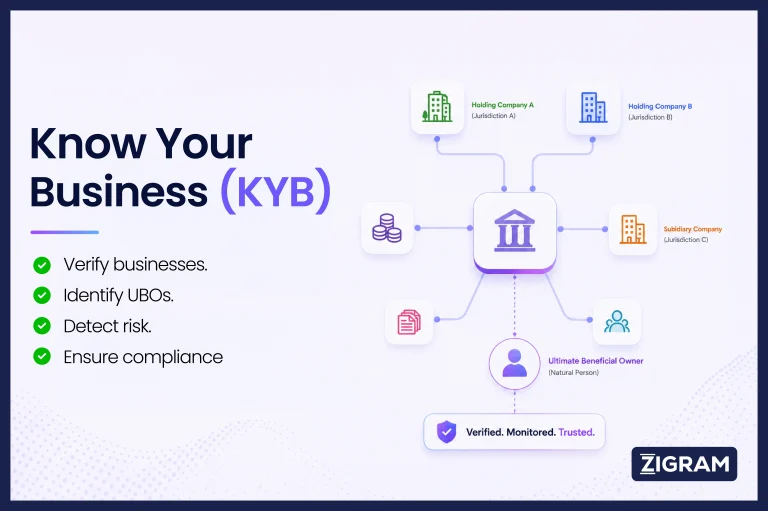
KYB stands for “Know Your Business”-the set of processes that financial institutions and other regulated firms use to verify the identity, ownership, legitimacy, and risk profile of business entities before forming or continuing a relationship. If you’re onboarding corporate customers, managing business partners, or maintaining business relationships with other businesses, KYB is the control that determines how well everything downstream works.
What Is Know Your Business (KYB)? Why KYB Matters?
Know your business (KYB) is the corporate analogue of KYC. Where KYC focuses on verifying individuals, KYB targets the legal persons-companies, partnerships, trusts, and other corporate structures-that make up the majority of high-value commercial and financial transactions. KYB verifies the identity and legitimacy of businesses by confirming legal existence, ownership structure, beneficial ownership, business activity, and risk profile. KYB requires verifying a business’s legal status and ownership before a relationship can proceed.
The urgency behind KYB compliance has accelerated sharply. KYB checks are required by anti money laundering regulations across virtually every major jurisdiction, and the regulatory bar keeps rising. Post-2023 sanctions waves, the US Corporate Transparency Act (which began requiring beneficial ownership reporting to the Financial Crimes Enforcement Network in January 2024), the EU’s AML package targeting 2024–2026, and tightening rules on ultimate beneficial owners have all converged to make robust KYB process design a non-negotiable priority for regulated industries.
The stakes are concrete. According to UNODC estimates, 2% to 5% of global GDP is laundered each year-roughly $2 trillion annually. Fraud is predicted to cost $58.3 billion by 2030. Financial crime costs the UK economy around £290 billion annually. In 2024, TD Bank paid $3.09 billion for AML compliance failures, underscoring that inadequate KYB may signal potential money laundering risks and invite catastrophic penalties. Businesses must collect documents like registration and ownership proof, screen for sanctions and politically exposed persons, and assess risk continuously-or face the consequences.
At ZIGRAM, we see KYB as the “front door” control. When KYB is strong, the rest of your aml compliance programme-screening, monitoring, due diligence-performs on solid data. When it’s weak, everything downstream is compromised.
KYB vs KYC and other due diligence processes
KYB, KYC, CDD, EDD, and CIP are overlapping but distinct layers within an AML and financial crime framework. Understanding where each fits prevents gaps and duplication.
KYB verifies businesses while KYC verifies individual customers. KYC focuses on individual identity verification for consumers-checking photo ID, proof of address, and confirming that a person is who they claim to be. KYC is older than KYB, established before the 2017 FinCEN CDD rule that formally extended similar rigour to corporate clients. KYB is required by AML regulations for corporate clients and involves substantially more complexity.
CDD (Customer Due Diligence) is the base-level framework of checks on risk, identity, and business relationship purpose-applicable to both individuals and entities. EDD (Enhanced Due Diligence) deepens those checks for high-risk entities, such as those with complex ownership in high-risk jurisdictions. CIP (Customer Identification Program), specific to the US context, is the minimum identity collection and verification step mandated under BSA and the USA PATRIOT Act.
Why is KYB harder than KYC? Consider a simple retail KYC scenario: a bank opens a personal account, verifies a driver’s licence, confirms an address, and screens the individual against sanctions and PEP lists. Now compare that with a multi-jurisdiction KYB case: a fintech onboards a supplier owned through three offshore holding companies, with nominee directors in one jurisdiction, a trust arrangement in another, and ultimate beneficial owners ubos who control via voting agreements rather than direct equity. Documents arrive in multiple languages, registries differ in reliability, and control may be exercised through mechanisms that don’t appear on any share register. That complexity gap is why KYB demands its own process, tools, and expertise.
KYB Compliance Requirements and Regulations
KYB compliance requirements vary by jurisdiction but share common principles aligned to FATF’s 40 Recommendations, particularly Recommendations 24 and 25 on beneficial ownership transparency. The FATF’s 2023–2025 guidance strengthened expectations for accurate, up-to-date beneficial ownership information across all member states.
The EU’s AML Directives (4AMLD through 6AMLD) and the new single AML rulebook, AMLR (Regulation EU 2024/1624), AMLD6 (Directive EU 2024/1640), and AMLA tighten requirements for central beneficial ownership registers, lower thresholds for high-risk entities to as low as 15% ownership, and mandate verification of registry data. In the US, the Bank Secrecy Act, the USA PATRIOT Act (which mandated KYB checks for financial institutions), FinCEN’s 2016 CDD Final Rule, and the Corporate Transparency Act collectively require beneficial ownership reporting to FinCEN, with updates due within 30 days of changes.
KYB checks must comply with AML regulations in most jurisdictions. The typical KYB requirements across major markets converge on a core set:
Verify legal existence and status of the business via government registries and registration documents.
Identify and verify directors and ultimate beneficial owners, normally those with 25% or more ownership or control-with lower thresholds for high-risk scenarios.
Understand the nature and purpose of the business relationship.
Perform sanctions, PEP, and adverse media screening on both the entity and key individuals.
Apply a risk-based approach and perform ongoing monitoring and record-keeping for at least five years.
KYB processes help identify ultimate beneficial owners (UBOs), and KYB checks include ownership structure and business activities as core verification elements. Sectors expressly in scope include banking, fintech, payments, securities, insurance, and crypto/VASPs-but many unregulated B2B companies voluntarily adopt KYB to manage third-party and supplier risk. The General Data Protection Regulation and equivalent data protection laws also shape how KYB data can be stored, processed, and retained, requiring purpose limitation and data accuracy.
What a Modern KYB Verification Process Should Include
A robust KYB process combines documentary verification, data-driven business checks, and risk intelligence drawn from multiple data sources. The depth of each check depends on the assessed risk level.
The main categories of data to collect for KYB verification include company identity details (legal name, trading names, registration number, incorporation date, registered address, and principal place of business), corporate documents (certificate of incorporation, memorandum and articles of association, business licences, tax ID numbers, and where relevant, audited financial statements and financial statements), ownership and control information (share registers, shareholder lists, board composition, voting rights, and any shareholder agreements that confer control), ultimate beneficial owners (names, dates of birth, nationalities, identification documents, ownership percentages, and control mechanisms), and an operational profile covering sector codes, main products and services, primary geographies, approximate financial transactions volumes, and counterparties.
Ultimate Beneficial Owners (UBOs) must be identified in KYB checks-this is non-negotiable under virtually every regulatory framework. KYB helps detect fraudulent businesses and reduce financial crime risks by surfacing shell companies, nominee arrangements, and hidden control.
Screening should cover the entity, its directors, and all UBOs against sanctions lists, watchlists, PEP lists, and adverse media. Adverse media monitoring should be automated, draw from multi-language sources, categorise findings by risk themes (fraud, corruption, sanctions evasion, environmental violations), and produce time-stamped entries.
ZIGRAM’s Complete AML System integrates these checks via PreScreening.io for name screening, sanctions, PEP, and adverse media. Entity Hero for entity risk assessment and ownership/UBO mapping; and Transact Comply for ongoing transaction monitoring once the business relationship is established.
Step-by-step KYB verification process

An effective KYB verification process can be broken into a clear sequence of stages, from initial business identity verification through ongoing monitoring. This sequence should be formalised in internal policy and aligned to jurisdictional KYB regulations.
Step 1 – Collect business information. Use digital intake forms, API data pulls from registries, and document uploads. Ensure mandatory fields are aligned to jurisdictional KYB requirements- legal name, registration number, address, director and shareholder details, and expected activity.
Step 2 – Verify legal existence and status. Cross-check against official corporate registries such as Companies House (UK), Secretary of State databases (US), MCA (India), or equivalents worldwide. Confirm incorporation status, active registration, and consistency of filed data.
Step 3 – Map ownership and identify UBOs. Trace through parent entities, subsidiaries, trusts, and nominees until natural persons are identified. Document each layer of the beneficial ownership structure carefully, noting control via equity, voting rights, or contractual mechanisms.
Step 4 – Perform sanctions, PEP, and adverse media screening. Screen both the corporate customer and all UBOs/directors using up-to-date global lists and adverse media sources. Real-time screening is increasingly expected.
Step 5 – Assess risk and categorise. Assign a risk rating (low, medium, high) based on industry, geography, ownership complexity, and screening hits. Decide whether enhanced due diligence is needed. This risk assessment determines the depth of subsequent checks.
Step 6 – Decide on onboarding. Approve, conditionally approve with mitigating controls, request additional information, or decline. Document the rationale and escalate high-risk cases to senior management or a KYB compliance officer. The onboarding process should produce a clear audit trail.
Step 7 – Ongoing monitoring and periodic reviews. Set review frequencies based on risk level- annual for high-risk, every two to three years for low-risk customers. Monitor for trigger events such as sanctions updates, adverse media, or major changes in ownership. Ongoing monitoring of business relationships is required in KYB and ensures that risk profiles remain accurate throughout the customer lifecycle.
The KYB verification process should harmonise global standards with local nuances, using configurable rules rather than one-size-fits-all checklists.
ZIGRAM’s Complete AML System automates each step: PreScreening.io for real-time screening and re-screening; Entity Hero for automated entity resolution, UBO extraction, and risk scoring; and Transact Comply with connecting onboarding risk scores to dynamic transaction monitoring scenarios.
Typical KYB red flags, adverse media, and risk indicators
Identifying red flags early allows organisations to avoid onboarding illicit business entities and to calibrate enhanced due diligence where relationships must be maintained. Ongoing monitoring helps identify red flags in business relationships that may not be visible at initial onboarding.
Corporate registration anomalies include recently incorporated entities with no clear business rationale, frequent changes of name or registered address, or registrations in known secrecy jurisdictions. Ownership concerns include undisclosed UBOs, use of bearer shares, nominee shareholders, or complex chains of corporate structures with no obvious commercial logic-hallmarks of shell companies designed to obscure true control. Management issues include directors involved in multiple collapsed or phoenix companies, banned directors, or individuals appearing in previous fraud or regulatory enforcement cases. Address and operational discrepancies-residential or mailbox addresses for supposedly large operations, multiple unrelated businesses sharing a small office, or inconsistencies between stated operations and public footprint-are classic indicators of business risk.
Adverse media can surface hidden risk through media reports of sanctions evasion, corruption, tax fraud, environmental violations, or major litigation involving the company or its UBOs. Coverage in investigative leaks (such as the Panama Papers, Paradise Papers, and Pandora Papers) often reveals aggressive secrecy or avoidance structures. Repeated references to regulatory actions, licence revocations, or serious compliance breaches are strong signals for escalation.
Behavioural and transactional red flags typically emerge post-onboarding and should tie back into KYB reassessment: unusual transaction volumes or patterns versus the stated business profile, extensive use of high-risk corridors or counterparties, and rapid movement of funds with low balances maintained (“fast in, fast out”). Data analysis helps to preempt threats by identifying weaknesses proactively-before potential risks become enforcement actions.
ZIGRAM’s adverse media and news modules, including Dragnet Alpha, can be embedded into KYB workflows to continuously flag and classify emerging negative news for corporate customers and UBOs.
Designing a risk-based KYB program inside your organisation
KYB compliance is most effective when built as a risk-based framework rather than a tick-box exercise, especially for institutions operating across multiple jurisdictions. Vision and goal alignment ensures strategic direction in decision-making when designing your program.
The key components of a risk-based KYB framework start with governance: appoint a KYB or broader AML Compliance Officer, define roles, and ensure board-level oversight. Policy and standards should document risk appetite, sector and geography risk ratings, and thresholds for UBO identification and EDD. Procedures and playbooks should provide clear, step-by-step guidance for onboarding, periodic reviews, and handling alerts or failed kyb checks.
Stratify your corporate customers based on risk. Low-risk customers include those with transparent ownership, operating in regulated sectors and low-risk geographies. Medium risk covers standard corporate structures in moderate-risk industries or markets. High risk encompasses opaque or multi-layer ownership, exposure to high-risk jurisdictions, crypto-related activities, cash-intensive businesses, or sectors frequently associated with financial crime.
Periodic reviews are essential for maintaining accurate risk profiles. Regular training for front-office, operations, and compliance teams on KYB requirements and emerging typologies is critical. Internal communication should emphasise that KYB protects the company’s reputation and its clients-not just regulators. Effective business analysis covers six key domains in planning, monitoring, and evaluation, and applying frameworks like SWOT Analysis (which evaluates business strengths, weaknesses, opportunities, and threats) and PESTLE Analysis (examining Political, Economic, Social, Technological, Legal, and Environmental factors) helps shape the program to real operating conditions. Evaluating resources and operations helps identify core competencies that the KYB program should leverage, while the “More, Better, Different, Less” Framework evaluates products, services, or processes for improvement within your compliance function. Regular customer and employee surveys are crucial for understanding loyalty and identifying friction in the verification process. Process mapping software is used to model and improve business processes, ensuring the KYB workflow is efficient and auditable.
Internal controls should include quality assurance and sample testing of completed KYB files, internal audits focused on KYB and wider financial crime controls, and clear escalation paths for complex cases or when adverse media or sanctions hits arise. ZIGRAM’s technology underpins a risk-based approach through configurable rules, automated risk scoring, and workflow routing to different review queues based on risk.
Manual vs automated KYB: why RegTech matters in 2026
Traditional manual KYB involves emails, spreadsheets, and ad hoc registry lookups. A 2026 survey of compliance professionals found that 44% still run fully manual kyb processes, 40% are partially automated, and just 16% are mostly automated. The limitations are clear: slow onboarding timelines and high operational cost, inconsistent decisions and documentation across teams and regions, and difficulty keeping pace with rapidly changing sanctions and regulatory requirements.
Automated KYB solutions and KYB-as-a-Service platforms transform this picture. They provide real-time access to corporate registries, sanctions lists, PEP databases, and adverse media feeds. They enable automated entity resolution and deduplication to avoid fragmented profiles and support configurable rules that encode kyb compliance requirements and adapt to jurisdictional nuances. Automated KYB solutions can reduce onboarding time by over 50%-one vendor pilot cut business verification process time from 22 minutes to 7 while boosting UBO detection accuracy from 61% to 95%. KYB automation can cut compliance operating costs by 25-30%, delivering measurable operational efficiency.
AI and advanced analytics now play a central role. AI-powered automation improves KYB efficiency and accuracy through automated extraction of entity data from documents in multiple languages, pattern recognition in ownership networks and business relationships to surface hidden UBOs, and dynamic risk scoring that updates when adverse media, sanctions, or transactional anomalies appear. Automated systems conduct real-time monitoring of business risk profiles and automated KYB checks enhance compliance with regulatory requirements continuously. Concrete analytics replace gut feelings in decision-making. Data visualization tools are essential for analyzing complex data and trends across your corporate customer base, while Business Intelligence consolidates data into interactive dashboards for analysis. Trend Analysis monitors financial and operational data to identify patterns that manual review would miss. Data-driven decision-making minimizes risks and aligns resources for growth.
ZIGRAM’s Complete AML System exemplifies an integrated automated KYB solution: PreScreening.io for automated global screening and risk list checks at onboarding and continuously; Entity Hero for entity risk assessment, registry enrichment, UBO discovery, and visualisation of ownership networks; and Transact Comply for linking initial KYB risk to ongoing transaction monitoring and case management.
KYB in high-risk and emerging sectors (crypto, fintech, and beyond)
Certain sectors face more intense KYB scrutiny due to regulatory focus and inherent risk. Crypto platforms, neobanks, cross-border payment service providers, and online marketplaces all sit in the spotlight.
Virtual Asset Service Providers (VASPs) fall under FATF guidance and the EU’s MiCA framework (effective from late 2024 for many provisions), requiring AML/CFT controls equivalent to traditional financial institutions. Fintechs and payment institutions relying on embedded finance or Banking-as-a-Service must perform KYB on merchants, business partners, and programme managers-not just direct customers. Marketplaces and platform businesses must understand sellers, suppliers, and large-volume partners across jurisdictions. Utilizing structured methodologies like SWOT and PESTLE is foundational for business insight when assessing sector-specific risks, and SWOT Analysis allows leaders to identify internal strengths and weaknesses of their compliance programmes relative to these emerging demands.
Special challenges in these sectors include high onboarding volumes requiring near-instant KYB decisions, cross-border activity spanning multiple regulatory regimes and registries, and a higher prevalence of shell entities, front companies, and synthetic identities. KYB in these environments must integrate with transaction monitoring tuned to sector-specific typologies (e.g., layering via stablecoins, rapid merchant cash-outs) and with real-time risk scoring that reflects both static KYB data and dynamic behavioural data.
ZIGRAM’s modules-including crypto entity risk tools and ESG risk assessments-extend beyond classic KYB to capture emerging risk dimensions relevant to balancing regulatory compliance with business growth in 2026 and beyond.
Building continuous KYB: from onboarding to perpetual monitoring
KYB is no longer a one-time onboarding exercise. Regulators increasingly expect “perpetual KYB”-continuous review models that keep pace with the real world. Ongoing monitoring ensures compliance with changing regulations and ongoing monitoring detects changes in business status or ownership before they become liabilities.
Perpetual KYB in practice means automated re-screening against sanctions, PEP, and adverse media lists whenever these lists are updated. It means event-driven reviews triggered by changes such as new UBO filings, company status updates, major management changes, or unusual transactional behaviour. And it means scheduled periodic reviews based on initial and evolving risk scores. Automated systems can conduct ongoing monitoring in real-time, removing the dangerous gap between a material change and your awareness of it.
The data and technology foundations required include a centralised entity master record (“golden record”) for each corporate customer, integration of internal data (transactions, behaviour) with external intelligence (registries, media, watchlists), and workflow tools that can assign, track, and audit KYB reviews and decisions.
Continuous KYB supports broader compliance and risk management: early detection of deteriorating counterparties or partners, faster reaction to new sanctions regimes and regulatory developments, and better alignment between front-office growth objectives and compliance safeguards.
Choosing KYB technology and partners
Selecting the right KYB tools and vendors is critical for effectiveness, scalability, and cost control-especially for institutions with global corporate customer bases. Your kyb solution should mitigate risks across every jurisdiction you operate in.
Key evaluation criteria for KYB platforms include data coverage (breadth and depth of global corporate registries, sanctions and watchlists, PEP data, and adverse media sources), UBO and ownership intelligence (ability to untangle complex structures, visualise networks, and maintain up-to-date UBO profiles), and workflow and integration capabilities (APIs, case management, audit trails, and compatibility with existing AML, CRM, and core banking systems).
Operational and strategic considerations matter equally. Time to value- how the solution can quickly be configured to local KYB requirements and risk rules-determines how fast you see results. Regulatory alignment with FATF, EU AMLDs, BSA/FinCEN guidance, and local supervisory expectations should be demonstrable, not just claimed. Access to subject-matter experts who understand KYB, AML, and evolving regulatory compliance trends ensures the platform evolves with you. To help prevent money laundering and terrorist financing, your technology must assess risk dynamically across the entire customer lifecycle, not just at the point of onboarding. The right platform will also store user preferences and case history to ensure continuity across reviews.
ZIGRAM’s Complete AML System combines screening (PreScreening.io), entity intelligence (Entity Hero), and monitoring (Transact Comply) with managed services and domain expertise- covering KYB verification important to institutions across banking, fintech, payments, insurance, and crypto.
KYB is no longer a back-office checkbox. It's a strategic capability that determines how well your entire AML programme performs. The institutions that modernise their KYB processes now will onboard faster, comply better, and catch more risk before it materialises.
Ready to see how automated KYB fits your compliance programme? Book a demo with ZIGRAM to explore KYB automation tailored to your jurisdiction and risk profile.