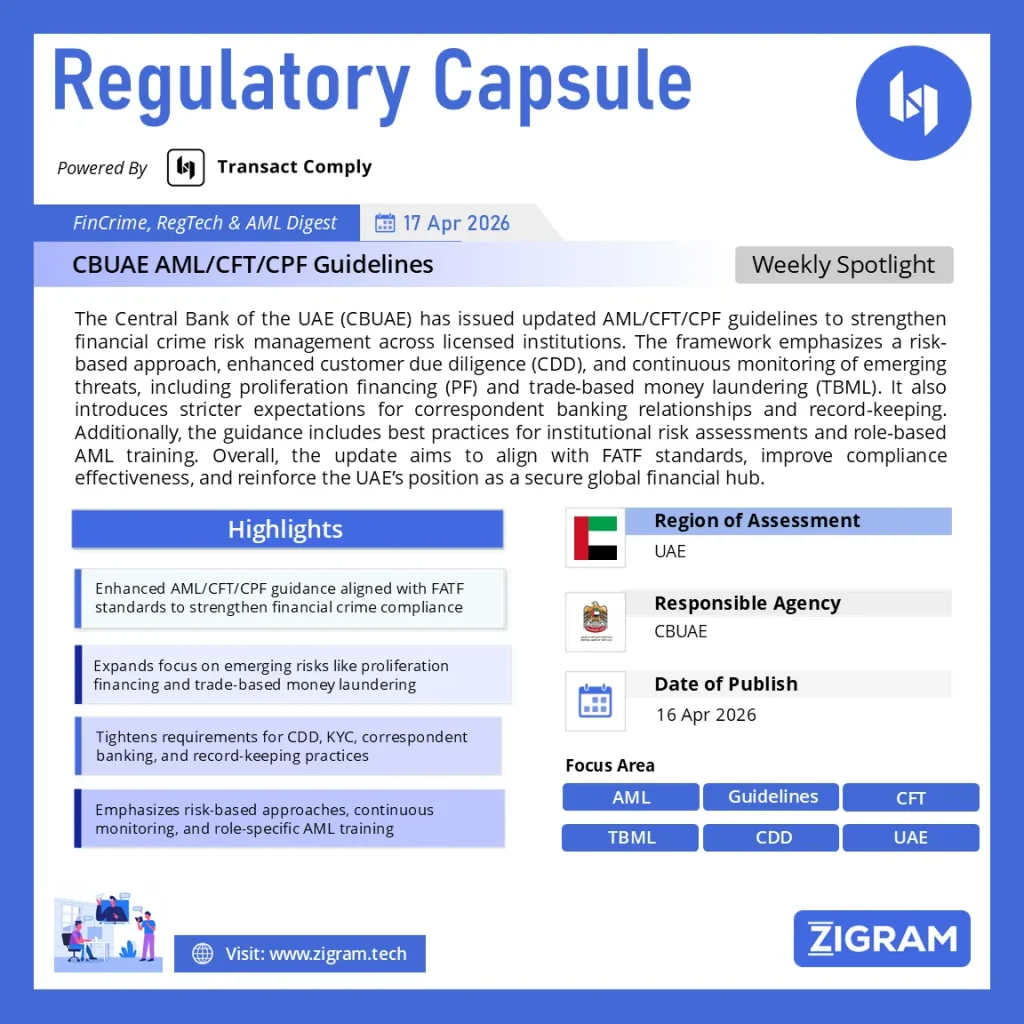
Regulation Name: CBUAE Updates AML/CFT/CPF Guidance for Licensed Financial Institutions
Date Of Issue: 16 Apr 2026
Region: United Arab Emirates
Agency: CBUAE
CBUAE’s 2026 AML/CFT/CPF Guidance: What AML Leaders Must Know to Stay Compliant
The Central Bank of the UAE (CBUAE) has introduced a comprehensive update to its Anti-Money Laundering (AML), Combating the Financing of Terrorism (CFT), and Countering Proliferation Financing (CPF) framework—marking a significant regulatory shift for financial institutions operating in or connected to the UAE.
Announced on 16 April 2026, the updated guidance package reflects a strategic push to align with Financial Action Task Force (FATF) standards, strengthen supervisory expectations, and enhance risk-based compliance systems across licensed financial institutions (LFIs) and Registered Hawala Providers (RHPs).
For AML compliance leaders, this is not just another regulatory update, it is a blueprint for future-ready compliance systems.
Why the CBUAE AML Update Matters Now
The updated AML/CFT/CPF guidance is part of the UAE’s National Strategy (2024–2027), aimed at reinforcing its position as a secure and globally trusted financial hub.
What makes this update critical:
- It expands focus beyond traditional AML to include proliferation financing (PF) risks
- It introduces granular supervisory expectations across high-risk areas like trade finance and correspondent banking
- It emphasizes continuous risk monitoring and proactive detection frameworks
- It operationalizes risk-based compliance as a measurable and auditable function
In short, regulators are moving from policy compliance to effectiveness validation.
Key Pillars of the CBUAE AML/CFT/CPF Guidance
- Proliferation Financing (PF): A New Compliance Priority
One of the most notable additions is the dedicated guidance on proliferation financing risks.
The CBUAE defines an effective CPF framework through three core components:
- Assessment of inherent PF risks
- Evaluation of internal controls and remediation of gaps
- Continuous monitoring of emerging typologies and actors
This signals a shift toward dynamic risk intelligence, where institutions must go beyond static sanctions screening and actively track evolving geopolitical and trade-related threats.
Implication for AML teams:
Traditional AML systems may not be sufficient—institutions need enhanced data intelligence, entity resolution, and network analysis capabilities.
- Trade-Based Money Laundering (TBML) and Transshipment Risks
TBML remains one of the most complex and under-detected forms of financial crime. The updated guidance provides a structured framework to:
- Identify risks embedded in cross-border trade flows
- Monitor trade anomalies and misinvoicing patterns
- Strengthen controls around transshipment activities
This is particularly relevant for banks involved in:
- Trade finance
- Supply chain financing
- Import-export facilitation
Key takeaway:
AML compliance must integrate with trade data, logistics intelligence, and customs-related indicators—breaking silos between compliance and business operations.
- Correspondent Banking Risk Management
Correspondent banking continues to be a high-risk area due to indirect exposure to global financial crime.
The CBUAE guidance mandates:
- Enhanced due diligence on respondent banks
- Clear risk-based policies and procedures
- Ongoing transaction monitoring aligned with risk profiles
What’s changing:
Regulators now expect institutions to demonstrate active risk ownership, not just reliance on counterparties’ controls.
- Strengthened CDD, KYC, and Record-Keeping Requirements
Customer Due Diligence (CDD) and Know Your Customer (KYC) frameworks are being sharpened with:
- Clear expectations on identity verification across lifecycle stages
- Risk-based application of simplified vs enhanced due diligence
- Defined requirements for data retention and documentation
Critical shift:
KYC is no longer a one-time onboarding exercise—it is a continuous risk assessment process.
Best Practices: From Compliance to Capability Building
Beyond regulatory guidance, the CBUAE also released best practice manuals focusing on implementation.
Risk-Based Approach and Institutional Risk Assessment
Institutions are expected to:
- Develop structured risk assessment methodologies
- Align controls proportionate to risk exposure
- Regularly update risk models based on emerging threats
This reinforces the global regulatory trend:
“One-size-fits-all compliance is no longer acceptable.”
Role-Based AML Training
The guidance emphasizes:
- Specialized training programs tailored to job roles
- Upskilling senior management for risk governance
- Enhancing early detection through employee awareness
Why this matters:
Human intelligence remains a critical layer in AML defense, especially in identifying complex typologies like TBML and PF.
Strategic Implications for AML Compliance Leaders
- Shift Toward Intelligence-Led Compliance
AML programs must evolve from rule-based systems to intelligence-driven frameworks that integrate:
- Adverse media
- Network analytics
- Trade and geopolitical data
- Increased Regulatory Scrutiny on Effectiveness
Regulators are no longer satisfied with documented policies. They will assess:
- Detection rates
- False positive reduction
- Timeliness of reporting
- Quality of risk assessments
- Technology Modernization is No Longer Optional
Legacy AML systems struggle with:
- PF risk detection
- TBML pattern recognition
- Cross-border transaction complexity
Modern compliance requires:
- AI/ML-driven monitoring
- Entity resolution across datasets
- Real-time screening and alerts
- Integration Across Business Functions
AML compliance can no longer operate in isolation. It must integrate with:
- Trade finance teams
- Relationship managers
- Risk and audit functions
How Financial Institutions Should Respond
To align with the CBUAE’s updated AML framework, institutions should prioritize:
- Conduct a Gap Assessment
- Benchmark current AML controls against new guidance
- Identify weaknesses in PF, TBML, and correspondent banking frameworks
- Upgrade Risk Assessment Models
- Incorporate new typologies and emerging risks
- Align with FATF and UAE National Strategy priorities
- Enhance Data Capabilities
- Integrate structured and unstructured data sources
- Improve entity and transaction visibility
- Strengthen Training Programs
- Implement role-specific AML training
- Focus on real-world typologies and case studies
- Adopt a Continuous Monitoring Approach
- Move from periodic reviews to real-time risk monitoring
The Bigger Picture: UAE’s Global AML Positioning
The CBUAE’s updated guidance reflects a broader ambition—to position the UAE as a leader in global AML compliance and financial integrity.
As highlighted by the CBUAE Governor, the initiative aims to:
- Strengthen the national financial crime framework
- Enable proactive risk detection
- Contribute to global financial system stability
Final Thoughts
The 2026 CBUAE AML/CFT/CPF guidance is a clear signal that the regulatory bar has been raised.
For AML compliance leaders, success will depend on:
- Moving beyond checkbox compliance
- Embedding risk intelligence into operations
- Leveraging technology for proactive detection
- Building a culture of continuous compliance
Those who adapt early will not only meet regulatory expectations but also gain a competitive advantage in an increasingly scrutinized global financial ecosystem.
Read about the guidelines here.
Read about the product: Transact Comply
Empower your organization with ZIGRAM’s integrated RegTech solutions – Book a Demo
- #AMLCompliance
- #CBUAE
- #FinancialCrime
- #AMLRegulations
- #KYC
- #FATF
- #CDD
- #RiskBasedApproach
- #TBML
- #ProliferationFinancing
- #CorrespondentBanking
- #RegTech
- #ComplianceLeadership
- #FinancialRegulation
- #AntiMoneyLaundering