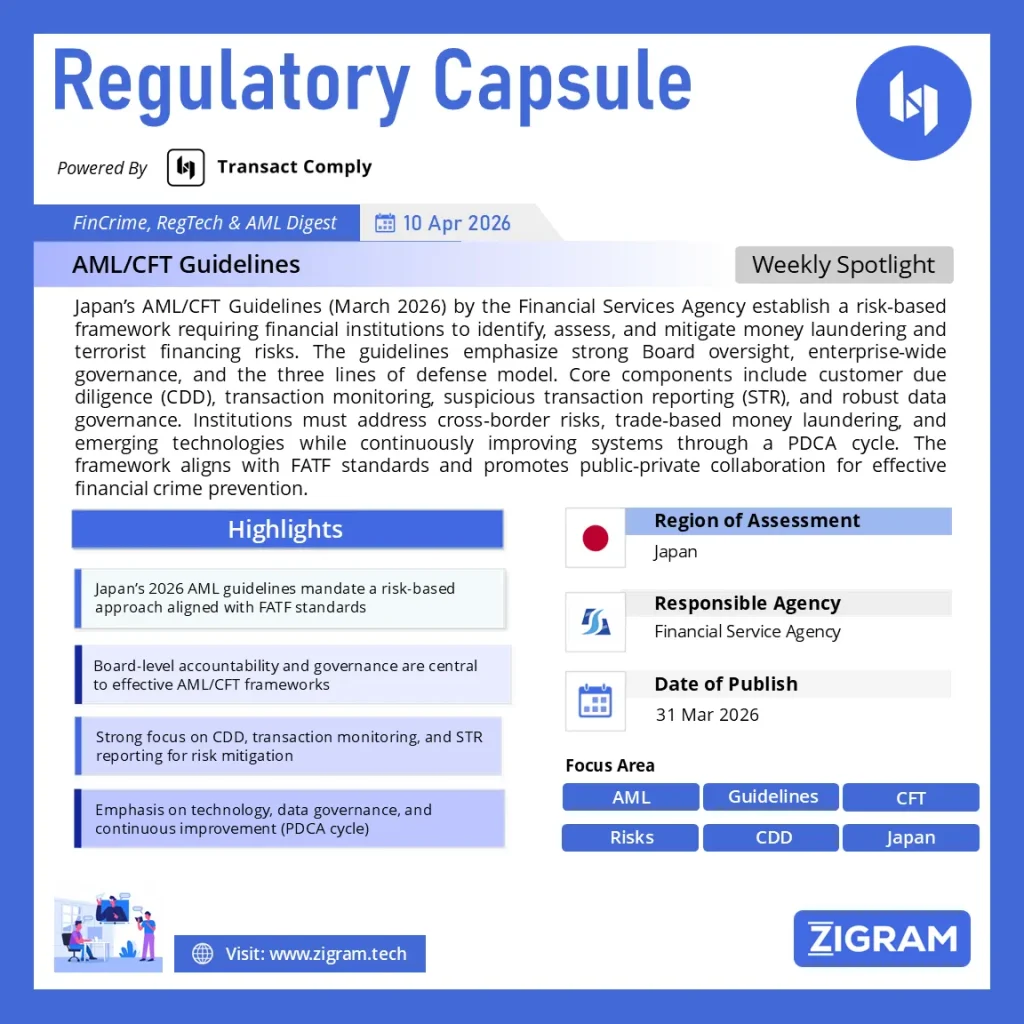
Regulation Name: Guidelines for Anti-Money Laundering and
Combating the Financing of Terrorism
Date Of Issue: 31 Mar 2026
Region: Japan
Agency: Financial Service Agency
Japan AML/CFT Guidelines 2026: A Strategic Playbook for Risk-Based Compliance and Financial Crime Prevention
The Japan Financial Services Agency (FSA) AML/CFT Guidelines (March 2026) mark a significant evolution in global anti-money laundering and counter-terrorism financing frameworks. Moving beyond traditional compliance checklists, the guidelines reinforce a risk-based, governance-driven, and technology-enabled approach to financial crime prevention.
For AML compliance leaders, these guidelines are not just regulatory expectations—they are a blueprint for building resilient, scalable, and intelligence-led compliance systems aligned with FATF standards and global supervisory trends.
What Makes Japan’s 2026 AML Guidelines Structurally Important?
At their core, the guidelines emphasize:
- Risk-based AML/CFT as a minimum global standard
- Strong Board-level accountability
- Continuous framework evolution (PDCA cycle)
- Integration of technology, data governance, and analytics
- Enhanced focus on cross-border and emerging risks
The FSA explicitly highlights that ineffective AML controls can result in heavy penalties, reputational damage, and loss of correspondent banking relationships .
The Risk-Based Approach: From Theory to Execution
What is the Risk-Based Approach?
The guidelines define the risk-based approach as:
Identifying, assessing, and mitigating ML/FT risks based on an institution’s unique risk exposure and business model
This aligns with FATF Recommendation 1, making it a non-negotiable standard for global financial institutions.
The Three Core Pillars
- Risk Identification
Financial institutions must evaluate risks across:
- Products and services
- Customer profiles and beneficial ownership
- Geographic exposure (including high-risk jurisdictions)
- Transaction types and delivery channels
This must be enterprise-wide and Board-led, ensuring no siloed risk assessments .
- Risk Assessment
Institutions must:
- Use objective, data-driven methodologies
- Incorporate Suspicious Transaction Report (STR) analytics
- Conduct annual reviews (minimum)
Risk assessments must directly inform resource allocation and control design.
- Risk Mitigation
Mitigation must be:
- Proportionate to risk levels
- Customer- and transaction-specific
- Continuously updated based on evolving threats
Customer Due Diligence (CDD): The Core Control Layer
CDD is positioned as the central pillar of AML/CFT controls, covering:
- Customer identity and verification
- Beneficial ownership identification
- Purpose and nature of transactions
- Source of funds and wealth
Risk-Based CDD Framework
Risk Level | Required Action |
High Risk | Enhanced Due Diligence (EDD), senior approval, stricter monitoring |
Low Risk | Simplified Due Diligence (SDD), reduced frequency of checks |
High-risk categories include:
- Foreign Politically Exposed Persons (PEPs)
- Transactions involving high-risk jurisdictions
- Complex or unusual transaction patterns
Transaction Monitoring and STR: Intelligence-Led Detection
The guidelines mandate:
- Scenario-based monitoring aligned with risk assessments
- Continuous optimization of thresholds and detection logic
- Integration of STR analytics into risk frameworks
Institutions must:
- Detect unusual patterns
- Investigate anomalies
- File STRs promptly
STR data is not just regulatory—it is strategic intelligence for risk recalibration.
Governance: The Board is No Longer Optional
One of the strongest messages in the guidelines:
AML/CFT is a strategic responsibility of the Board, not just a compliance function
Board Responsibilities Include:
- Approving AML frameworks and policies
- Allocating resources (budget, technology, talent)
- Driving top-down compliance culture
- Reviewing risk assessments and mitigation effectiveness
Failure at the Board level is framed as a systemic governance failure.
The Three Lines of Defense Model
The guidelines formalize the three lines of defense:
- First Line: Business Operations
- Customer-facing teams
- Responsible for executing controls and identifying risks
- Second Line: Compliance & Risk
- Oversight and policy enforcement
- Supports and monitors first-line activities
- Third Line: Internal Audit
- Independent assurance
- Evaluates effectiveness of AML framework
This structure ensures accountability, independence, and continuous improvement.
Technology, Data, and AML Modernisation
The FSA strongly pushes for technology-driven AML systems, including:
- AI and machine learning for transaction monitoring
- Automated screening and alert systems
- Integrated data platforms
Data Governance Requirements
Institutions must ensure:
- Accurate and complete customer and transaction data
- Structured, analyzable datasets
- Regular validation and integrity checks
Without high-quality data, even advanced AML systems fail.
Cross-Border Risk and Correspondent Banking
Cross-border transactions are identified as high-risk vectors, requiring:
- Enhanced due diligence
- Sanctions screening
- Monitoring of correspondent banking partners
Institutions must also:
- Avoid relationships with shell banks
- Assess counterparties’ AML frameworks
- Ensure transparency in payment chains
Emerging Risks: Trade-Based Money Laundering & New Technologies
Trade-Based Money Laundering (TBML)
Risks include:
- Mis-invoicing
- Fake trade transactions
- Dual-use goods
Institutions must evaluate:
- Trade routes
- Goods and pricing anomalies
- Counterparty legitimacy
New Technologies
The FSA encourages adoption of:
- AI for anomaly detection
- Blockchain analytics
- Robotic Process Automation (RPA)
However, institutions must evaluate effectiveness before deployment.
Continuous Improvement: The PDCA Cycle
The guidelines mandate a Plan-Do-Check-Act (PDCA) approach:
- Plan: Develop AML policies and frameworks
- Do: Implement controls
- Check: Monitor effectiveness
- Act: Improve systems continuously
This ensures AML programs remain dynamic and future-ready .
Public-Private Partnership: A Strategic Necessity
The FSA emphasizes collaboration between:
- Financial institutions
- Regulators
- Industry bodies
- International authorities
This enables:
- Intelligence sharing
- Faster response to emerging threats
- Industry-wide resilience
Key Strategic Takeaways for AML Leaders
- Risk-based AML is now non-negotiable and enforceable
- Board accountability is a regulatory expectation
- Data and technology are core to compliance effectiveness
- Cross-border and trade finance risks require specialized controls
- AML frameworks must be continuously evolving, not static
Conclusion
The Japan AML/CFT Guidelines 2026 signal a global shift toward intelligent, risk-driven, and governance-focused compliance frameworks.
For AML leaders, the message is clear:
Compliance is no longer about meeting minimum standards—it is about building adaptive, data-driven systems that can anticipate and mitigate financial crime risks in real time.
Institutions that align early with these principles will not only ensure compliance but also gain a strategic advantage in risk management and regulatory trust.
Read about the guidelines here.
Read about the product: Transact Comply
Empower your organization with ZIGRAM’s integrated RegTech solutions – Book a Demo
- #JapanAML
- #AMLCFT
- #RiskBasedApproach
- #AMLCompliance
- #EDD
- #FinancialCrime
- #CDD
- #TransactionMonitoring
- #STRReporting
- #RegTech
- #FATF
- #ComplianceFramework
- #DataGovernance
- #KYC
- #FinancialRegulation