FIUTT Annual Report 2025: Key AML/CFT/CPF Developments, Statistics, and Strategic Insights for Compliance Leaders
The Financial Intelligence Unit of Trinidad and Tobago (FIUTT) Annual Report 2025 provides a critical lens into evolving global and regional AML/CFT/CPF frameworks. As jurisdictions prepare for heightened FATF scrutiny and the 5th Round Mutual Evaluation (March 2026), the report outlines regulatory enhancements, intelligence trends, enforcement actions, and strategic priorities that compliance leaders must closely track.
This article breaks down key statistics, regulatory developments, supervisory trends, and actionable insights to help AML professionals align with emerging global expectations.
Executive Overview: Strengthening AML/CFT/CPF Effectiveness
The FIUTT continues to position itself as a central intelligence and supervisory authority, aligning with FATF Recommendation 29 and global best practices. Its mandate spans:
- Financial intelligence collection and dissemination
- Risk-based AML supervision
- Enforcement and compliance monitoring
- Strategic analysis and typology development
- Domestic and international collaboration
The report highlights a strong shift toward digitisation, AI-driven intelligence, and risk-based supervision, indicating where global AML frameworks are heading.
Key AML Statistics (FY 2024–2025)
Suspicious Transaction Reporting (STR/SAR Trends)
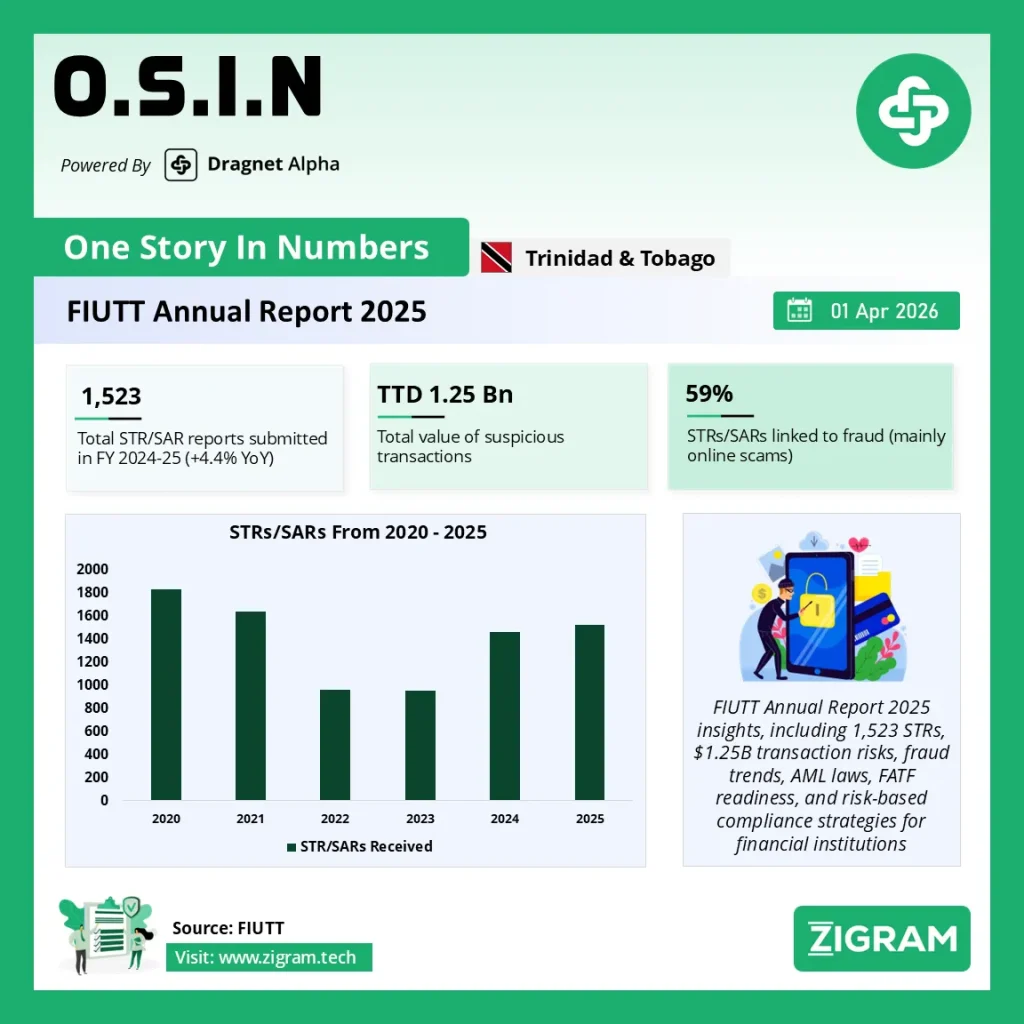
- Total STRs/SARs filed: 1,523 (+4.4% YoY)
- Total transaction value: TT$1.25 billion
- Completed: TT$762.7 million
- Attempted: TT$490.8 million
Typology Breakdown:
- Fraud (primarily online scams): 59%
- Money laundering: 16%
- Suspicious activity: 10%
- Tax crimes: 7%
👉 Insight: The dominance of fraud (especially digital scams) confirms a global shift toward cyber-enabled financial crime, requiring enhanced transaction monitoring and behavioral analytics.
Law Enforcement Outcomes
- 112 money laundering charges against 13 individuals
- Value of ML charges:
- TT$2.28 million
- USD $18,994
👉 Insight: Strong FIU-law enforcement integration is increasingly critical for asset tracing and parallel financial investigations.
Compliance & Supervision Metrics
- Registered entities: 5,072
- New registrations: 314 (~5% growth)
- Compliance examinations: 26
- Outreach sessions: 23
- Participants trained: 1,678
👉 Insight: Expansion in regulated entities—especially in real estate, legal, and motor vehicle sectors—signals increased regulatory focus on DNFBPs.
AML/CFT/CPF Regulatory Developments
Major Legislative Changes (2024–2025)
- FATF Compliance Act 2024
Amended 8 major laws, including:
- Proceeds of Crime Act (POCA)
- Anti-Terrorism Act (ATA)
- FIUTT Act
- Securities and Insurance laws
Key Impact:
- Improved proportionality in fines
- Enhanced due process protections
- Global Forum Act 2024
- Strengthens beneficial ownership transparency
- Aligns with FATF + OECD Global Forum requirements
👉 Compliance Impact: Increased scrutiny on UBO identification, verification, and record-keeping
- Upcoming Bills (Critical for AML Leaders)
- Counter-Proliferation Financing Bill 2025
- Virtual Asset Service Providers (VASP) Bill 2025
- Expanded FATF Compliance Bill 2025
👉 Key Risk Area: Crypto regulation and proliferation financing controls will become top compliance priorities globally
- Risk-Based Supervision: The Core Compliance Shift
The FIUTT has embedded a Risk-Based Approach (RBA) across supervision:
Key Features:
- Prioritisation of high-risk sectors/entities
- Technology-driven risk profiling
- Continuous monitoring and feedback loops
- Alignment with National Risk Assessments (2nd & 3rd NRA)
👉 Strategic Takeaway:
AML programs must evolve from rule-based compliance → risk-intelligent systems
- Financial Intelligence & Typology Insights
Key Emerging Threats
- Online fraud and scams (dominant threat)
- Increasing complexity in financial crime networks
- Cross-border intelligence dependencies
- Beneficial ownership opacity risks
FIU Intelligence Capabilities
- Operational + strategic intelligence reports
- Typologies and advisories
- Beneficial ownership tracing support
- Asset recovery intelligence
👉 FIUTT produced:
- 3 advisories
- 1 typology report
- Ongoing advanced strategic analysis
Technology Transformation in AML
The FIUTT is actively investing in:
Key Innovations:
- AI for STR/SAR analysis
- Data analytics platforms
- Digital compliance systems (end-to-end lifecycle)
- Cybersecurity enhancements
- Infrastructure upgrades
👉 Global Relevance:
This aligns with the broader shift toward AI-powered AML (RegTech + SupTech).
Sector-Specific AML Developments
Virtual Assets & FinTech
- Initial scoping of VASP regulation
- Upcoming legal framework for crypto oversight
👉 Implication:
Crypto compliance frameworks will soon become mandatory and enforceable
MVTS / Payment Systems
- Increased supervision of:
- E-Money Issuers (EMIs)
- Payment Service Providers (PSPs)
- 5 licensed EMIs under AML supervision
Non-Profit Organisations (NPOs)
- Shift from supervision → oversight model
- Focus on FATF-defined high-risk NPOs
👉 Key Risk: Terrorist financing misuse via NPOs
Public-Private Partnerships (PPP): A Critical AML Trend
The FIUTT strengthened collaboration with:
- Banking associations
- Compliance working groups
- Industry stakeholders
Focus areas:
- STR quality improvement
- Typology sharing
- Risk intelligence exchange
👉 Global Insight:
PPP frameworks are becoming essential for effective AML ecosystems
FATF Alignment & Global Positioning
- Adherence to FATF 40 Recommendations
- Active participation in:
- CFATF
- Egmont Group
- Preparation for 5th Round Mutual Evaluation (2026)
👉 Compliance Priority:
Jurisdictions must demonstrate effectiveness, not just technical compliance
Strategic Priorities for 2026 and Beyond
The FIUTT roadmap includes:
- AI-driven intelligence expansion
- Enhanced international cooperation
- Improved supervisory digitisation
- Increased enforcement effectiveness
- Strengthened risk-based frameworks
👉 Core Theme:
From compliance → intelligence-led financial crime prevention
Key Takeaways for AML Compliance Leaders
- Fraud is the #1 AML Risk
Shift focus toward:
- Scam detection models
- Behavioral analytics
- Risk-Based AML is Non-Negotiable
- Static compliance frameworks are obsolete
- Beneficial Ownership is Under the Spotlight
- UBO transparency = regulatory priority
- Crypto & VASPs are the Next Compliance Frontier
- Prepare for stricter regulations
- AI is Reshaping AML
- Invest in intelligent monitoring systems
- PPP Collaboration is Critical
- Intelligence sharing improves outcomes
Conclusion
The FIUTT Annual Report 2025 reflects a broader global transformation in AML compliance—from reactive reporting to proactive, intelligence-led risk management.
With rising fraud, digital financial ecosystems, and evolving FATF expectations, institutions must:
- Adopt AI-driven AML systems
- Strengthen risk-based frameworks
- Enhance cross-border intelligence collaboration
- Ensure end-to-end compliance visibility
Failure to adapt will not only increase regulatory risk but also expose institutions to rapidly evolving financial crime threats.
Source: FIUTT Annual Report 2025
Please read about our product: Dragnet Alpha
Click here to book a free demo
- #AMLCompliance
- #FinancialCrime
- #FATF
- #STR
- #SuspiciousTransactions
- #RiskBasedApproach
- #FraudPrevention
- #RegTech
- #FinCrime
- #AMLTrends
- #ComplianceLeaders
- #FinancialIntelligence
- #CryptoCompliance
- #KYC
- #DueDiligence
- #AMLRegulations
- #GlobalCompliance