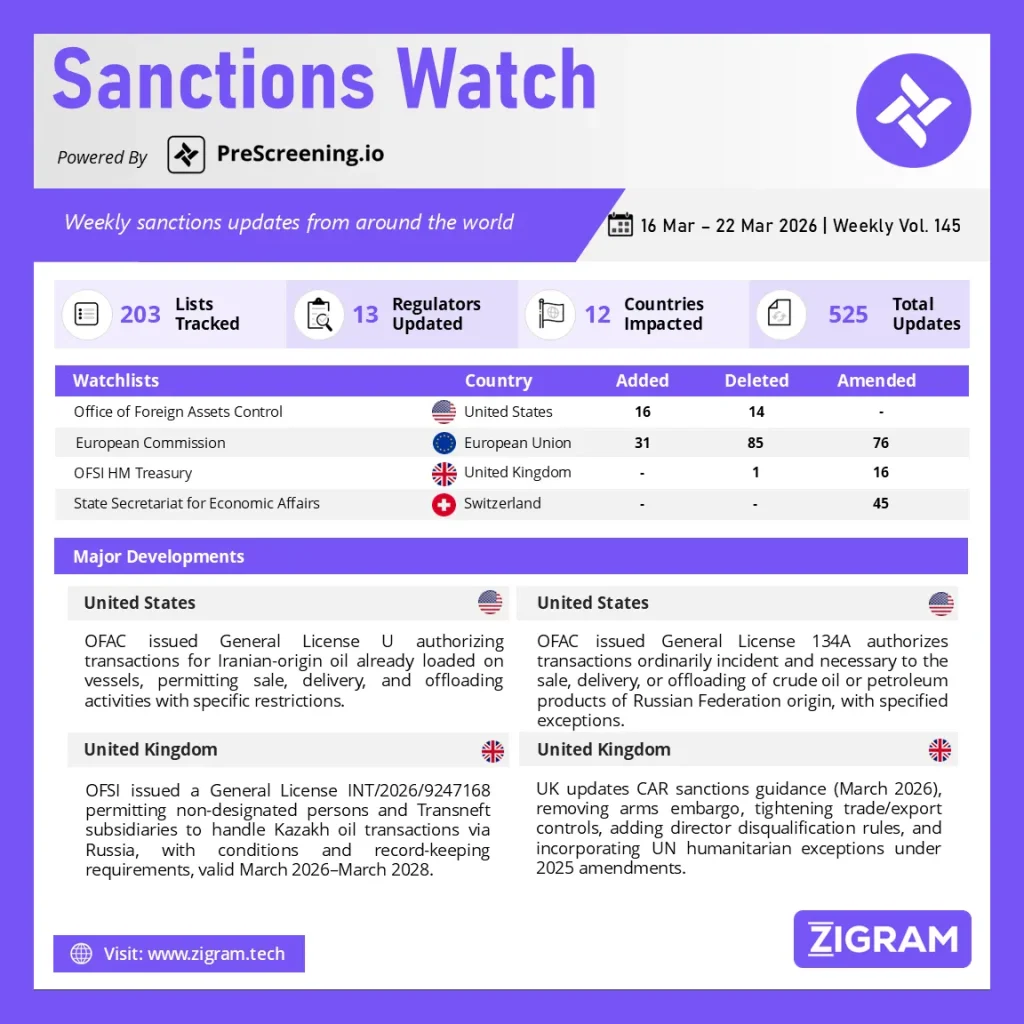
Sanctions Watch Vol 145
In the latest edition of our Sanctions Watch weekly digest, we present significant updates on sanction watchlists and regulatory developments.
U.S. Issues Temporary General License Allowing Limited Trade of Iranian Oil Already in Transit
The U.S. Department of the Treasury’s Office of Foreign Assets Control (OFAC) has issued General License U, providing temporary authorization for certain transactions involving Iranian-origin crude oil and petroleum products. The license permits the sale, delivery, and offloading of such cargoes that were already loaded onto vessels on or before March 20, 2026. This authorization remains valid until April 19, 2026.
The move aims to facilitate the safe and orderly handling of oil shipments already in transit, reducing risks related to maritime safety, environmental hazards, and crew welfare. Permitted activities include vessel docking, anchoring, emergency repairs, crew support, insurance, and other logistical services necessary for completing these transactions.
Importantly, the license also allows the import of these oil shipments into the United States if such actions are part of completing the authorized transactions.
However, the authorization comes with strict limitations. It does not permit dealings involving entities linked to North Korea, Cuba, or certain sanctioned regions of Ukraine, nor does it override other existing sanctions frameworks.
Overall, General License U reflects a controlled and time-bound easing designed to manage pre-existing shipments without signaling a broader relaxation of U.S. sanctions on Iran.
U.S. Treasury Issues Temporary Authorization for Russian Oil Shipments Loaded Before March 12, 2026
The U.S. Department of the Treasury’s Office of Foreign Assets Control (OFAC) has issued General License 134A, providing a temporary authorization for transactions involving Russian-origin crude oil and petroleum products. This license permits activities such as the sale, delivery, and offloading of these products, provided they were loaded onto vessels on or before March 12, 2026. The authorization remains valid until April 11, 2026.
The move is designed to allow for the orderly wind-down of shipments already in transit, helping to avoid disruptions in global energy supply chains and mitigating safety or environmental risks. Covered transactions include essential maritime operations such as docking, crew safety, emergency repairs, insurance, and vessel management.
However, the license includes strict limitations. It does not permit transactions involving sanctioned jurisdictions such as Iran, North Korea, Cuba, or certain regions of Ukraine, nor does it override other existing sanctions frameworks. Additionally, any dealings involving Iranian entities or goods remain prohibited unless separately authorized.
General License 134A replaces the earlier General License 134 and reflects OFAC’s continued effort to balance enforcement of sanctions with practical considerations for global trade and maritime safety.
UK Grants Licence to Facilitate Kazakh Oil Exports via Russia, Easing Energy Supply Channels
The UK’s Office of Financial Sanctions Implementation (OFSI) has issued a general licence permitting certain activities involving the transportation and trade of Kazakh-origin crude oil through Russia, providing a pragmatic solution to maintain global energy flows while upholding sanctions frameworks. Effective from 19 March 2026 to 18 March 2028, the licence allows non-designated persons and specific entities, including PJSC Transneft and its subsidiaries, to engage in transactions related to Kazakh oil, provided the oil is not owned by individuals or entities connected to Russia.
The licence enables essential operations such as supply, purchase, payment processing, and transportation of Kazakh crude oil transiting Russian territory. Importantly, UK financial institutions are authorised to process related payments, ensuring smooth financial facilitation of these transactions.
Strict compliance conditions remain in place, including comprehensive record-keeping for a minimum of six years and adherence to broader sanctions regulations. The licence does not permit any activity that would otherwise violate existing sanctions beyond its defined scope.
This move reflects a balanced regulatory approach, supporting global energy stability and supply chain continuity while maintaining pressure through targeted sanctions. It highlights the UK’s commitment to enabling legitimate trade without compromising its sanctions regime.
UK Updates Central African Republic Sanctions Regime: Arms Embargo Lifted, New Compliance Rules Introduced (March 2026)
The United Kingdom has issued updated guidance on its Central African Republic (CAR) sanctions regime as of March 2026, reflecting amendments introduced through the 2025 regulations and aligning with the latest UN Security Council resolutions. A key development is the removal of the CAR arms embargo, signaling a shift in the international approach toward the region, while still maintaining strict controls on military goods, technology, and related services linked to armed groups.
The updated framework strengthens compliance requirements across financial, trade, immigration, and corporate governance domains. Financial sanctions continue to impose asset freezes and prohibit making funds or economic resources available to designated persons, with expanded reporting obligations to the Office of Financial Sanctions Implementation (OFSI). Notably, new provisions introduce director disqualification measures, preventing designated individuals from managing or controlling UK-linked companies.
Trade sanctions remain targeted, particularly restricting support to armed groups through goods, technical assistance, and financial services, alongside updated export control rules. The guidance also incorporates United Nations humanitarian exceptions, ensuring that aid and basic human needs support can continue without breaching sanctions.
Overall, the update enhances clarity, enforcement, and accountability while balancing security objectives with humanitarian considerations.
Know more about the product: PreScreening.io
Click here to book a free demo.
Sanctions Watch is a weekly recap of events and news related to sanctions around the world.
- #Sanctions
- #OFAC
- #OilTrade
- #IranSanctions
- #RussiaSanctions
- #UKSanctions
- #EnergySecurity
- #GlobalTrade
- #Compliance
- #Geopolitics