FIU Sweden Annual Report 2025: Key AML Trends, Risks, and Strategic Shifts Reshaping Financial Crime Compliance
Introduction: A Defining Year for AML Intelligence and Enforcement
The Financial Intelligence Unit (FIU) Sweden Annual Report 2025 highlights a pivotal shift in the global fight against money laundering and terrorist financing. With record-breaking suspicious activity reporting, expanded regulatory scope, and stronger public-private collaboration, 2025 marks a transition from reactive compliance to proactive financial crime intelligence ecosystems.
The report reflects how AML frameworks are evolving into intelligence-led, partnership-driven models, aligning with upcoming EU regulations such as the Sixth Anti-Money Laundering Directive (6AMLD) and the establishment of the Anti-Money Laundering Authority (AMLA).
Top AML Statistics (FIU Sweden 2025):
Core Reporting Metrics
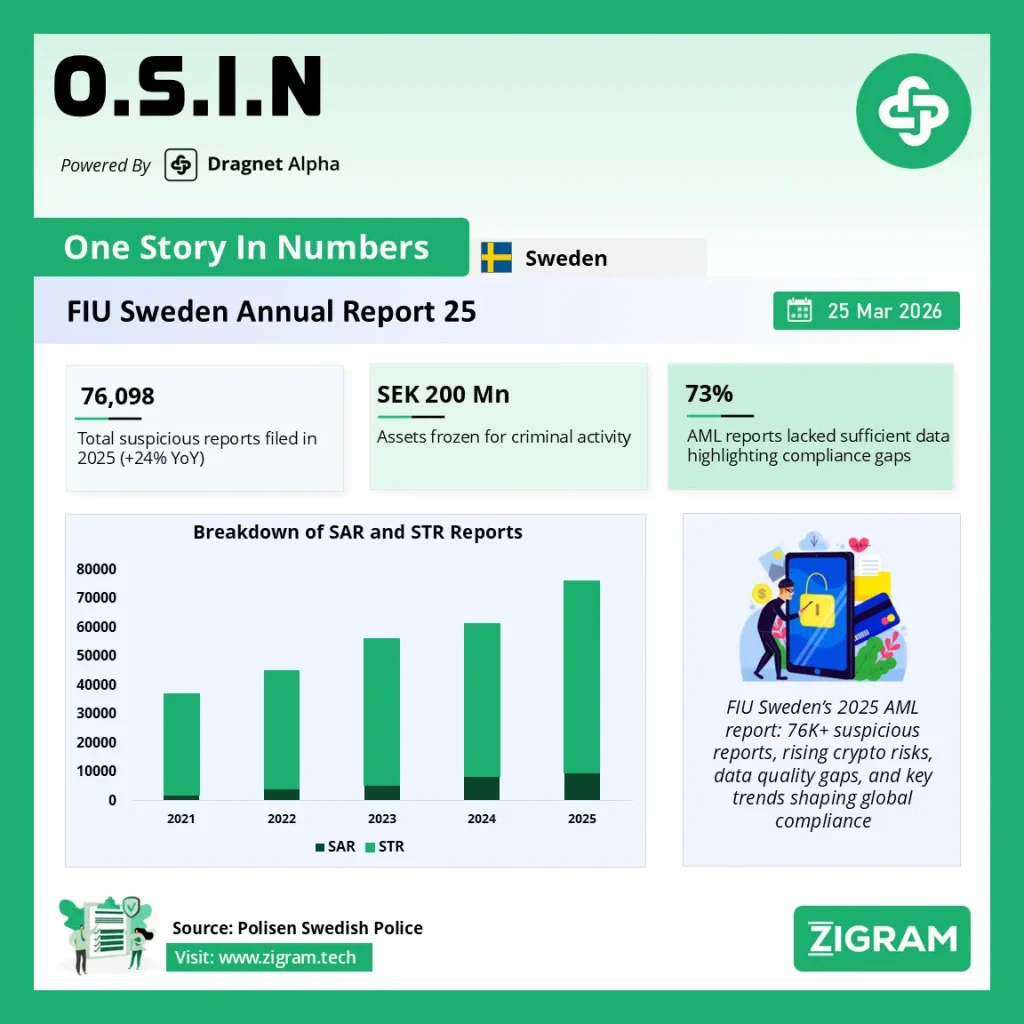
- 76,098 total suspicious reports filed in 2025 (+24% YoY)
- 66,341 Suspicious Transaction Reports (STRs) (+26%)
- 9,757 Suspicious Activity Reports (SARs) (+15%)
Insight: AML reporting volumes are growing rapidly, signaling stronger detection frameworks.
Reporting Entities & Coverage
- 2,869 registered obligated entities (+35%)
- 533 entities actively submitted reports (+7%)
Insight: AML participation is expanding, but active reporting concentration remains limited.
Data Quality Red Flags
- 73% of accounts lacked sufficient identification data
- 41% of accounts had no account holder information
Insight: Poor data quality remains one of the biggest AML intelligence gaps.
Preventive AML Actions
- 11,632 suspicious transactions were rejected by institutions (~300% increase)
Insight: Financial institutions are increasingly stopping suspicious transactions before execution.
Intelligence Sharing & Global Cooperation
- 3,233 international disseminations (+1,193%)
- 263 incoming international intelligence requests (+14%)
- 4,866 domestic intelligence disseminations (+1%)
Insight: Cross-border AML intelligence sharing is scaling at unprecedented levels.
Enforcement & Asset Recovery
- 133 restraint orders issued (+71%)
- ~200 million SEK in criminal assets frozen (+160%)
- 47 million SEK linked to independent forfeiture cases
Insight: Asset recovery is becoming a central pillar of AML strategy.
Corporate & Structural Risks
- 15% of reports involved companies
Insight: Corporate structures remain a major vehicle for large-scale money laundering.
Sectoral Reporting Trends
- Banking & financial institutions contributed 52,468 reports
- Crypto-asset service providers reported 8,621 cases (sharp rise)
Insight: Crypto and payment sectors are rapidly emerging as high-risk AML reporting domains.
Operational Intelligence Outputs
- 3,233 cross-border intelligence disseminations
- 4,419 domestic intelligence unit shares
- 163 disseminations supporting ongoing investigations
- 92 crime reports filed by FIU Sweden
Insight: FIUs are evolving into high-impact intelligence hubs supporting enforcement.
Featured Snippet:
- “Sweden recorded over 76,000 suspicious transaction reports in 2025, a 24% annual increase.”
- “73% of AML reports lacked sufficient account identification data, highlighting major compliance gaps.”
- “International AML intelligence sharing surged by over 1,100% in 2025.”
- “Authorities froze approximately 200 million SEK through 133 restraint orders in 2025.”
- “Crypto firms reported over 8,600 suspicious cases, reflecting rising digital asset risks.”
FIU Sweden’s Expanding Role in the AML Ecosystem
FIU Sweden operates as an independent intelligence unit under the Swedish Police Authority, with a mandate to:
- Detect and prevent money laundering (ML) and terrorist financing (TF)
- Receive and analyze Suspicious Transaction Reports (STRs) and Suspicious Activity Reports (SARs)
- Disseminate actionable intelligence to law enforcement and global FIUs
- Support asset recovery through financial intelligence
Importantly, FIUs do not conduct investigations but act as intelligence multipliers, enabling enforcement agencies to act effectively.
Headline Statistics 2025: Record Growth in Financial Intelligence Activity
According to the headline statistics on page 6, FIU Sweden recorded unprecedented growth across key AML indicators:
- 66,341 STRs (+26% YoY)
- 9,757 SARs (+15% YoY)
- 76,098 total reports (+24% YoY)
- 2,869 registered obligated entities (+35%)
- 533 reporting entities (+7%)
- 3,233 international disseminations (+1,193%)
- 4,866 domestic disseminations (+1%)
- 200 million SEK frozen via 133 restraint orders (+160% value growth)
Key Insight:
This surge indicates maturing AML systems, improved detection capabilities, and heightened awareness across both financial and non-financial sectors.
Suspicious Activity Reporting: Volume vs Quality Challenge
Rising Reporting Volumes
In 2025, FIU Sweden received 76,098 reports, with the majority coming from financial institutions, though crypto-asset service providers and payment firms saw significant growth.
Critical Data Quality Gaps
However, the report identifies a major systemic weakness:
- 73% of accounts lacked sufficient identification data
- 41% had no account holder information at all
This severely limits:
- Network analysis
- Beneficial ownership tracing
- Detection of complex laundering structures
Insight:
High reporting volume ≠ high intelligence value. Data completeness is now a core AML priority.
Emerging AML Risks: Corporate Structures and Professional Enablers
FIU Sweden highlights increasing misuse of legal entities:
- 15% of reports involved companies
- Corporate accounts are being used for layering and cross-border laundering
Additionally, professional enablers are becoming critical risk nodes:
- Crypto exchanges
- Financial intermediaries
- Legal and accounting professionals
Trend:
Criminal networks are shifting toward:
- Structured laundering via companies
- Use of regulated infrastructure to bypass controls
- Movement into unregulated channels when controls tighten
Public-Private Partnerships: The New AML Operating Model
A major theme in 2025 is collaborative intelligence-sharing frameworks.
Key Developments:
- Launch of a Financial Intelligence Center (banks + authorities)
- Expansion of SamLit Financial Crime Prevention initiative
- Cross-sector collaboration with:
- Supervisory authorities
- Credit institutions
- International FIUs
Impact:
- Identification of corporate laundering patterns
- Closure of suspicious bank accounts
- Targeting of criminal networks using shell companies
Insight:
Sweden is emerging as a global benchmark for AML public-private partnerships, influencing EU and international frameworks.
Cross-Border Intelligence and International Coordination
AML is increasingly global, and FIU Sweden significantly scaled international cooperation:
- 263 incoming international requests (+14%)
- 3,233 outbound disseminations (+1,193%)
Key collaborations included:
- Nordic countries (Norway, Denmark)
- EU partners (Netherlands, Ireland)
Focus areas:
- Underground banking networks
- Drug trafficking financial flows
- Sanctions evasion
Key Outcome:
Arrests of key individuals and disruption of cross-border laundering ecosystems.
Asset Recovery: From Freezing to Independent Forfeiture
Restraint Orders
- 133 orders issued
- ~200 million SEK frozen
These enable rapid intervention in fast-moving financial flows.
Independent Forfeiture (Game-Changer)
For the first full year, Sweden applied non-conviction-based asset seizure:
- 47 million SEK linked to unexplained wealth
- Focus on:
- Real estate
- Vehicles
Strategic Impact:
This marks a shift toward:
➡️ “Follow the money” enforcement
➡️ Targeting economic foundations of organized crime
Technology and Automation: Scaling AML Intelligence
FIU Sweden is increasingly leveraging automation:
- Automated data validation during reporting
- Enhanced intelligence dissemination systems
- Integration with international FIU networks
Result:
- Faster intelligence sharing
- Reduced manual processing burden
- Improved detection of hidden connections
Regulatory Developments: Expanding AML Scope
Key regulatory updates in 2025:
- Clearing institutions added as reporting entities
- Licensing requirements for currency exchange services
- Preparation for:
- AMLA (EU-level AML authority)
- 6AMLD implementation (2027)
Implication:
AML compliance is becoming:
➡️ More centralized (EU-level)
➡️ More data-driven
➡️ More enforcement-focused
Key Challenges for AML Professionals
- Data Quality Deficiencies
Incomplete SAR/STR data reduces effectiveness.
- Underreporting of Corporate Laundering
Significant gaps remain in identifying company-based ML schemes.
- Speed vs Compliance
Delays in reporting can allow funds to disappear.
- Complex Cross-Border Flows
Requires stronger global coordination.
Strategic Takeaways for AML Leaders
- Shift to Intelligence-Led Compliance
Move beyond reporting → focus on actionable intelligence generation
- Strengthen Data Governance
Ensure:
- Complete customer data
- Accurate transaction metadata
- Structured reporting
- Invest in Collaboration Models
Public-private partnerships are now core AML infrastructure
- Prioritize Corporate Risk Monitoring
Enhance:
- Beneficial ownership analysis
- Corporate account monitoring
- Shell company detection
- Prepare for EU AML Transformation
Align early with:
- AMLA expectations
- 6AMLD requirements
Conclusion: The Future of AML is Collaborative, Data-Driven, and Proactive
The FIU Sweden Annual Report 2025 underscores a fundamental shift:
From compliance-driven reporting → to intelligence-driven financial crime disruption
With rising reporting volumes, stronger partnerships, and advanced asset recovery mechanisms, AML frameworks are entering a new phase where:
- Data quality determines effectiveness
- Collaboration determines impact
- Speed determines success
For AML professionals and compliance leaders, the message is clear:
➡️ Build intelligence capabilities
➡️ Strengthen data ecosystems
➡️ Collaborate across sectors
➡️ Act faster than financial crime networks
Source: Polisen Swedish Police
Please read about our product: Dragnet Alpha
Click here to book a free demo
- #AML
- #AntiMoneyLaundering
- #FinancialCrime
- #Compliance
- #RiskManagement
- #KYC
- #TransactionMonitoring
- #FinancialIntelligence
- #FraudPrevention
- #RegTech