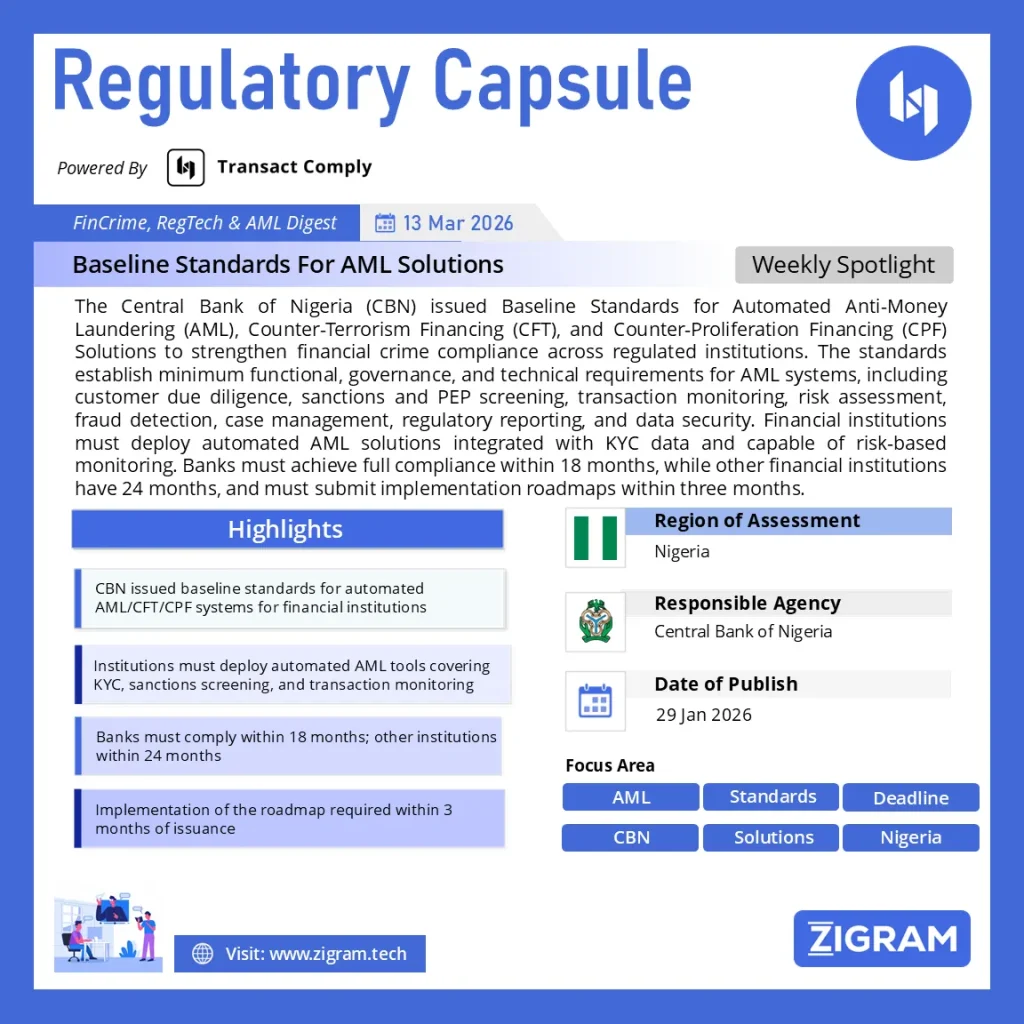
Regulation Name: Issuance Of Baseline Standards For Automated Anti-Money Laundering (AML) Solution For Financial Institutions In Nigeria
Date Of Issue: 10 Mar 2026
Region: Nigeria
Agency: Central Bank of Nigeria
CBN Issues Baseline Standards for Automated AML Solutions: What Financial Institutions Must Know (2026)
The Central Bank of Nigeria (CBN) has introduced a major regulatory development aimed at modernizing financial crime compliance. In March 2026, the regulator issued Baseline Standards for Automated Anti-Money Laundering (AML), Counter-Terrorism Financing (CFT), and Counter-Proliferation Financing (CPF) Solutions for financial institutions operating in Nigeria.
These standards require banks and financial institutions to implement automated AML solutions capable of detecting suspicious transactions, conducting risk-based monitoring, and ensuring real-time screening. The goal is to strengthen Nigeria’s financial crime defenses in an increasingly digital financial ecosystem.
The new framework reflects global AML trends where regulators expect institutions to move away from manual compliance controls toward technology-driven financial crime monitoring systems.
For compliance leaders, this marks a critical shift: AML technology is no longer optional infrastructure — it is now a regulatory requirement.
Why the CBN Introduced Automated AML Standards
The CBN acknowledges that manual AML processes are no longer sufficient to detect complex financial crime patterns, particularly as financial services become digitized and transaction volumes increase.
The regulator therefore established minimum functional and governance requirements for AML technology deployed by regulated institutions.
The key motivations behind the regulation include:
- Strengthening the detection of money laundering (ML), terrorism financing (TF), and proliferation financing (PF).
- Ensuring real-time suspicious activity monitoring and reporting.
- Aligning Nigeria’s AML regime with FATF international standards.
- Enabling advanced analytics, AI, and machine learning to improve financial crime detection.
- Enhancing the quality and timeliness of suspicious transaction reporting.
Importantly, the CBN emphasized that automated systems must demonstrate actual effectiveness, not just feature-based compliance or vendor-driven implementation.
Implementation Timeline for Nigerian Financial Institutions
The rollout of the new AML technology framework follows a structured compliance timeline.
Financial institutions must submit implementation roadmaps within three months of the circular’s issuance.
The full compliance deadlines are:
- 18 months for Deposit Money Banks (DMBs)
- 24 months for Other Financial Institutions
The CBN will monitor implementation through supervisory reviews, on-site inspections, and regulatory oversight. Institutions that fail to comply may face administrative sanctions or penalties.
Scope of the Regulation
The baseline standards apply to all financial institutions regulated by the CBN, including:
- Banks
- Mobile Money Operators
- International Money Transfer Operators
- Payment Service Providers
- Other regulated financial institutions
However, the CBN introduced a proportionality principle, meaning the complexity and sophistication of AML systems must reflect the institution’s:
- Size
- Business model
- Transaction volumes
- Customer base
- Geographic exposure
- Financial crime risk profile
High-risk institutions must deploy more advanced monitoring capabilities, regardless of their size.
Core Capabilities Required in Automated AML Systems
Under the new standards, financial institutions must deploy AML solutions that include multiple integrated compliance functions.
- Customer Due Diligence and Risk Profiling
AML systems must support automated KYC, KYB, and customer risk assessment, including:
- Risk-based customer due diligence (CDD)
- Enhanced due diligence (EDD)
- Continuous customer risk profiling
- Behavioral analysis using historical data
Institutions must ensure KYC data is continuously synchronized with transaction monitoring systems so alerts can be evaluated within the context of the customer’s risk profile.
The regulation also encourages integration with Nigeria’s identity infrastructure such as:
- Bank Verification Number (BVN)
- National Identification Number (NIN)
These integrations enable real-time identity verification during onboarding.
- Sanctions and PEP Screening
AML systems must perform comprehensive screening against:
- Domestic sanctions lists
- Global sanctions lists
- Politically Exposed Persons (PEPs)
- Internal watchlists
- Adverse media sources
The system must support fuzzy matching and AI-based name variation detection to reduce false negatives.
Financial institutions must also be able to block transactions or onboarding where a confirmed sanctions match occurs.
- Risk Assessment and Dynamic Risk Scoring
AML platforms must enable enterprise-level and customer-level risk assessments, including:
- Automated risk scoring at onboarding
- Dynamic risk profile updates
- Aggregation of risk across products and channels
- Analysis of external risk data
Where AI or machine learning models are used, institutions must implement governance frameworks ensuring transparency, explainability, and human oversight.
- Transaction Monitoring and Behavioral Analytics
Transaction monitoring must use risk-based monitoring models and behavioral analysis techniques, including:
- Anomaly detection
- Predictive analytics
- Customer segmentation
- Network analysis and related-party mapping
Monitoring must evaluate transactions using both transactional data and customer profile information rather than relying solely on raw transaction patterns.
Financial institutions must also conduct annual independent validation of AI and machine learning models used in AML monitoring.
- Fraud Detection Integration
While the regulation does not mandate a unified system, institutions must implement automated fraud monitoring capabilities.
Fraud monitoring should:
- Detect unusual activity across digital channels
- Analyze historical fraud patterns
- Integrate with AML risk scoring where appropriate
High-risk institutions are encouraged to adopt a unified financial crime architecture combining AML and fraud intelligence systems.
- Case Management and Investigation Workflows
AML systems must include Enterprise Case Management (ECM) functionality.
Required capabilities include:
- Automated alert generation
- Case creation and assignment
- Maker-checker workflows
- Escalation paths
- Full audit trails of investigative actions
This ensures that all alerts and investigations are documented and traceable for regulatory inspection.
- Regulatory Reporting
AML systems must support automated or semi-automated reporting for regulatory submissions such as:
- Suspicious Transaction Reports (STRs)
- Suspicious Activity Reports (SARs)
- Currency Transaction Reports (CTR)
- Foreign Currency Transaction Reports (FTR)
Internal management reports must also be generated to support board and senior management oversight of AML risks.
- Security, Data Protection, and System Integration
AML solutions must implement strong security controls including:
- Data encryption (at rest and in transit)
- Multi-factor authentication (MFA)
- Role-based access controls
- Compliance with the Nigeria Data Protection Act (NDPA)
Systems must also support secure API integration with core banking systems, onboarding platforms, and other operational systems.
Governance, Audit, and Vendor Oversight
The CBN also places strong emphasis on governance.
Institutions must implement:
- Documented AML system governance frameworks
- Independent internal audit reviews
- Vendor risk management policies
- Third-party due diligence for AML technology providers
AML systems must maintain tamper-proof audit logs recording user actions, configuration changes, and case decisions.
Enforcement and Regulatory Consequences
The CBN will enforce compliance through:
- Off-site monitoring
- On-site supervisory inspections
- Thematic regulatory reviews
Institutions that operate ineffective AML solutions may face:
- Regulatory remediation orders
- Administrative sanctions
- Financial penalties
- Enforcement actions against responsible individuals
Why This Regulation Matters Globally
Although these standards apply specifically to Nigeria, they reflect a global regulatory trend toward automated financial crime compliance systems.
Regulators worldwide increasingly expect institutions to deploy technology-enabled AML programs capable of real-time monitoring, AI-driven analytics, and integrated financial crime intelligence.
For fintech companies, banks, and compliance vendors, the CBN framework signals that AML technology will become a central pillar of regulatory compliance in emerging markets.
Institutions that adopt scalable AML architectures early will be better positioned to meet evolving regulatory expectations.
Conclusion
The CBN Baseline Standards for Automated AML Solutions represent a major transformation in Nigeria’s financial crime regulatory landscape.
Financial institutions are now expected to move beyond fragmented compliance tools and deploy integrated AML systems capable of automated monitoring, intelligent risk assessment, and real-time regulatory reporting.
For compliance leaders, the message from the regulator is clear:
Effective AML compliance now requires advanced technology, strong governance, and continuous system improvement.
Institutions that fail to modernize their AML infrastructure risk falling behind both regulatory expectations and emerging financial crime threats.
Read about the circular here.
Read about the product: Transact Comply
Empower your organization with ZIGRAM’s integrated RegTech solutions – Book a Demo
- #AML
- #FinancialCrime
- #AMLCompliance
- #AntiMoneyLaundering
- #FinancialCrimeCompliance
- #CBN
- #NigeriaRegulation
- #Compliance
- #RiskManagement
- #RegulatoryCompliance