Sanctions Watch Vol 143
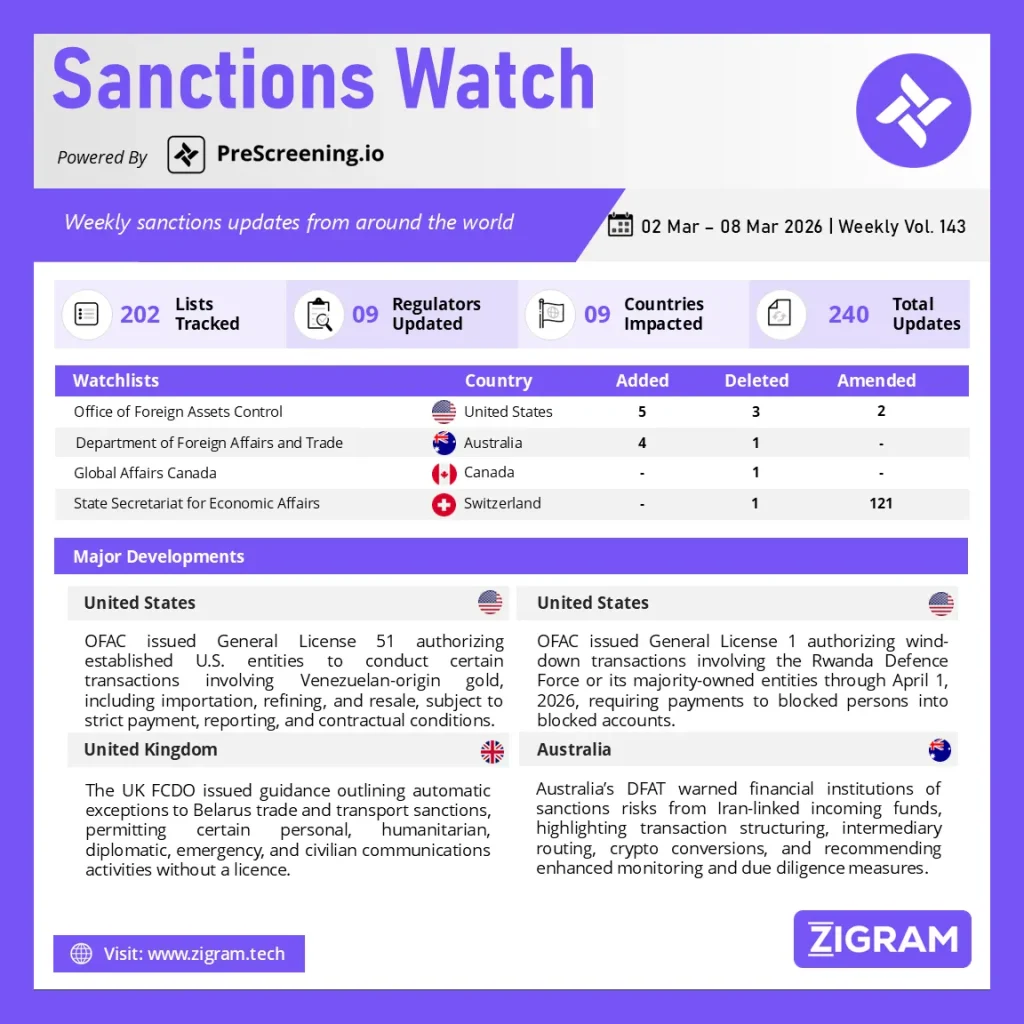
In the latest edition of our Sanctions Watch weekly digest, we present significant updates on sanction watchlists and regulatory developments.
1. U.S. Treasury Issues General License Allowing Limited Trade of Venezuelan-Origin Gold Under Strict Conditions
The U.S. Department of the Treasury’s Office of Foreign Assets Control (OFAC) issued General License No. 51 on March 6, 2026, authorizing limited activities involving Venezuelan-origin gold under the Venezuela Sanctions Regulations. The license allows established U.S. entities (formed on or before January 29, 2025) to engage in transactions related to the export, purchase, transport, storage, refining, and resale of Venezuelan gold in the United States, including dealings with the Government of Venezuela and Minerven (CVG Compañía General de Minería de Venezuela) or entities majority-owned by Minerven.
The authorization applies only if contracts specify U.S. law and U.S.-based dispute resolution, and any payments to blocked persons—except local taxes or fees—are directed to Foreign Government Deposit Funds or other accounts designated by the U.S. Treasury.
However, the license prohibits certain transactions, including those involving parties from Russia, Iran, North Korea, Cuba, or China-linked entities, as well as deals using digital currencies issued by the Venezuelan government (such as the petro). It also bars activities related to gold mining, exploration, or refining within Venezuela, blocked vessels, or the unblocking of sanctioned property.
Entities using this authorization must conduct supply-chain due diligence and submit detailed reports on transaction parties, gold quantities, pricing, and payments to Venezuelan authorities within 10 days of the first transaction and every 30 days thereafter.
2. U.S. Treasury Authorizes Temporary Wind-Down of Transactions Involving Rwanda Defense Force Under DRC Sanctions
The U.S. Department of the Treasury’s Office of Foreign Assets Control (OFAC) issued General License No. 1 under the Democratic Republic of the Congo Sanctions Regulations (31 CFR Part 547) on March 2, 2026, allowing a temporary wind-down of transactions involving the Rwanda Defense Force (RDF). The license authorizes transactions that are ordinarily incident and necessary to terminate existing dealings with the RDF or entities in which the RDF owns 50 percent or more, provided such activities occur before 12:01 a.m. EDT on April 1, 2026.
Under authorization, any payments made to blocked persons must be deposited into a blocked account in accordance with the DRC sanctions regulations. The license strictly limits its scope to wind-down activities and does not permit new business or transactions otherwise prohibited under the sanctions framework.
Additionally, the authorization does not extend to dealings with other individuals or entities designated under the Democratic Republic of the Congo sanctions regime unless separately authorized by OFAC. The measure provides a short compliance window for organizations to safely exit or terminate existing relationships with the RDF while remaining aligned with U.S. sanctions requirements.
3. UK Issues Statutory Guidance Detailing Exceptions to Belarus Trade and Transport Sanctions
The UK Foreign, Commonwealth & Development Office (FCDO) published updated statutory guidance on 5 March 2026 outlining several automatic exceptions to Belarus trade and transport sanctions, allowing certain otherwise restricted activities under defined circumstances. The guidance clarifies that these exceptions apply without requiring a licence, although some may include reporting obligations.
Key trade-related exceptions include personal or humanitarian purchases of Belarusian mineral products, the movement of personal effects or goods for diplomatic missions, and non-commercial luxury goods or gold jewellery carried by travelers. Limited exceptions also permit the transfer of gold and processed gold for diplomatic purposes, as well as the export of consumer communication devices and software updates intended for civilian use.
Additional allowances cover emergency-related activities, such as providing goods or services to mitigate serious threats to human health, safety, infrastructure, or the environment, and delivering technical assistance to aircraft or ships in emergencies where lives or safety are at risk. The guidance also permits travelers to carry banknotes up to £10,000 for personal use, while larger amounts are allowed for diplomatic missions.
Certain machinery-related goods and technology may also be supplied for non-military humanitarian, medical, disaster-response, cybersecurity, or media purposes. Transport-related exceptions permit emergency aircraft landings in the UK and access to UK ports for ships in emergencies.
4. Australia Warns Financial Sector of Rising Sanctions Risks from Iran-Linked Incoming Funds
The Australian Sanctions Office (ASO) within the Department of Foreign Affairs and Trade issued an advisory note on 3 March 2026 warning the financial sector about heightened sanctions risks associated with incoming funds linked to Iran. The guidance highlights that during periods of conflict, economic stress, sanctions tightening, and currency volatility, banks, remitters, and virtual asset service providers may observe increased capital inflows connected to Iran.
Although capital flight itself is not illegal, the advisory notes that funds may originate from sanctioned sectors or designated persons, often routed through intermediary jurisdictions and accompanied by opaque source-of-funds documentation or layered transaction structures.
The ASO identifies several risk indicators, including large transfers inconsistent with a customer’s income profile, complex ownership structures used to acquire assets, and attempts to conceal Iranian links through alternate spellings or beneficial ownership opacity. Funds may also be routed through regional financial hubs such as the UAE, Türkiye, or Malaysia, often using multiple correspondent banks before arriving in Australia.
The advisory also flags cryptocurrency conversions into Australian bank accounts, structuring of transfers below risk thresholds, and fragmented remittances consolidated for property or business investment. Financial institutions are urged to enhance transaction monitoring, strengthen due diligence, and apply additional scrutiny to politically exposed persons and high-net-worth migrants from high-risk jurisdictions.
Know more about the product: PreScreening.io
Click here to book a free demo.
Sanctions Watch is a weekly recap of events and news related to sanctions around the world.
- #OFAC
- #VenezuelaSanctions
- #DRCSanctions
- #BelarusSanctions
- #IranSanctions
- #UKSanctions
- #AustraliaSanctions
- #Minerven
- #RwandaDefenceForce
- #SanctionsCompliance
- #GlobalSanctions
- #FinancialCrime
- #ExportControls
- #TradeSanctions
- #OFACLicenses