FATF Annual Report 2024–2025: What Compliance Leaders Must Know About Global AML/CFT Priorities
The FATF Annual Report 2024–2025 outlines a pivotal year in global anti-money laundering (AML), counter-terrorist financing (CFT), and counter-proliferation financing (CPF) efforts. For compliance leaders, MLROs, regulators, and financial crime professionals, the report provides strategic insight into evolving risks, regulatory reforms, peer review developments, and global enforcement trends.
Drawing directly from the FATF Annual Report 2024–2025 , this article distils the most critical developments and their operational impact.
Executive Overview: A Year of Action and Reform
Under the Presidency of Elisa de Anda Madrazo (2024–2026), the FATF focused on:
- Strengthening the risk-based approach (Recommendation 1)
- Updating Payment Transparency standards (Recommendation 16)
- Advancing global implementation of Virtual Asset (VA) standards (Recommendation 15)
- Enhancing terrorist financing risk understanding
- Reforming peer review and listing processes
- Supporting low-capacity jurisdictions
- Improving asset recovery effectiveness
The report confirms that nearly 200 jurisdictions have now been assessed in the latest evaluation cycle, reinforcing FATF’s global footprint covering 99% of global GDP
1. Terrorist Financing: Persistent Structural Weaknesses
One of the most significant findings concerns terrorist financing (TF) effectiveness.
Key Findings from the Latest Assessments
According to the report:
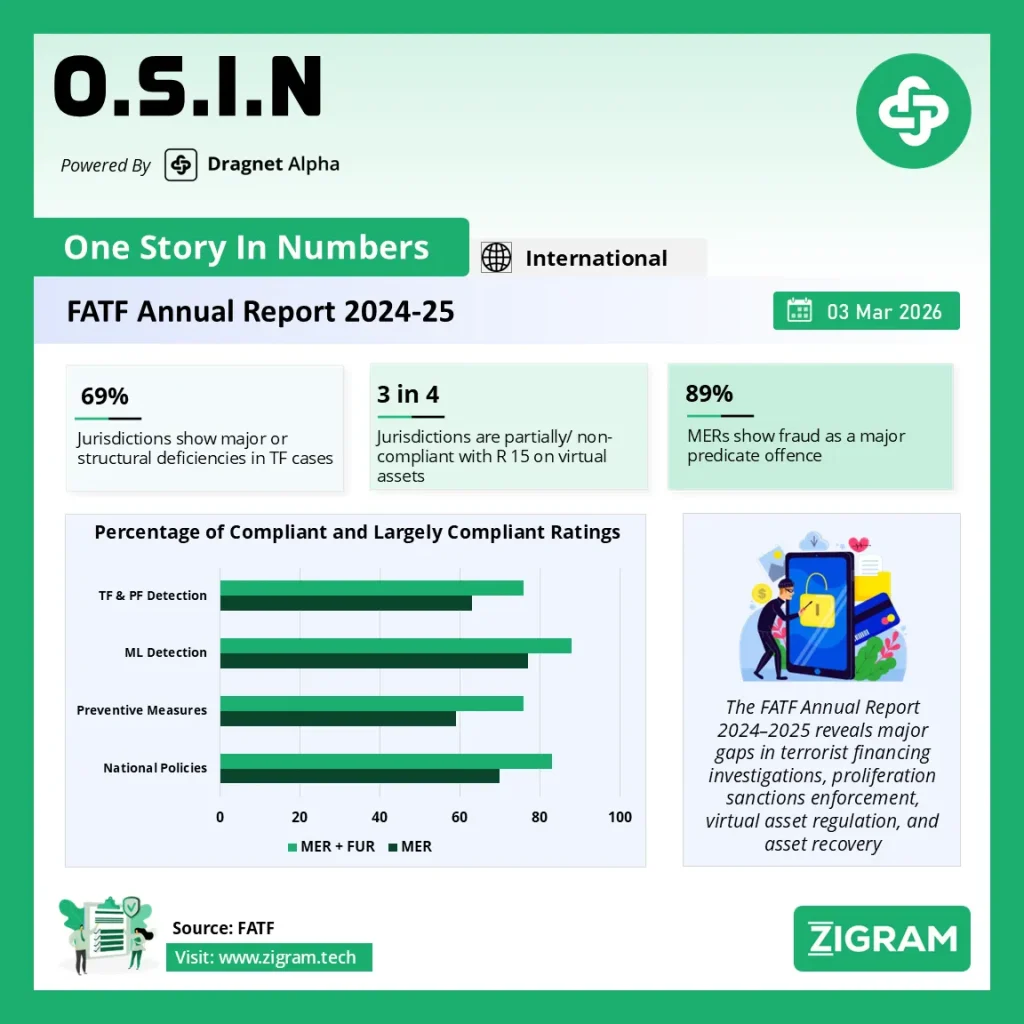
- 69% of jurisdictions show major or structural deficiencies in investigating and prosecuting terrorist financing cases .
- 30% of assessments identified porous borders as a contextual risk factor.
- 20% cited systemic corruption and weak governance.
- 30% identified natural resource exploitation as influencing TF risk.
- 20% highlighted informal or cash-based economies.
For compliance leaders, this signals:
- Greater scrutiny on cross-border fund flows
- Increased focus on politically exposed persons (PEPs)
- Higher expectations for transaction monitoring related to conflict regions
- Expanded scrutiny of informal value transfer systems
The Comprehensive Update on Terrorist Financing Risks (2025) consolidates more than 10 years of case studies across 80+ jurisdictions .
2. Proliferation Financing & Sanctions Evasion: Sophistication Rising
The June 2025 report on Complex Proliferation Financing and Sanctions Evasion Schemes highlights troubling statistics:
- Only 16% of countries demonstrate high or substantial effectiveness in implementing targeted financial sanctions under UN Security Council Resolutions .
Common typologies identified:
- Trade-based schemes (falsified invoices, dual-use goods)
- Shell/front companies (≈80% of cases)
- Use of formal banking channels (≈66%)
- Professional intermediaries (≈45%)
- Virtual assets involvement (≈25%)
Implication for compliance teams:
- Trade finance controls must integrate export control and sanctions intelligence.
- Beneficial ownership transparency remains critical.
- Enhanced due diligence (EDD) for high-risk trade corridors is no longer optional.
3. Virtual Assets: Progress in MIVAs, Gaps Elsewhere
The FATF continues to prioritise virtual asset regulation.
Global Implementation Snapshot
- 3 out of 4 assessed jurisdictions are non-compliant or partially compliant with Recommendation 15 .
- Among 67 Jurisdictions with Materially Important VA Activity (MIVAs), 57 have implemented or are implementing the Travel Rule.
- Travel Rule implementation remains globally inconsistent.
The June 2025 Best Practices Paper aims to accelerate Travel Rule compliance.
For VASPs, banks onboarding crypto clients, and fintech platforms:
- AML-by-Design expectations are rising.
- Cross-border data transparency will be enforced more aggressively.
- Supervisory convergence is accelerating.
4. Fraud: Now a Dominant Predicate Offence
Fraud is cited in:
- 89% of mutual evaluation reports (156 countries) .
This makes fraud the second most common predicate offence after corruption.
To address this, FATF:
- Updated Recommendation 16 (Payment Transparency)
- Promoted better data consistency in cross-border payment messages
- Encouraged tools to prevent fraud and operational errors
For banks and PSPs:
- Transaction monitoring must increasingly integrate fraud intelligence.
- Sanctions, AML, and fraud teams can no longer operate in silos.
- Real-time payment environments will require stronger pre-transaction controls.
5. Financial Inclusion & Risk-Based Reform
In February 2025, FATF strengthened Recommendation 1 on the risk-based approach .
The aim:
- Reduce unintended financial exclusion
- Minimise over-de-risking
- Enable proportionate AML/CFT controls
With 1.3 billion people globally unbanked, FATF is aligning inclusion with risk management.
For compliance leaders:
- Expect regulatory guidance favouring proportional CDD.
- Simplified due diligence for low-risk segments will expand.
- Supervisors will evaluate whether institutions apply risk calibration appropriately.
6. Grey List & Listing Process Reform
The FATF grey list remains one of its most powerful enforcement tools.
2024–2025 Outcomes
- 5 countries removed from the grey list: Croatia, Mali, Tanzania, the Philippines, and Senegal .
- 11 countries strengthened ML investigations and prosecutions.
- 15 countries improved supervision and private sector implementation.
- 32 countries supported through the listing process.
Reforms include:
- Reduced burden on Low Capacity Countries.
- Prioritisation of FATF members, high-income countries, or those with financial sector assets > USD 10 billion.
- Estimated 50% reduction in low-capacity countries being added to the grey list.
For multinational institutions:
- Country risk ratings must remain dynamic.
- Grey listing impacts correspondent banking exposure.
- De-risking strategies must be risk-based, not reactionary.
7. Peer Review: A New Effectiveness-Centric Cycle
The new round of evaluations introduces:
- 6-year assessment cycle
- Stronger emphasis on the 11 Immediate Outcomes (effectiveness)
- More rigorous follow-up
- Practical reform roadmaps
The process spans approximately 16 months and includes on-site reviews, up to 80 meetings, and global peer commentary .
Technical compliance now exceeds 75% in major areas, yet effectiveness remains uneven .
For regulators and financial institutions:
- Effectiveness metrics will outweigh policy documentation.
- Demonstrable asset recovery and enforcement outcomes matter more than legal frameworks alone.
8. Asset Recovery: Still a Global Weakness
Despite improvements:
- Global asset recovery remains insufficient relative to hundreds of billions in criminal proceeds .
- Weaknesses persist under Immediate Outcomes 3, 4, and 5.
FATF will release comprehensive asset recovery guidance in 2025.
Compliance implications:
- Financial institutions must enhance suspicious activity reporting quality.
- Asset freezing and tracing cooperation with FIUs will intensify.
- Regulators will scrutinise recovery metrics more closely.
9. Strengthening the Global Network
Key statistics:
- 370 officials from 127 jurisdictions qualified as assessors.
- 146 jurisdictions participated in plenary meetings.
- 40+ observer organisations contributed to FATF projects.
- 200+ global engagements were conducted during the year .
The report highlights increasing public-private collaboration, including:
- 650+ participants at the Virtual Asset Symposium.
- 840+ submissions informing terrorist financing risk updates.
- 300 consultation responses for Payment Transparency revisions.
This signals growing regulatory expectation of structured private sector engagement.
Strategic Implications for Compliance Leaders
The 2024–2025 report confirms several irreversible trends:
- Effectiveness over Formalism
Regulators will measure outcomes, not policies.
- Fraud and Sanctions Convergence
AML, sanctions, export controls, and fraud risk are converging operationally.
- Travel Rule Enforcement Acceleration
Virtual asset supervision is moving from standard-setting to enforcement.
- Risk-Based Inclusion
Overly conservative de-risking will face scrutiny.
- Grey List as Geopolitical Signal
Country risk management must incorporate FATF developments dynamically.
Conclusion: A More Demanding AML/CFT Era
The FATF Annual Report 2024–2025 marks a shift from standard-setting to measurable impact. While technical compliance has improved globally, effectiveness gaps remain pronounced—particularly in terrorist financing, proliferation financing, and asset recovery.
For compliance leaders, the message is clear:
- Strengthen risk intelligence.
- Demonstrate measurable disruption of illicit finance.
- Integrate fraud, sanctions, and AML systems.
- Prepare for more outcome-driven supervision.
As the FATF enters a new round of evaluations, the institutions that invest in adaptive, data-driven, and risk-calibrated compliance frameworks will be best positioned to withstand regulatory scrutiny and geopolitical volatility.
Source: FATF Annual Report 2024-25
Please read about our product: Dragnet Alpha
Click here to book a free demo
- #FATF
- #AML
- #CFT
- #FinancialCrime
- #SanctionsCompliance
- #ProliferationFinancing
- #TerroristFinancing
- #VirtualAssets
- #TravelRule
- #RiskBasedApproach
- #FraudRisk
- #FinancialRegulation
- #ComplianceLeadership
- #GreyList
- #AssetRecovery