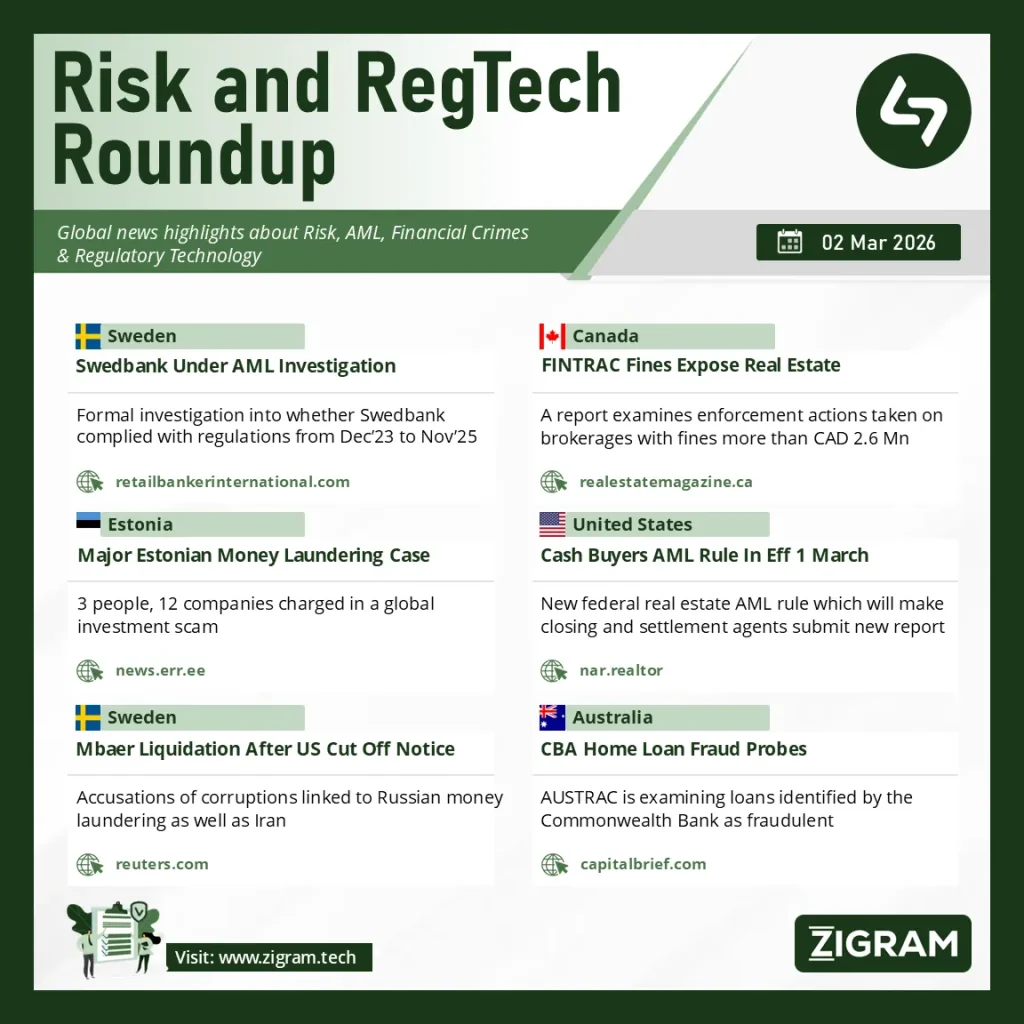
Anti Money Laundering News (23 Feb – 01 Mar 2026)
Welcome to this week’s edition of the Global AML News Weekly Digest. Here are the top stories making headlines around the world:
1) FINTRAC Fines Expose Anti-Money Laundering Gaps in Canadian Real Estate: Report
A new analysis by the national accounting firm MNP highlights significant anti-money-laundering (AML) compliance shortcomings across Canada’s real estate sector, revealed through a string of enforcement actions by the Financial Transactions and Reports Analysis Centre of Canada (FINTRAC) between 2021 and November 30, 2025. The report shows that 24 real estate brokerages were hit with administrative monetary penalties totalling over CAD 2.6 million, with the largest individual fine nearing CAD 282,000 and the average fine around CAD 110,000.
MNP’s review of FINTRAC’s public notices points to pervasive deficiencies in brokerages’ AML compliance programs, particularly regarding policies, procedures and documented frameworks. Crucially, many firms lacked robust mechanisms for ongoing monitoring of client relationships and risk factors, while recordkeeping was frequently inadequate — often missing key details such as complete client information and receipt-of-funds data. More than half of the penalized brokerages also failed to conduct the mandatory independent prescribed review of their AML program within the stipulated two-year period, and training gaps were common, with 15 of the 24 firms failing to develop or document comprehensive AML training plans.
Governance weaknesses were another recurring theme, with several firms either not appointing a designated compliance officer or assigning the role without sufficient authority or resources. Although reporting deficiencies were less widespread, seven brokerages neglected to file required suspicious transaction reports, and one failed to submit a large cash transaction filing. The report underscores that AML compliance is a continuous process demanding effective program design, ongoing oversight and leadership accountability to meet regulatory expectations.
2) Sweden Launches Fresh AML Compliance Probe into Swedbank
Sweden’s financial regulator — the Financial Supervisory Authority (FSA) — has initiated a new investigation into whether Swedbank complied with the nation’s anti-money-laundering (AML) laws, intensifying scrutiny of the lender’s compliance controls after a recent high-profile U.S. case closure. The probe will evaluate the bank’s customer due diligence processes and related AML measures over the period from December 2023 through November 2025, focusing on whether Swedbank’s internal checks and monitoring procedures meet Sweden’s AML regulatory requirements.
The regulator’s review comes just weeks after the U.S. Department of Justice (DOJ) and the U.S. Securities and Exchange Commission (SEC) brought a six-year investigation into historical anti-money-laundering practices to an end without fines or enforcement action, though related inquiries in New York remain open. The Swedish FSA’s renewed focus underscores ongoing concerns about the bank’s governance and effectiveness of controls designed to prevent illicit financial flows, particularly after earlier scandals tied to weaknesses in AML oversight in its Baltic operations.
Swedbank has faced years of regulatory scrutiny over AML deficiencies, dating back to broader issues that previously led to significant fines and reputational damage. The latest FSA probe highlights that global regulatory authorities continue to challenge the bank to bolster its compliance frameworks and demonstrate robust systems for customer risk assessment and transaction monitoring. Market reaction to the probe has been cautious, with modest downward pressure on Swedbank’s share price following the announcement, reflecting investor concern over potential compliance gaps and increased supervisory attention.
3) 3 People and 12 Companies Charged in Major Estonian Money Laundering Case
Estonian prosecutors have brought criminal charges against three individuals and 12 corporate entities tied to a substantial money laundering network linked to an international investment scam, potentially involving hundreds of millions of euros in illicit proceeds. The District Prosecutor’s Office for Economic Crime and Corruption revealed that the scheme began with a 60-year-old Estonian national who allegedly orchestrated the movement of nearly €10 million through a web of controlled companies, making the transfers appear legitimate while hiding their criminal origins. His spouse and a Norwegian citizen have also been charged in connection with the network.
According to the indictment, the underlying fraud involved a Hong Kong–registered firm that solicited investments via online platforms, promising high returns from foreign exchange trading but instead diverting investor funds for personal use. Prosecutors say around €11 million was transferred into Estonia, then routed among multiple company accounts spanning Estonia, Lithuania, Finland, Norway and Germany. Some funds were subsequently transferred to Spain and linked to others involved in the broader fraudulent operation. A portion of the money was also withdrawn in cash or used for personal expenditures, including the purchase of a luxury vehicle.
The case unfolded after Estonia’s Financial Intelligence Unit (FIU) identified suspicious activity from a bank report and shared crucial information with other financial institutions. This collaboration helped freeze suspect assets and enabled law enforcement to trace and disrupt further transfers, ultimately leading to asset seizures worth approximately €4.5 million of presumed criminal origin. Investigators from the Northern Prefecture of the Police and Border Guard Board partnered with the prosecutor’s office in the comprehensive probe.
4) Anti-Money Laundering Rule Aimed at All-Cash Buyers Goes Into Effect March 1
A new federal anti-money-laundering regulation in the United States took effect on March 1, 2026, fundamentally changing how certain residential real estate transactions must be reported to federal authorities. The rule — part of the Financial Crimes Enforcement Network’s (FinCEN) Residential Real Estate Reporting Rule — targets “all-cash” and non-financed residential property transfers where the buyer is a legal entity or trust, such as an LLC, corporation, partnership or similar structure. Its intent is to increase transparency and deter money laundering through opaque real estate purchases that previously lacked federal oversight.
Under the new reporting regime, the “reporting person” — usually the closing or settlement agent — must collect and submit detailed information to FinCEN about the transaction. This includes identification of the beneficial owners behind the entity buyer or trust, the seller, the property itself, and specifics like purchase price and payment method. The rule covers transfers of residential real property, including single-family homes, townhouses, condominiums and certain vacant land intended for residential use, as long as the transaction lacks traditional financing and no exemption applies.
The regulation was slightly delayed from its initial December 2025 start date to give the industry more time to adjust, and recently withstood a legal challenge that affirmed FinCEN’s authority to implement it. While individual buyers using mortgages or other bank-regulated financing remain exempt, the rule closes a longstanding loophole that allowed anonymous entity-based purchases to evade federal reporting. Its implementation is expected to fundamentally shift compliance practices for title companies, attorneys, settlement professionals and real estate brokers who must now ensure that all required data is gathered before closing or risk disruption.
5) Swiss Watchdog Says Liquidation Order for MBaer Merchant Bank AG Is Now Effective
Switzerland’s financial regulator, the Swiss Financial Market Supervisory Authority (FINMA), has formally put into effect a liquidation order for MBaer Merchant Bank AG, a Zurich-based private bank, after the institution withdrew its appeal against enforcement actions that began in 2024. The decision follows mounting concerns over the bank’s significant anti-money-laundering (AML) deficiencies and links to sanctioned actors, which prompted coordinated pressure from U.S. authorities and domestic supervisors.
FINMA’s investigation identified “serious systemic deficiencies” at MBaer in fulfilling due diligence and AML obligations — particularly in managing high-risk client relationships and complying with sanctions requirements. Findings showed that 80 % of the bank’s business relationships involved elevated risks and 98 % of incoming assets originated from high-risk clients, raising serious alarms about the institution’s governance and internal controls. The regulator concluded that under these conditions, the bank no longer met licensing requirements, leading to its revocation and immediate liquidation process.
This regulatory action dovetails with U.S. efforts to curb illicit financial flows: the U.S. Treasury’s Financial Crimes Enforcement Network (FinCEN) has proposed a rule under Section 311 of the USA PATRIOT Act to prohibit U.S. banks from maintaining correspondent accounts for MBaer, effectively cutting its access to the U.S. financial system due to alleged facilitation of money laundering and sanctions evasion linked to actors tied to Russia and Iran.
MBaer, which manages roughly CHF 4.9 billion in assets and employed more than 60 people, has stated it has sufficient assets to satisfy obligations to clients and creditors. However, current restrictions limit transactions to Swiss francs and set per-client payout caps amid the wind-down process. The bank’s board has resigned, and appointed liquidators are overseeing the orderly closure.
6) AUSTRAC Probes Suspected CBA Home-Loan Fraud for Money Laundering Risks
Australia’s financial intelligence regulator AUSTRAC is investigating whether a large volume of suspected fraudulent home loans identified by Commonwealth Bank of Australia (CBA) may have been connected to money laundering, after the bank self-reported the issue to law enforcement and regulators. Sources familiar with the matter told Capital Brief that AUSTRAC is now examining whether borrowers used forged or false documentation to secure loans and then integrate the proceeds of crime through property purchases. There is no suggestion that CBA itself facilitated laundering, but the probe marks a significant escalation in scrutiny of credit-fraud controls at Australia’s largest bank.
The issue first emerged when CBA internally flagged about AUD 1 billion in loans suspected to involve fraudulent documents — prompting the bank to report these cases to the NSW Police financial crimes squad and the corporate regulator ASIC. Police authorities are now working with CBA representatives as part of the inquiry.
Market reaction has been cautious, with Commonwealth Bank’s share price initially dipping amid concern over compliance and governance risks. Analysts say the heightened oversight reflects broader sectorwide challenges in managing credit-fraud risk, which can enable money laundering if not properly detected and reported. Australian banks, including CBA, have faced regulatory action before over AML/CTF compliance — most notably a 2018 settlement with AUSTRAC over AML failures — and this latest episode is likely to trigger renewed focus on internal controls, borrower verification systems, and suspicious matter reporting frameworks in the mortgage market.
Stay informed with our weekly digest, bringing you the most impactful news from around the globe. Thank you for reading!
Subscribe to our weekly Newsletter – Click Here
Empower your organization with ZIGRAM’s integrated RegTech solutions – Book a Demo
- #AML
- #AntiMoneyLaundering
- #FinancialCrime
- #RegulatoryEnforcement
- #FINTRAC
- #FinCEN
- #AUSTRAC
- #FINMA
- #Swedbank
- #RealEstateCompliance
- #BankingRegulation
- #MoneyLaundering
- #ComplianceRisk
- #GlobalRegulation