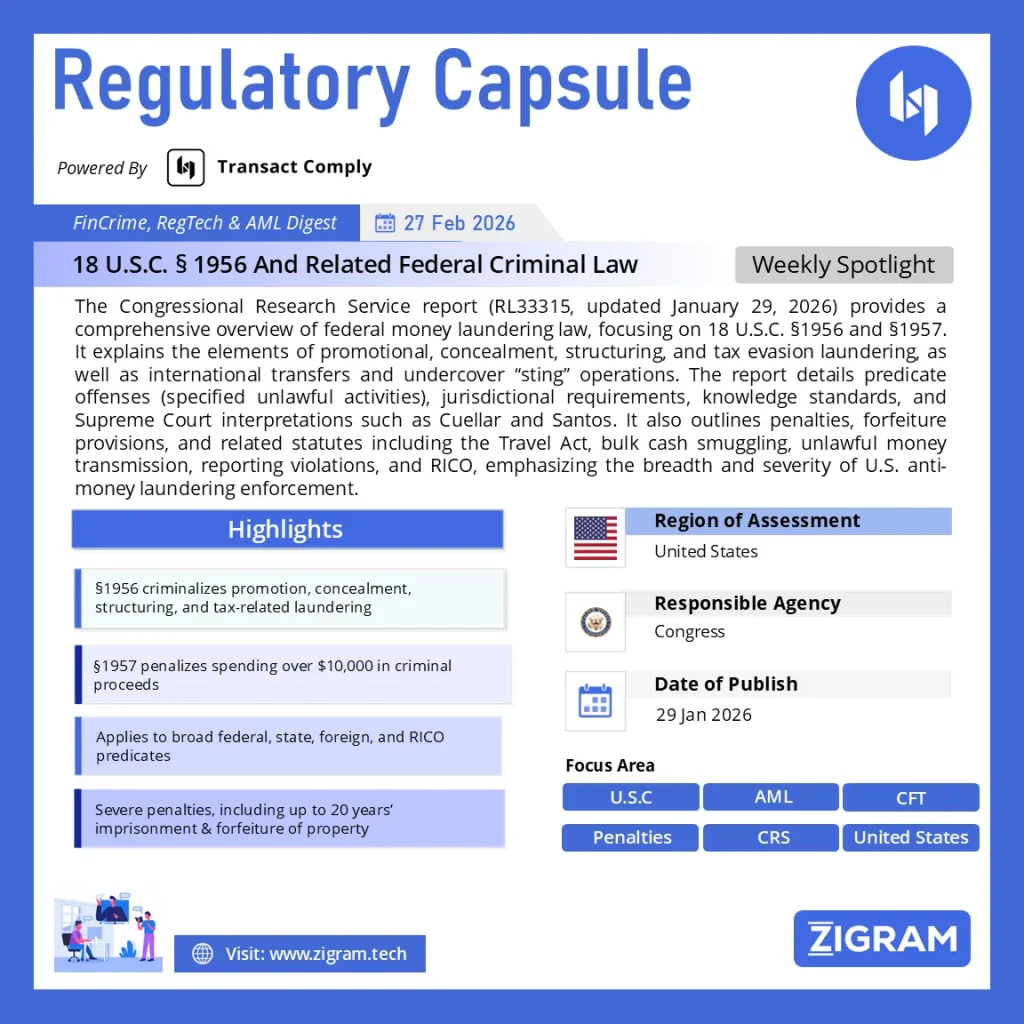
Regulation Name: Money Laundering: An Overview of 18 U.S.C. § 1956 and Related Federal Criminal Law
Date Of Issue: 29 Jan 2026
Region: United States
Agency: US Congressional Research Services
Money Laundering Under U.S. Federal Law: A Complete Guide to 18 U.S.C. § 1956, § 1957, and Related Statutes (2026 Update)
Updated: January 2026 | Source: Congressional Research Service (RL33315)
Money laundering is not merely the act of “cleaning dirty money.” Under U.S. federal criminal law, it is a complex statutory framework that connects hundreds of state, federal, and foreign predicate crimes to financial transactions, international transfers, reporting obligations, and enterprise crime structures.
This guide provides a comprehensive, structured explanation of:
- 18 U.S.C. § 1956 (primary money laundering statute)
- 18 U.S.C. § 1957 (spending over $10,000 of criminal proceeds)
- Related statutes including:
- 18 U.S.C. § 1952 (Travel Act)
- 31 U.S.C. § 5324 (Anti-Structuring)
- 31 U.S.C. § 5332 (Bulk Cash Smuggling)
- 18 U.S.C. § 1960 (Unlawful Money Transmission)
- RICO (18 U.S.C. § 1961 et seq.)
What Is Money Laundering Under U.S. Federal Law?
Under federal law, money laundering occurs when an individual engages in financial or international transactions involving proceeds of specified unlawful activities (SUAs) with one of four prohibited intents:
- Promotion of further criminal activity
- Concealment of criminal proceeds
- Evasion of reporting requirements (structuring/smurfing)
- Tax evasion involving criminal proceeds
The principal statute is 18 U.S.C. § 1956, which criminalizes financial transactions or international transfers involving proceeds of specified unlawful activity when done with prohibited intent .
18 U.S.C. § 1956 – The Core Federal Money Laundering Statute
Section 1956 criminalizes four types of laundering under three jurisdictional categories:
Jurisdictional Categories:
- Financial transactions
- International transportation or transmission
- Undercover sting operations
- Promotional Money Laundering
Statutory Basis:
- 18 U.S.C. § 1956(a)(1)(A)(i)
- 18 U.S.C. § 1956(a)(2)(A)
- 18 U.S.C. § 1956(a)(3)(A)
What It Prohibits:
Using criminal proceeds (or funds represented as criminal proceeds in stings) to promote or facilitate further criminal activity .
Key Elements:
- Knowledge that the property represents criminal proceeds
- Financial transaction or international transfer
- Intent to promote specified unlawful activity
Important Clarification:
After the Supreme Court’s decision in United States v. Santos, Congress clarified that “proceeds” includes gross receipts, not merely profits, through the Fraud Enforcement and Recovery Act (FERA) of 2009 .
- Concealment Money Laundering
Statutory Basis:
- 18 U.S.C. § 1956(a)(1)(B)(i)
- 18 U.S.C. § 1956(a)(2)(B)(i)
What It Prohibits:
Financial transactions or international transfers designed to conceal or disguise:
- Nature
- Source
- Ownership
- Location
- Control of criminal proceeds
Critical Supreme Court Guidance:
In Cuellar v. United States, the Court clarified that concealment must be the purpose of transportation—not merely a side effect .
Simply smuggling money is insufficient unless the transportation is designed to conceal.
- Structuring (Smurfing) & Reporting Evasion
Statutory Basis:
- 18 U.S.C. § 1956(a)(1)(B)(ii)
- 31 U.S.C. § 5324
What It Prohibits:
Structuring transactions to avoid:
- Currency Transaction Reports (CTR)
- Suspicious Activity Reports (SAR)
- Other Bank Secrecy Act reporting requirements
This includes breaking deposits into smaller amounts below the $10,000 threshold.
- Tax Evasion Laundering
Statutory Basis:
- 18 U.S.C. § 1956(a)(1)(A)(ii)
Criminalizes financial transactions conducted with intent to evade federal or state tax obligations related to unlawful activity .
18 U.S.C. § 1957 – Spending Over $10,000 in Criminal Proceeds
This companion statute makes it a crime to knowingly engage in a monetary transaction involving more than $10,000 in criminal proceeds derived from a specified unlawful activity .
Key Differences from §1956:
- No need to prove intent to conceal or promote
- Focuses purely on spending or depositing criminal proceeds
- Lower maximum penalty (10 years)
Predicate Offenses: What Qualifies as “Specified Unlawful Activity”?
The scope of predicate offenses is extremely broad.
It includes:
State Crimes:
- Murder
- Kidnapping
- Gambling
- Arson
- Robbery
- Bribery
- Extortion
- Drug trafficking
Federal Crimes:
- Mail fraud
- Wire fraud
- Bank fraud
- Terrorism offenses
- Theft from federally funded programs
Foreign Crimes:
- Drug trafficking
- Violent crimes
- Fraud
- Corruption
- Export control violations
- Human trafficking
The statute incorporates the RICO predicate offense list, making the coverage extensive .
Related Federal Statutes
- Travel Act – 18 U.S.C. § 1952
Criminalizes use of interstate or foreign travel or facilities to:
- Distribute criminal proceeds
- Promote unlawful activity
Penalty: Up to 5 years imprisonment .
- Bulk Cash Smuggling – 31 U.S.C. § 5332
Criminalizes smuggling more than $10,000 across U.S. borders without reporting .
- Anti-Structuring – 31 U.S.C. § 5324
Targets deliberate evasion of reporting thresholds .
- Unlawful Money Transmission – 18 U.S.C. § 1960
Prohibits operating:
- Unlicensed money transmitting businesses
- Transmission businesses involved in criminal funds
Often applied to underground banking systems and unregistered crypto transmitters .
- RICO – Racketeer Influenced and Corrupt Organizations Act
RICO criminalizes conducting enterprise affairs through a pattern of racketeering activity.
Money laundering predicate offenses are automatically incorporated into RICO, and vice versa .
Penalty: Up to 20 years per racketeering count.
Penalties Under Federal Money Laundering Law
18 U.S.C. § 1956:
- Up to 20 years imprisonment
- Fines
- Criminal forfeiture of involved property
18 U.S.C. § 1957:
- Up to 10 years imprisonment
- Forfeiture
Property involved in laundering or traceable to laundering is subject to confiscation .
Key Legal Standards and Interpretations
Knowledge Requirement
The government must prove the defendant knew the property represented proceeds of some form of unlawful activity, though not necessarily the specific crime .
Interstate Commerce Threshold
Only a minimal effect on interstate commerce is required.
Attempt and Conspiracy
Both attempted money laundering and conspiracy to launder are prosecutable offenses.
Frequently Asked Questions
What is the difference between §1956 and §1957?
Section 1956 requires proof of intent (promotion, concealment, structuring, or tax evasion).
Section 1957 only requires spending over $10,000 in criminal proceeds.
Can gross receipts qualify as proceeds?
Yes. Congress clarified that “proceeds” includes gross receipts, not just profits .
Is simple smuggling money laundering?
No. Under Cuellar, concealment must be the purpose of transportation .
Does money laundering require a completed underlying crime?
The proceeds must derive from specified unlawful activity, though courts analyze when a predicate offense is sufficiently completed.
Why This Matters for Financial Institutions and Compliance Leaders
The federal framework demonstrates:
- Broad predicate coverage
- Aggressive prosecutorial tools
- Significant forfeiture risk
- Overlap with terrorism financing
- International reach
- Enterprise-level liability via RICO
For banks, fintechs, crypto platforms, and regulated financial institutions, this framework underpins:
- AML program requirements
- SAR reporting obligations
- Customer due diligence standards
- Transaction monitoring systems
Understanding §1956 and related statutes is foundational to mitigating regulatory and criminal exposure.
Conclusion
The U.S. federal money laundering framework—centered on 18 U.S.C. § 1956 and § 1957—is expansive, interconnected, and punitive. It reaches:
- Domestic and international conduct
- Financial institutions and individuals
- Direct actors and facilitators
- Criminal enterprises and structured organizations
The 2026 CRS update confirms that federal money laundering law remains one of the most powerful prosecutorial tools in combating financial crime.
Read about the CRS Report here.
Read about the product: Transact Comply
Empower your organization with ZIGRAM’s integrated RegTech solutions – Book a Demo
- #MoneyLaundering
- #AML
- #FinancialCrime
- #USLaw
- #Compliance
- #BankSecrecyAct
- #RICO
- #RegulatoryCompliance
- #FinancialInstitutions
- #EconomicCrime
- #AMLCompliance
- #WhiteCollarCrime
- #FinCrime
- #LegalFramework
- #AntiMoneyLaundering