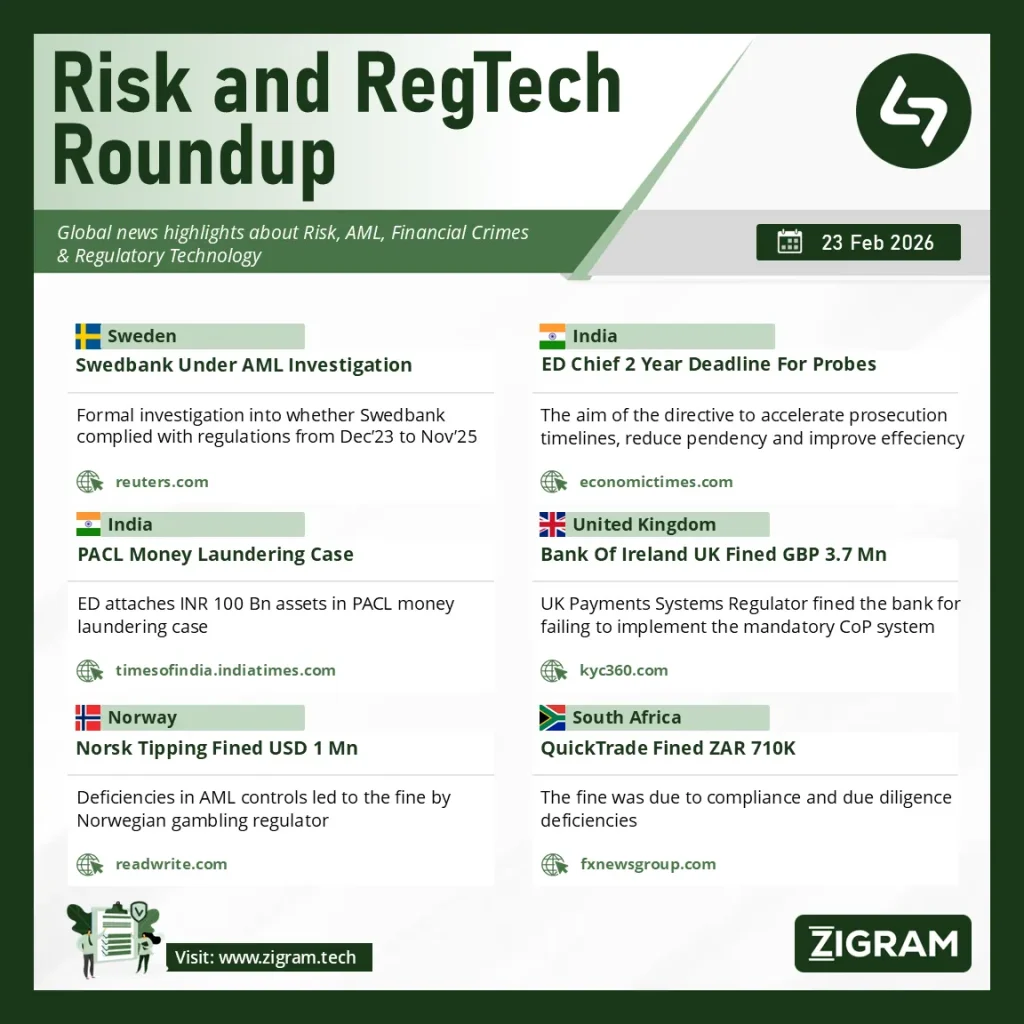
Anti Money Laundering News (16 Feb – 22 Feb 2026)
Welcome to this week’s edition of the Global AML News Weekly Digest. Here are the top stories making headlines around the world:
🇸🇪 Sweden’s FSA Launches AML Investigation Into Swedbank
Swedish Financial Supervisory Authority (Finansinspektionen) has opened a formal investigation into whether Swedbank complied with anti-money laundering regulations between December 2023 and November 2025.
The probe will assess whether the bank fulfilled customer due diligence (CDD), ongoing monitoring, and risk assessment obligations under Sweden’s AML Act. The regulator stated that AML/CFT supervision remains a top enforcement priority in 2026.
This investigation follows prior Nordic scrutiny of cross-border money laundering risks and indicates continued supervisory pressure on large systemic banks. Depending on findings, Swedbank could face administrative sanctions or monetary penalties.
The action reinforces the expectation that financial institutions maintain effective transaction monitoring, risk-based controls, and governance oversight across all high-risk exposures.
🇮🇳 ED Chief Sets Two-Year Deadline for Concluding PMLA Probes
Enforcement Directorate Director announced that investigations under the Prevention of Money Laundering Act (PMLA) should ideally be concluded within one to two years, except in complex cases.
The directive aims to accelerate prosecution timelines, reduce pendency, and improve asset confiscation efficiency. The ED emphasized structured case management, inter-agency coordination, and faster attachment proceedings under Section 5 of PMLA.
The move signals procedural tightening rather than a new law, but it has enforcement implications for corporates and individuals under investigation, as well as banks handling provisional attachment orders and suspicious transaction reports linked to ongoing probes.
It reflects India’s increasing focus on enforcement efficiency within its AML regime.
🇮🇳 ED Attaches ₹10,021 Crore in PACL Money Laundering Case
In one of India’s largest financial fraud investigations, the Enforcement Directorate provisionally attached 247 immovable properties worth over ₹10,021 crore across Mohali, Zirakpur, and Ropar in connection with the PACL case.
The attachments were made under the Prevention of Money Laundering Act following allegations that investor funds were diverted and laundered through complex property acquisitions.
The scale of asset attachment underscores aggressive recovery efforts and signals robust use of provisional seizure powers. Financial institutions handling property transactions linked to historical fraud cases face heightened scrutiny regarding due diligence failures.
This case reinforces India’s assertive asset confiscation strategy under PMLA enforcement.
🇬🇧 Bank of Ireland UK Fined £3.7 Million for Missing Fraud Safeguard Deadline
UK Payments Systems Regulator fined Bank of Ireland UK £3.78 million for failing to implement the mandatory Confirmation of Payee (CoP) system by the required deadline.
While primarily a fraud prevention breach, the failure directly affects AML controls by weakening payment verification safeguards and increasing vulnerability to mule account activity and financial crime exposure.
The regulator determined that the delay in system implementation undermined payment system integrity and consumer protection frameworks.
This enforcement highlights how operational compliance lapses in payment systems can carry financial crime implications and regulatory penalties.
🇳🇴 Norway Fines Norsk Tipping $1M Over AML Failures
Norwegian gambling regulator Norwegian Gambling Authority imposed a $1 million fine on state-owned operator Norsk Tipping for deficiencies in anti-money laundering controls.
The regulator identified weaknesses in customer risk classification, transaction monitoring systems, and reporting of suspicious activity. Authorities determined that the operator failed to sufficiently monitor high-risk players and did not adequately document risk-based assessments.
The fine signals increased AML scrutiny of gambling operators, a sector considered high-risk for money laundering.
Operators must ensure robust KYC, enhanced due diligence for high-risk customers, and continuous monitoring of gaming transactions to prevent illicit fund movement.
🇿🇦 QuickTrade Fined R710,000 Over Compliance and Due Diligence Failures
South Africa’s Financial Sector Conduct Authority fined CFD broker QuickTrade R710,000 for compliance and due diligence deficiencies.
The regulator found shortcomings in customer onboarding procedures, inadequate risk profiling, and gaps in internal compliance oversight. The enforcement reflects stricter application of South Africa’s Financial Intelligence Centre Act (FICA) obligations for financial intermediaries.
Authorities emphasized that licensed brokers must implement effective AML risk management programs, conduct enhanced due diligence for high-risk clients, and maintain documented compliance controls.
The fine underscores growing regulatory enforcement across emerging market financial services sectors.
Stay informed with our weekly digest, bringing you the most impactful news from around the globe. Thank you for reading!
Subscribe to our weekly Newsletter – Click Here
Empower your organization with ZIGRAM’s integrated RegTech solutions – Book a Demo
- #AML
- #FinancialCrime
- #PMLA
- #RegulatoryEnforcement
- #Sanctions
- #Compliance
- #BankingRegulation
- #GamblingCompliance
- #ForexRegulation
- #GlobalAML