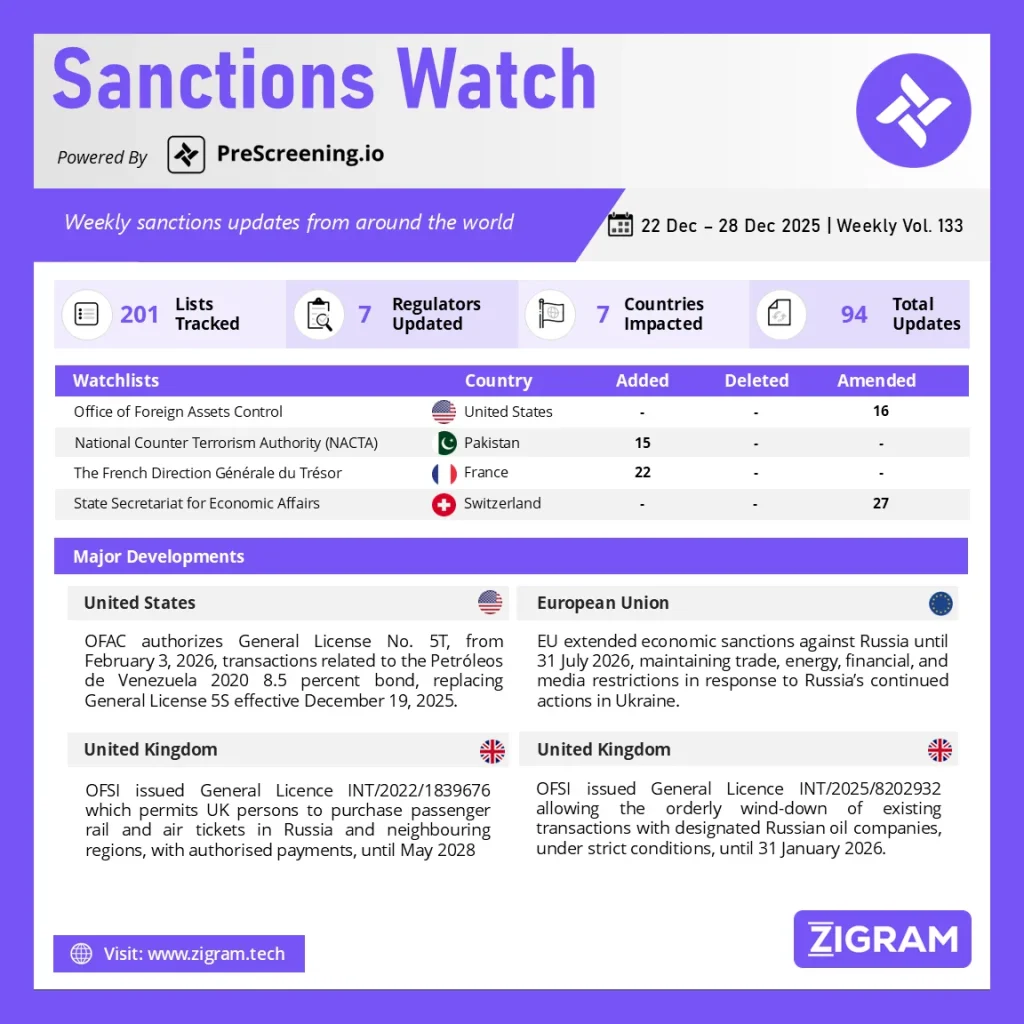
Sanctions Watch Vol 133
In the latest edition of our Sanctions Watch weekly digest, we present significant updates on sanction watchlists and regulatory developments.
OFAC Clears Path for Venezuela 2020 Bond Transactions Starting February 2026
The U.S. Department of the Treasury’s Office of Foreign Assets Control (OFAC) has issued General License No. 5T under the Venezuela Sanctions Regulations (31 CFR Part 591), authorizing transactions related to the Petróleos de Venezuela, S.A. (PDVSA) 2020 8.5 Percent Bond beginning on or after February 3, 2026. This move represents a significant regulatory development for bondholders, financial institutions, and market participants previously restricted under U.S. sanctions.
Under paragraph (a) of the license, OFAC authorizes all transactions, financing, and other dealings involving the PDVSA 2020 bond that would otherwise be prohibited by Executive Order 13835, as amended by Executive Order 13857. This authorization provides long-awaited legal clarity and relief for stakeholders seeking to engage with this specific debt instrument after the stated date.
However, the license is narrowly tailored. Paragraph (b) makes clear that it does not permit transactions prohibited under other provisions of the Venezuela Sanctions Regulations or any other part of 31 CFR Chapter V, ensuring that broader sanctions compliance obligations remain intact. Effective December 19, 2025, General License No. 5T fully replaces and supersedes General License No. 5S, streamlining the regulatory framework. Overall, this license signals a measured easing of restrictions and offers renewed certainty for investors while maintaining the integrity of the U.S. sanctions regime.
EU Reaffirms Unity by Extending Economic Sanctions on Russia Until July 2026
The Council of the European Union announced the extension of its economic sanctions against the Russian Federation for a further six months, maintaining them in force until 31 July 2026. These restrictive measures respond to Russia’s continued actions destabilising the situation in Ukraine and its ongoing war of aggression, which the EU considers a serious violation of international law and the United Nations Charter.
The economic sanctions, originally introduced in 2014, were significantly expanded from February 2022 following Russia’s full-scale invasion of Ukraine. They include wide-ranging sectoral restrictions covering trade, finance, energy, technology and dual-use goods, industry, transport, and luxury goods. The measures also impose a ban on the import and transfer of seaborne crude oil and certain petroleum products from Russia to the EU. In addition, several Russian banks have been removed from the SWIFT system, and broadcasting activities and licenses of Kremlin-backed disinformation outlets have been suspended within the EU.
The sanctions framework further includes mechanisms to counter circumvention and is complemented by additional restrictive measures, such as asset freezes, travel bans, and limits on economic relations with illegally annexed or non-government-controlled Ukrainian territories. The Council confirmed that all measures will remain in place as long as Russia’s illegal actions continue, with further sanctions possible if necessary.
UK Extends Travel Licence Allowing Essential Passenger Journeys In and Around Russia Until 2028
The UK government has taken a constructive step to support lawful and essential travel by extending and amending its General Licence for Russian travel, providing much-needed clarity and continuity for passengers and financial institutions. Under this licence, UK nationals and UK-incorporated entities are permitted to purchase passenger rail and air tickets for journeys originating in, or within, Russia, despite existing sanctions restrictions.
The licence also allows ticket purchases for passenger rail journeys operated by South Caucasus Railway CJSC between Armenia and Georgia, as well as within either of those countries. This provision supports regional connectivity and ensures that individuals can continue to travel for legitimate reasons such as family needs, humanitarian considerations, or essential personal circumstances.
Crucially, the licence authorises relevant UK financial institutions, payment service providers, and even the designated transport providers themselves to carry out all activities reasonably necessary to facilitate these ticket purchases. This removes uncertainty around payments and transactions, ensuring that travel arrangements can be completed smoothly and legally.
The licence, originally introduced in May 2022, has now been extended to remain in force until 22 May 2028, reflecting a balanced approach by HM Treasury. It maintains the integrity of the UK’s sanctions framework while recognising the importance of preserving limited, lawful travel options for civilians and legitimate journeys.
UK Issues Time-Limited General Licence Allowing Wind-Down of Transactions with Designated Russian Oil Companies
The The UK Government, through HM Treasury’s Office of Financial Sanctions Implementation (OFSI), has issued a new General Licence permitting the controlled wind-down of transactions involving specific Russian oil companies that are subject to UK sanctions Granted under Regulation 64 of the Russia (Sanctions) (EU Exit) Regulations 2019, the licence provides a narrowly defined exemption from prohibitions set out in Regulations 11 to 15, solely to enable an orderly exit from existing commercial and financial relationships.
The licence applies to transactions involving designated persons, including PJSC Russneft, PJSC Tatneft, LLC Rusneftegaz Group, LLC NNK-Oil, and any entities owned or controlled by them. It allows non-designated persons, relevant UK financial institutions, and the designated entities themselves to take actions reasonably necessary to close out contracts, settle obligations, and terminate positions in an orderly manner. Importantly, the licence does not permit the initiation of new business or any activity beyond what is required for wind-down purposes.
Strict compliance conditions apply. All parties relying on the licence must maintain accurate and complete records of permitted activities for a minimum of six years. The licence came into force on 18 December 2025 and will expire at 23:59 on 31 January 2026. HM Treasury retains the right to vary, suspend, or revoke the licence at any time, underscoring the temporary and conditional nature of this regulatory relief.
Know more about the product: PreScreening.io
Click here to book a free demo.
Sanctions Watch is a weekly recap of events and news related to sanctions around the world.
- #OFAC
- #Sanctions
- #GeneralLicense
- #VenezuelaBonds
- #PDVSA2020
- #EUSanctions
- #RussiaSanctions
- #UKSanctions
- #OFSI
- #GlobalCompliance