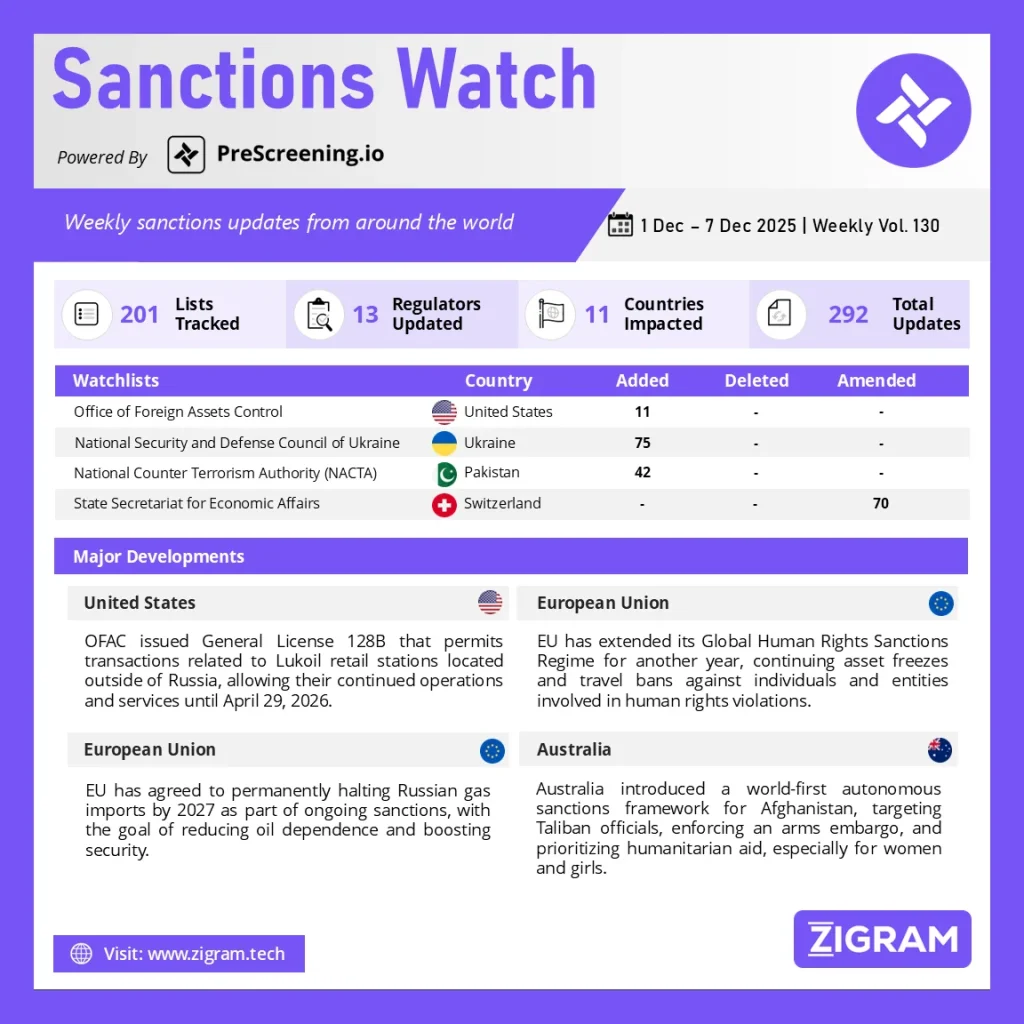
Sanctions Watch Vol 130
In the latest edition of our Sanctions Watch weekly digest, we present significant updates on sanction watchlists and regulatory developments.
OFAC Issues General License 128B, Authorizing Certain Transactions for Lukoil Retail Service Stations Outside Russia
The U.S. Department of the Treasury’s Office of Foreign Assets Control (OFAC) issued General License 128B, which provides specific authorizations for transactions involving Lukoil retail service stations located outside of Russia. This license permits transactions necessary for the purchase of goods and services or the maintenance and operation of these stations through April 29, 2026. The license applies to entities such as Lukoil International GmbH (LIG) and its subsidiaries, including Lukoil North America LLC and Lukoil Americas Corporation, allowing them to continue operations outside Russia without breaching sanctions under Executive Order 14024.
However, the license explicitly excludes transactions prohibited by other directives, such as those related to the Central Bank of Russia or financial institutions blocked under Russian sanctions. The license is designed to allow for the wind-down or continuation of retail services globally, as long as transactions remain outside the Russian Federation. General License 128B supersedes the previous 128A, marking a significant shift in policy for Lukoil’s operations beyond Russia.
EU Extends Sanctions on Human Rights Violators for Another Year, Demonstrating Continued Commitment to Global Justice
The European Union extended its Global Human Rights Sanctions Regime, prolonging the list of individuals, entities, and bodies subject to restrictive measures for serious human rights violations and abuses until December 8, 2026. This decision reinforces the EU’s unwavering commitment to combat human rights abuses globally. Currently, 135 individuals and 37 entities are subject to these sanctions, which include asset freezes and travel bans to the EU. EU persons and entities are prohibited from making any funds or financial resources available to these sanctioned individuals and organizations.
The EU’s sanctions regime, established on December 7, 2020, allows it to target both state and non-state actors responsible for or involved in human rights violations. The listings under the regime are reviewed annually, ensuring they reflect ongoing human rights developments. By extending the sanctions, the EU emphasizes its dedication to holding violators accountable and protecting the universal rights of individuals. This move follows the EU’s broader goal of advancing human rights and ensuring that those responsible for abuses face global consequences, furthering the EU’s role as a key advocate for justice and human dignity worldwide.
EU Agrees to Permanently End Russian Gas Imports and Phase Out Russian Oil
The European Union has reached a historic political agreement to permanently halt the import of Russian gas and gradually phase out Russian oil, marking a significant step towards energy independence from Russia. This move comes as part of the REPower EU initiative, aimed at reducing Europe’s reliance on Russian fossil fuels and ensuring energy security and market stability. The ban on Russian gas will be implemented in phases, with liquefied natural gas (LNG) imports to be fully stopped by December 2026 and pipeline gas imports by September 2027. Long-term contracts for LNG and pipeline gas will also be gradually phased out, with flexibility for certain countries until late 2027.
The EU’s commitment to ending fossil fuel imports from Russia is seen as both a strategic and ethical response to Russia’s energy blackmail and its role in destabilizing European markets. Additionally, the European Commission will support member states through national diversification plans to explore alternative energy sources and suppliers. This agreement also includes safeguards to prevent circumvention of the gas ban. The phase-out of Russian oil is set to be completed by the end of 2027, with a legislative proposal expected early next year to formalize the ban.
Australia Launches World-First Autonomous Sanctions Framework Targeting Taliban and Implements Arms Embargo on Afghanistan
Australian Government introduced a world-first autonomous sanctions framework for Afghanistan to directly target the Taliban and increase pressure on its oppressive regime. This new framework enables Australia to impose financial sanctions and travel bans on individuals and entities that contribute to the oppression of the Afghan people, especially women and girls, and actions that undermine governance and rule of law. It expands on the existing UN sanctions by targeting specific individuals responsible for human rights violations.
The framework also introduces a comprehensive arms embargo, prohibiting Australians from supplying arms, related materials, or services to Afghanistan. This move is part of Australia’s ongoing commitment to hold the Taliban accountable for its actions since it took control of Afghanistan. Australia’s sanctions will further prevent the Taliban from gaining access to resources that fuel its oppressive policies.
Additionally, the Australian Government has issued a class-based humanitarian permit to facilitate certain essential humanitarian activities that may otherwise be restricted by the sanctions framework. This is part of Australia’s broader efforts to provide over $260 million in humanitarian assistance to Afghanistan, with an emphasis on supporting women and girls.
Know more about the product: PreScreening.io
Click here to book a free demo.
Sanctions Watch is a weekly recap of events and news related to sanctions around the world.
- #OFAC
- #LukoilSanctions
- #EU
- #HumanRightsSanctions
- #RussiaEnergyBan
- #TalibanSanctions
- #AfghanistanSanctions
- #EnergyIndependence
- #GlobalJustice
- #HumanitarianAid