Politically Exposed Person (PEP) Weekly Digest – Volume 180
Weekly Vol. 180 | 9 November 2026 – 15 November 2026
Political resignations, ministerial appointments, regulatory changes, and fraud convictions can reshape the global Politically Exposed Persons (PEP) landscape.
The 180th edition of ZIGRAM’s PEP Tracker examines significant developments across Indonesia, Nepal, Guatemala, Switzerland, and Russia. From leadership transitions to changes in Anti-Money Laundering (AML) regulations, this week’s updates highlight why accurate PEP screening, ongoing monitoring, and risk-based due diligence remain important for financial institutions and compliance teams.
The digest also tracks recent and upcoming elections that may influence public-office appointments and PEP records across multiple jurisdictions.
Recent and Upcoming Global Election Events
Elections are important events for maintaining accurate Politically Exposed Persons (PEP) data, as changes in government can result in new appointments, resignations, and shifts in public-office responsibilities.
The latest PEP Tracker covers the following election events:
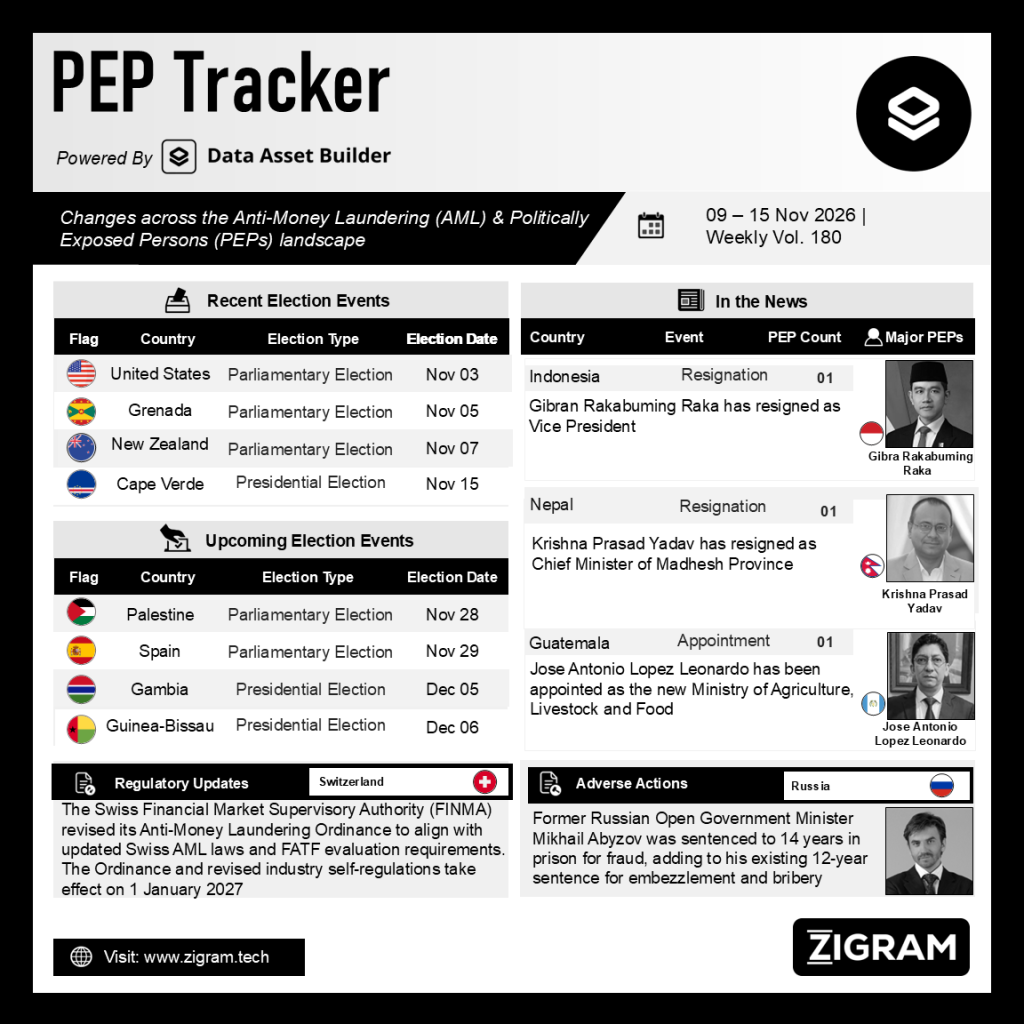
| Country | Election Type | Date |
|---|---|---|
| United States | Congressional Elections | 3 Nov 2026 |
| Grenada | Parliamentary Election | 5 Nov 2026 |
| New Zealand | Parliamentary Election | 7 Nov 2026 |
| Cape Verde | Presidential Election | 15 Nov 2026 |
| Palestine | Parliamentary Election | 28 Nov 2026 |
| Spain | Parliamentary Election | 29 Nov 2026 |
| Gambia | Presidential Election | 5 Dec 2026 |
| Guinea-Bissau | Presidential Election | Originally 6 Dec 2026 — postponed |
Such political developments are relevant to PEP identification, customer risk assessment, and ongoing AML monitoring, particularly where customers or beneficial owners hold public positions or maintain relationships with government officials.
1. Indonesia Vice President Gibran Rakabuming Raka Resigns Amid Eligibility and Educational Credential Disputes
Indonesia witnessed a significant political development on November 12, 2026, as Vice President Gibran Rakabuming Raka resigned following growing scrutiny over his eligibility for office and academic credentials.
Gibran, the 39-year-old son of former Indonesian President Joko Widodo, submitted his resignation amid legal challenges concerning whether his educational qualifications satisfied the requirements for holding public office.
The resignation followed court rulings questioning his educational documentation and renewed political debate surrounding his eligibility. Gibran maintained that his academic records were complete and denied that his resignation amounted to an admission of wrongdoing.
President Prabowo Subianto accepted the resignation, while the country’s constitutional procedures provide for selecting a replacement vice president.
The development represents a significant change in Indonesia’s political leadership and highlights the importance of monitoring changes in public-office status. For financial institutions, verified political resignations can trigger updates to PEP screening records, position histories, and customer risk profiles.
Source: ABC News – Indonesia’s Vice President Resigns
2. Nepal’s Madhesh Province Chief Minister Krishna Prasad Yadav Resigns Ahead of Confidence Vote
In Nepal, Krishna Prasad Yadav resigned as Chief Minister of Madhesh Province on November 14, 2026, after losing the support of key coalition partners.
Yadav, a leader of the Nepali Congress parliamentary party, announced his resignation during a Provincial Assembly meeting rather than proceeding with a scheduled vote of confidence.
The political crisis emerged after the Communist Party of Nepal (Unified Marxist–Leninist), or CPN-UML, and the Nepal Communist Party withdrew their support from his government.
Their withdrawal left Yadav without sufficient political backing to demonstrate a majority in the Provincial Assembly. During the assembly session, he addressed lawmakers, discussed his government’s achievements, and formally announced his decision to step down.
The resignation demonstrates how changes in coalition arrangements can rapidly alter provincial political leadership.
From a PEP monitoring perspective, such developments are relevant to maintaining accurate records of current and former public officials, particularly when political changes affect positions carrying significant decision-making authority.
Source: The Kathmandu Post – Madhesh Chief Minister Resigns
3. José Antonio López Leonardo Appointed Guatemala’s New Minister of Agriculture, Livestock and Food
Guatemala announced a ministerial leadership change as José Antonio López Leonardo assumed office as the new Minister of Agriculture, Livestock and Food (MAGA) on November 9, 2026.
His appointment followed the departure of María Fernanda Rivera and marked a transition in the leadership of the government institution responsible for agricultural development, food production, livestock policies, and rural development initiatives.
López Leonardo is an agronomist specialising in renewable natural resources and has an academic background in business administration, project evaluation, and rural development.
According to the Guatemalan government’s announcement, his priorities include strengthening institutional engagement across rural communities, improving agricultural support, and promoting cooperation with producers and local organisations.
The appointment introduces a new senior government official into Guatemala’s public administration.
For organisations maintaining global PEP databases, ministerial appointments are important events that may require updating public-position records, reviewing relevant relationships, and supporting risk-based customer due diligence.
Source: Government of Guatemala – José Antonio López Leonardo Appointed Agriculture Minister
4. Switzerland’s FINMA Revises Anti-Money Laundering Ordinance Ahead of 2027 Implementation
In a significant AML regulatory update, the Swiss Financial Market Supervisory Authority (FINMA) announced the partial revision of its Anti-Money Laundering Ordinance (AMLO-FINMA) on November 10, 2026.
The amendments reflect recent changes to Switzerland’s Anti-Money Laundering Act and the Federal Council’s Anti-Money Laundering Ordinance, taking into consideration the country’s forthcoming Financial Action Task Force (FATF) mutual evaluation.
FINMA also recognised revised due diligence standards for Swiss banks and updated self-regulatory provisions applicable to the Swiss insurance sector.
The revised ordinance and accompanying self-regulatory standards are scheduled to take effect on January 1, 2027, with the self-regulatory frameworks providing a four-month transition period.
Among the notable changes are clarifications concerning correspondent banking relationships, transparency of ownership and control structures, documentation requirements, and measures intended to prevent violations of restrictions under Switzerland’s Embargo Act.
FINMA also clarified how certain risk-based controls should be applied to complex corporate structures and the monitoring of business relationships and transactions.
For financial institutions, these changes reinforce the importance of effective AML compliance, customer due diligence, beneficial ownership transparency, and sanctions monitoring.
Official Source: FINMA – Revised Anti-Money Laundering Ordinance
5. Former Russian Minister Mikhail Abyzov Receives Combined 14-Year Prison Sentence in Fraud Case
A Moscow court sentenced Mikhail Abyzov, Russia’s former Open Government Minister, to a combined 14 years in prison following a further fraud conviction involving investments in a US-based solar energy company.
According to reporting published on November 11, 2026, the Tagansky District Court found Abyzov guilty in connection with investment activities involving Alion Energy.
Prosecutors alleged that Abyzov and two associates misled the state-owned Russian Venture Company into continuing investments in the project, resulting in the alleged embezzlement of approximately $5 million.
Abyzov was already serving a 12-year sentence imposed in 2023 following earlier convictions involving fraud, organised criminal activity, illegal business operations, and bribery.
Taking his previous conviction into account, the court imposed a combined 14-year prison sentence. The court also ordered a substantial financial penalty and restrictions on holding public office.
Abyzov denied the latest allegations, and the judgment remained subject to appeal at the time of reporting.
The case highlights the relevance of adverse media monitoring and financial crime risk assessment when examining individuals who have held senior public positions.
For compliance teams, verified judicial developments can provide information for enhanced due diligence and ongoing reviews of customer relationships involving politically exposed persons.
Source: The Moscow Times – Former Minister Mikhail Abyzov Sentenced
Why These Developments Matter for PEP Screening and AML Compliance
Political appointments, resignations, election results, and judicial proceedings can affect the information financial institutions rely on for identifying and assessing politically exposed persons.
Accurate and regularly updated PEP data supports risk-based due diligence, customer screening, ongoing monitoring, and financial crime investigations.
However, holding a public position or being identified as a PEP does not automatically indicate criminal activity. Institutions must assess risks proportionately, considering applicable regulations and the circumstances of each relationship.
ZIGRAM’s Global PEP Data supports the identification and monitoring of relevant political and public-office changes, helping financial institutions maintain current information for AML and compliance workflows.
Explore more developments in the PEP Tracker weekly digest.
Visit: www.zigram.tech
- #AWEB
- #ElectionGuide
- #FatimaEzzahraElMansouri
- #Morocco
- #ArrmanathaNasir
- #Indonesia
- #Slovakia
- #TomasTaraba
- #HongKongSFC
- #AMLCFT
- #DavidRivera
- #Venezuela