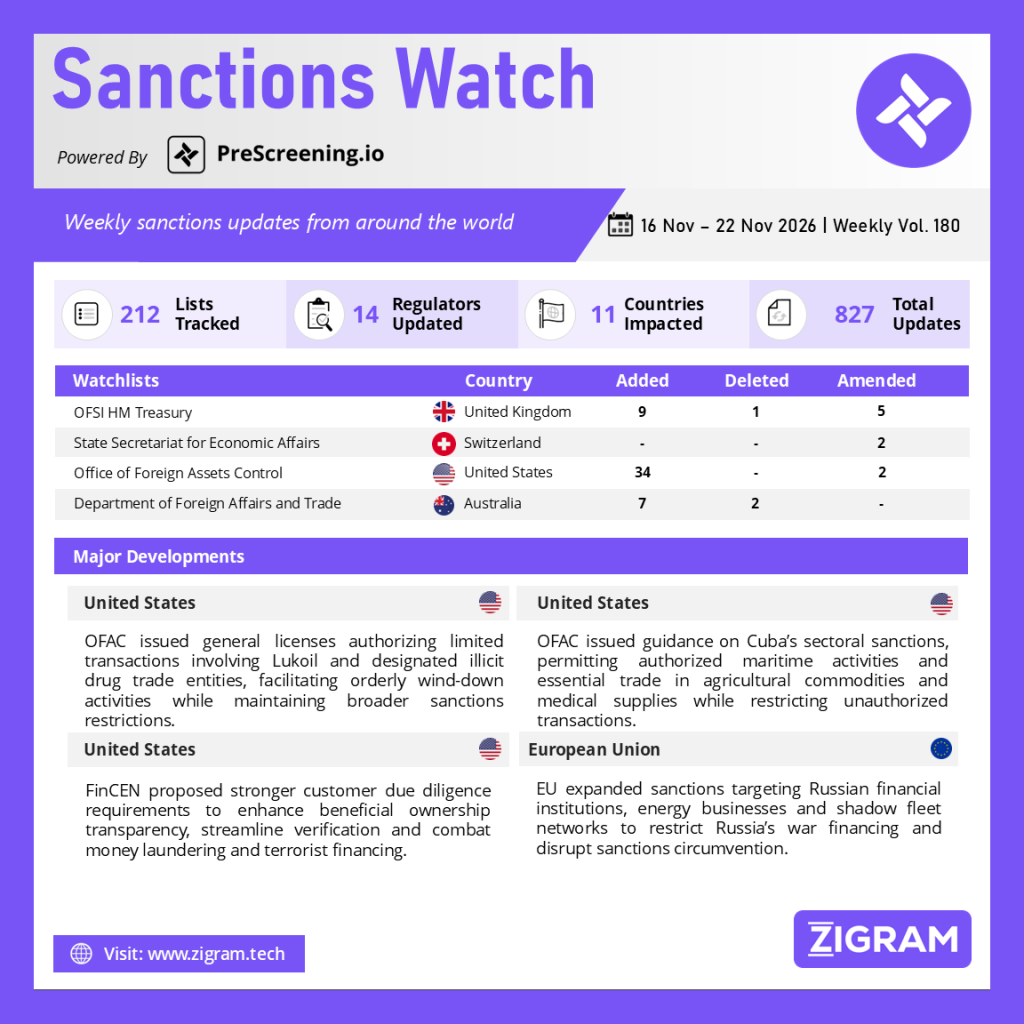
Sanctions Watch Vol 180
In the latest edition of our Sanctions Watch weekly digest, we present significant updates to sanctions watchlists and regulatory developments.
1. OFAC Issues General Licenses Under Russian and Illicit Drug Trade Sanctions Regimes, Authorizing Limited Transactions and Wind-Down Activities
The U.S. Department of the Treasury’s Office of Foreign Assets Control (OFAC), on 19 November 2026, issued two general licenses under the Russian Harmful Foreign Activities Sanctions Regulations (RuHSR) and the Illicit Drug Trade Sanctions Regulations (IDTSR), authorizing specified transactions involving sanctioned entities.
Under the Russian sanctions regime, OFAC issued General License 131L, superseding General License 131K, permitting negotiations and entry into contingent contracts for the sale, disposition, or transfer of Lukoil International GmbH (LIG) and its qualifying subsidiaries through 19 December 2026. The license also authorizes maintenance and wind-down activities through 20 February 2027. Performance of such contingent contracts remains subject to separate OFAC authorization, while transfers of funds to persons or accounts located in Russia remain prohibited under the license.
Separately, OFAC issued General License 1 under the illicit drug trade sanctions regime, authorizing the wind-down of transactions involving four blocked entities: Fratelli Vescio Funeral Homes Ltd., Phantom Limousine Services Inc., Vescio Funeral Homes Inc., and Vescio Funeral Home (Maple) Inc.
The authorization remains effective through 18 December 2026 and extends to entities directly or indirectly owned 50% or more, individually or collectively, by the blocked persons. Payments to blocked persons must be deposited into blocked, interest-bearing accounts located in the United States.
These measures underscore OFAC’s continued efforts to facilitate orderly disengagement from sanctioned entities while maintaining broader financial restrictions and sanctions compliance requirements.
Official Source: OFAC – Issuance of General Licenses, 19 November 2026
2. OFAC Clarifies Cuba Sectoral Sanctions and Continued Authorized Maritime and Trade Activities
The U.S. Department of the Treasury’s Office of Foreign Assets Control (OFAC), on 20 November 2026, issued two new Frequently Asked Questions (FAQs 1277 and 1278), clarifying the scope of sanctions targeting Cuba’s manufacturing, technology, electronics, and marine sectors under Executive Order (E.O.) 14404.
Through FAQ 1277, OFAC clarified that the sectoral determination issued on 5 November 2026 does not automatically impose sanctions on all individuals and entities operating or having previously operated in the identified sectors. However, foreign persons engaged in these sectors may face potential sanctions risks unless their activities are exempt or otherwise authorized under applicable licenses.
Additionally, FAQ 1278 confirms that U.S. persons may continue conducting authorized activities involving Cuba’s marine sector, including payments to and transactions involving Cuban ports, particularly Mariel Port, in accordance with applicable sanctions regulations.
OFAC further clarified that the U.S. government does not intend to target non-U.S. persons operating in Cuba’s marine sector when conducting transactions related to the supply of agricultural commodities, food, medicines, medical devices, replacement parts and components, and medical device software updates.
Existing restrictions on transactions involving Cuban nationals remain applicable to U.S. persons unless specifically exempt or authorized under the Cuban Assets Control Regulations.
The guidance underscores OFAC’s efforts to clarify sector-specific sanctions exposure, maintain restrictions on unauthorized economic activities, and facilitate legitimate trade involving essential agricultural and medical supplies.
Official Source: OFAC – Cuba Frequently Asked Questions, 20 November 2026
3. FinCEN Proposes Strengthened Customer Due Diligence Requirements to Combat Money Laundering and Terrorist Financing
The U.S. Department of the Treasury’s Financial Crimes Enforcement Network (FinCEN), on 17 November 2026, issued a proposed rule to strengthen Customer Due Diligence (CDD) requirements for covered financial institutions. The proposal forms part of the Treasury’s implementation of Executive Order 14406, Restoring Integrity to America’s Financial System, aimed at combating money laundering, terrorist financing, and other illicit financial activities.
A key provision would explicitly permit covered financial institutions to collect additional information on the beneficial owners of legal entity customers to mitigate financial crime risks and address supervisory concerns.
The proposed rule also seeks to formalize previously granted regulatory relief, removing the requirement for covered financial institutions to repeatedly identify and verify beneficial owners whenever an existing legal entity customer opens a new account, subject to the applicable conditions.
Additionally, the proposal specifies the information that financial institutions must obtain regarding each beneficial owner of a legal entity customer, providing greater regulatory clarity and supporting effective risk-based compliance practices.
FinCEN has invited public comments on the proposed amendments, with the consultation period closing on 19 January 2027.
The proposed measures underscore the U.S. Treasury’s efforts to strengthen anti-money laundering and countering the financing of terrorism (AML/CFT) frameworks, improve beneficial ownership due diligence, and reduce unnecessary regulatory burdens while enhancing the financial sector’s ability to combat illicit financial activities.
Official Source: U.S. Treasury – FinCEN’s Proposed CDD Rule
4. EU Expands Sanctions Against Russia, Targeting Financial Institutions, the Energy Sector, and Shadow Fleet Networks to Restrict War Financing
On 16 November 2026, the Council of the European Union imposed additional restrictive measures against 12 individuals and 101 entities to restrict Russia’s ability to finance its war against Ukraine. The sanctions target key economic sectors generating substantial revenues for Russia and supporting its shadow fleet operations.
A key development is the designation of nearly 50 Russian banks and financial institutions, aimed at disrupting financial channels that facilitate state revenue flows and military financing.
The measures also extend to Russia’s e-commerce sector, targeting individuals with ownership interests in major online retailers Wildberries and Ozon. Additionally, the Council designated companies and businesspersons operating in Russia’s oil and energy sector, including those involved in refinery operations, the St. Petersburg oil terminal, and oil exploration and production.
The EU further expanded sanctions against Russia’s shadow fleet networks, targeting companies based in the United Arab Emirates, China, Seychelles, and Oman involved in purchasing Russian-origin crude oil products. Individuals owning or managing sanctioned vessels involved in illicit oil transportation and high-risk maritime activities were also designated.
The designated individuals and entities are subject to asset freezes and prohibitions on the direct or indirect provision of funds or economic resources. Designated individuals also face EU travel bans.
The measures underscore the EU’s continued efforts to restrict Russia’s financial and energy revenues, disrupt sanctions circumvention networks, and increase economic pressure on Russia, with broader implications for international banking, energy trading, and maritime shipping.
Official Source: Council of the EU – 113 Individuals and Entities Listed
- #Sanctions
- #OFAC
- #FinCEN
- #AML
- #CustomerDueDiligence
- #RegulatoryCompliance
- #Beneficial Ownership
- #EUSanctions
- SanctionsCompliance